

San Francisco startups face a maze of legal decisions before they’ve even launched. Most founders focus on product and growth while overlooking the legal groundwork that protects their business.
We at Primum Law Group have seen countless early-stage companies stumble because they skipped critical steps like proper entity formation or founder agreements. This guide walks you through the SF startup legal guidance you need to build a solid foundation and scale confidently.
What’s Really Costing SF Startups Their First Funding Round
Most founders think their biggest problem is the product. We at Primum Law Group see a different pattern: investors reject startups because their legal foundation crumbles under scrutiny. The gap between a startup that closes a round and one that gets rejected often isn’t product quality-it’s preventable legal mistakes that stack up during the first six months. A Delaware C-corporation with a single-founder structure might feel fine when you’re bootstrapping, but it becomes a massive liability the moment a VC runs due diligence. According to data from the ACA Angel Funders Report, early-stage deals hinge on clean cap tables and clear ownership. Startups that skip entity formation or run as sole proprietorships face a choice: spend weeks untangling the structure before closing or miss the funding window entirely. The real cost isn’t the filing fee-it’s the momentum you lose while lawyers clean up paperwork that should have been handled on day one.
Founder Equity Disasters That Kill Deals
Co-founders who don’t document their equity splits in writing create a ticking bomb. One founder leaves, another wants to dilute the departing co-founder’s stake, and suddenly your startup can’t raise money because the cap table is ambiguous. Vesting schedules matter more than most founders realize. A typical four-year vesting period with a one-year cliff means that if a co-founder walks after eight months, they forfeit most of their stake-but only if the agreement says so in writing. Without this structure, you negotiate equity splits mid-crisis instead of having clear rules from the start. Startups that document vesting from day one also signal maturity to investors, which accelerates due diligence. The 83(b) election is another blind spot: founders who hold restricted stock have 30 days to file this form with the IRS, and missing that window costs them years of capital gains taxes they could have avoided. Founders lose tens of thousands in unnecessary taxes because they don’t know this deadline exists.
IP Ownership Gaps That Investors Won’t Overlook
Intellectual property ownership is non-negotiable for any startup raising capital. If your company doesn’t own the code, designs, or algorithms that power your product, you don’t have a business to sell. Too many founders write code before incorporating and assume the company owns it automatically-it doesn’t. Pre-incorporation IP stays with the founder unless you execute an assignment agreement. Investors run IP searches specifically to catch these gaps, and they walk away when they find them. Global trademark activity reached 15.2 million class counts in 2024 according to WIPO data, and startups that protect their brand early avoid rebranding costs later. A single trademark filing in your core market costs far less than pivoting your entire brand because someone else claimed it first. Patent applications in the US hit over 700,000 in 2024 with 368,597 grants, showing that IP protection matters across your industry.
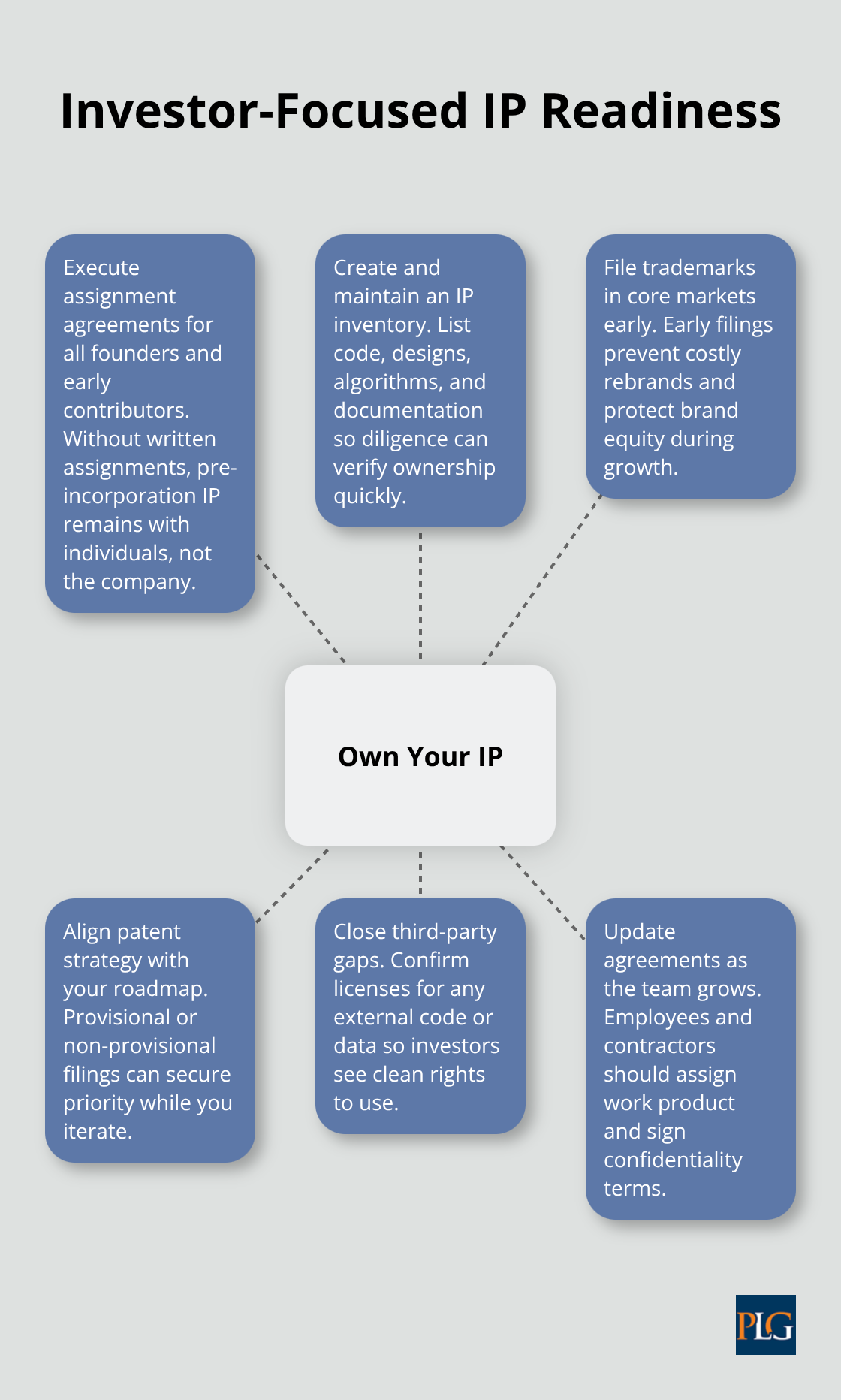
The mistake founders make is waiting until Series A to clean up IP. Then you’re burning runway on legal fees that should have been preventive costs months earlier.
Why Clean Legal Foundations Accelerate Funding Timelines
Investors expect startups to arrive at due diligence with their legal house in order. When you have proper entity formation, documented founder agreements, and clear IP ownership, you compress the diligence timeline from weeks to days. Startups that skip these steps face investor requests for legal remedies-assignments, vesting agreements, cap table corrections-that delay closing and drain resources. The cost of fixing legal problems after the fact (legal fees, founder disputes, IP complications) far exceeds the cost of handling them upfront. A startup that invests in solid legal groundwork from the beginning signals to investors that the founders take their business seriously and understand what it takes to scale.
How to Structure Equity and Own Your IP From Day One
Equity structure and IP ownership form the backbone of any fundable startup. Get these wrong and you’re rebuilding your legal foundation while investors wait. Most founders handle equity casually in the first months, then panic when a VC asks for cap table documentation.
Set Up Vesting Schedules That Protect Your Cap Table
Startups with four-year vesting schedules and one-year cliffs from the beginning avoid the messy situation where a co-founder who left after six months still holds 25% of the company. The one-year cliff is not negotiable if you want investor confidence. It means a departing co-founder forfeits their entire stake if they leave in the first 12 months, which protects the remaining founders and simplifies your cap table.
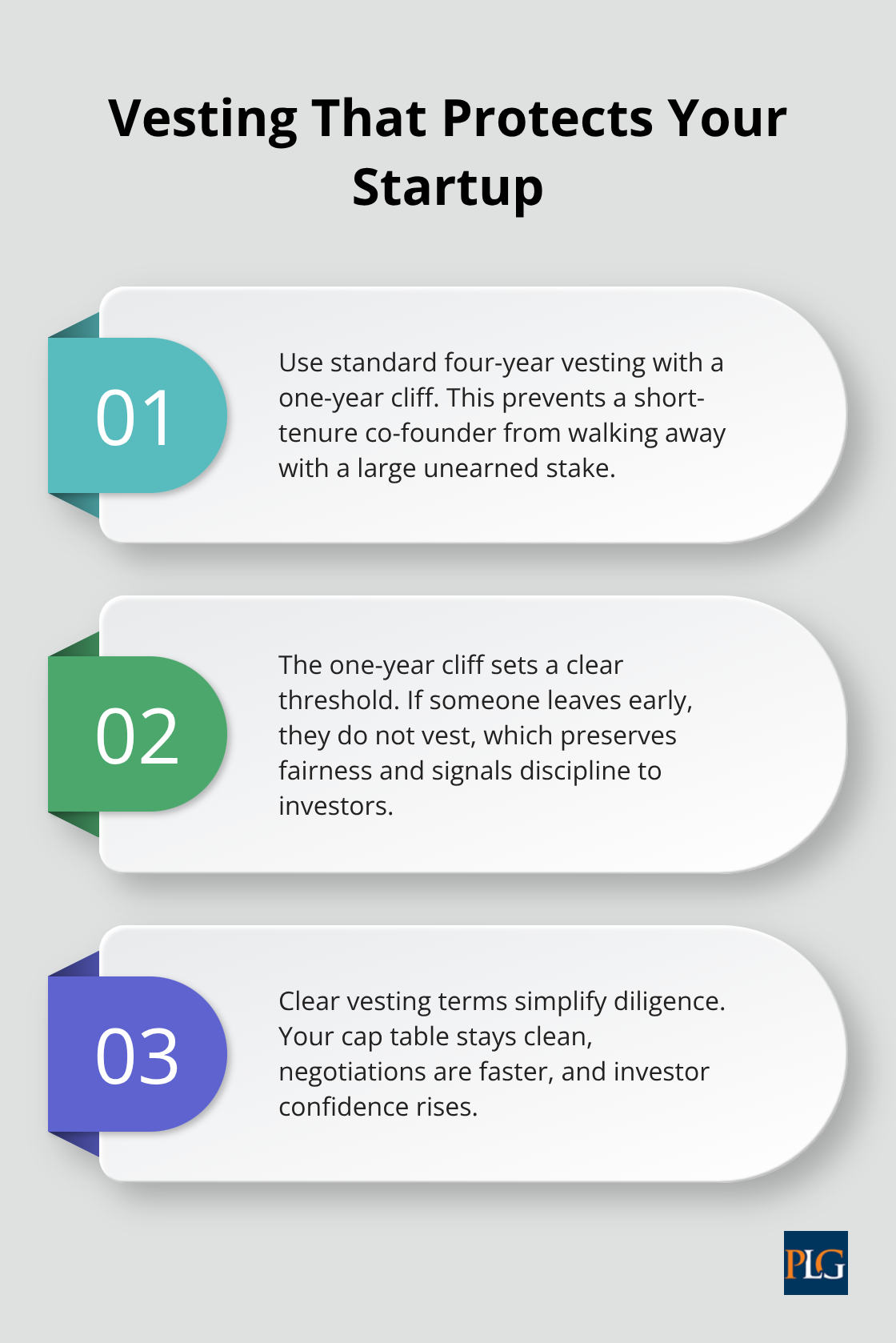
Document your founder agreement before you write a single line of code. Specify equity percentages, vesting schedules, acceleration triggers (what happens if the company is acquired), and repurchase rights. This prevents disputes later and shows investors you operate with clarity.
File Your 83(b) Election Within 30 Days
Many San Francisco startups miss the 83(b) election deadline, a 30-day window after receiving restricted stock to file with the IRS. Missing this deadline locks you into paying ordinary income tax rates on the stock’s appreciated value, not capital gains rates. That difference costs founders tens of thousands of dollars over time. File this form immediately after your founder agreement is signed.
Assign All IP to Your Company in Writing
IP ownership is where most founders fail catastrophically. Code written before incorporation belongs to the individual founder, not the company, unless you execute a written assignment agreement. Investors will not close a round if the company doesn’t own its own technology.
Your startup needs to own all pre-existing IP, including code, designs, algorithms, and documentation. Create an IP inventory that lists what you own and execute assignment agreements with every founder and employee. This process takes a few hours but saves weeks of due diligence delays. Global patent applications reached 3.7 million in 2024, and trademark filings hit 15.2 million class counts according to WIPO data, reflecting how seriously the market treats IP protection.
Lock Down Employment IP Agreements
Employment agreements should specify that any IP created during employment belongs to the company, with narrow exceptions for work done on personal time using personal resources. Without this language, an engineer’s side project becomes ambiguous, and you face potential disputes during fundraising. This single clause prevents costly conflicts down the road.
With your equity structure locked in and IP ownership documented, you’re ready to prepare for the investor conversations that will define your next growth phase.
Preparing Your Startup for What Investors Actually Check
Investor due diligence is not a theoretical exercise. Investors examine your cap table, founder agreements, IP assignments, employment contracts, and vendor relationships to calculate risk. If gaps exist, they either demand legal remedies before closing (which delays funding and burns runway) or they walk away.
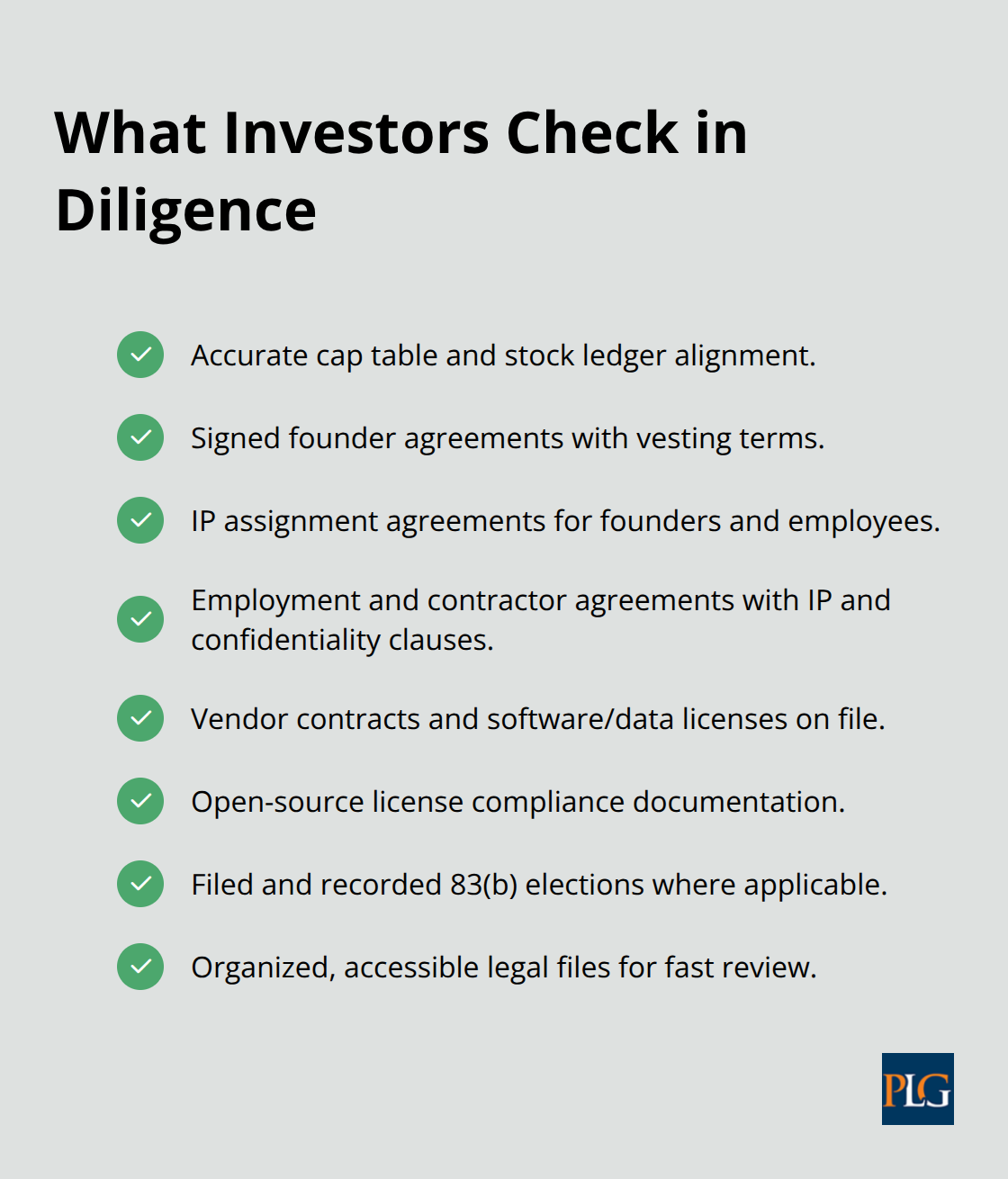
The ACA Angel Funders Report shows that early-stage deals hinge on clean documentation, and startups that arrive at due diligence with organized legal files close faster.
Cap Tables and Equity Documentation
Your cap table must be accurate and complete, showing all equity holders, vesting schedules, and option pools. Mismatched records between your stock ledger and your cap table software create red flags that trigger investor requests for legal opinions and corrections. If a founder holds restricted stock, that 83(b) election must be filed and documented in your records. If you’ve granted equity to advisors or employees, those restricted stock purchase agreements must exist in writing with clear vesting terms.
Investors also verify that your company owns all IP by reviewing assignment agreements with founders and examining your IP inventory. Missing assignments mean the investor cannot close without legal indemnification, which kills most deals.
Third-Party Code and Open-Source Compliance
Vendor contracts and commercial agreements matter significantly: if you license third-party code or data, investors want to see those license terms to confirm you have the right to use them in your product. Open-source licenses require special attention because certain licenses (like GPL) impose obligations on your code that affect valuation and exit potential.
Document which open-source libraries your product uses, what their license terms are, and whether your use complies with those terms. This takes a few hours but prevents last-minute legal discoveries that tank rounds.
Compliance Obligations Change as You Hire and Scale
Regulatory requirements shift the moment you hire your first employee. Before that, you focus primarily on entity formation and IP protection. Once you hire, employment law kicks in immediately. California requires employers to maintain workers compensation insurance, follow wage and hour laws, and comply with anti-discrimination statutes. If you hire remote employees outside California, you inherit compliance obligations in their home states as well.
The Federal Trade Commission has tightened scrutiny around data privacy and consumer protection, particularly for startups collecting user data. If your product touches consumer data, you need a privacy policy that accurately describes how you collect, use, and store that information. Many San Francisco startups operate without formal privacy policies or with policies that don’t match their actual practices, which creates liability with regulators and investors.
Startups in regulated industries face additional requirements: healthcare startups must comply with HIPAA, fintech startups must navigate state money transmitter regulations, and AI startups increasingly face scrutiny around model training and bias. These regulations exist before you launch, so identify your industry’s compliance obligations early and budget for legal support to handle them.
Growth also triggers new compliance work. Series A investors require board governance documents, including bylaws, board resolutions, and minutes. You’ll need an option plan and equity documentation for employees. Tax compliance becomes more complex once you have multiple equity holders and cross-border transactions. Rather than treating compliance as a checkbox, build it into your operational calendar so deadlines don’t surprise you.
Vendor and Partner Contracts Shape Your Scalability
Contracts with vendors, partners, and service providers create operational and legal risk if you don’t structure them carefully. Too many startups use vendor templates without modification, accepting terms that create exposure or limit their flexibility. If you license software or data from a vendor, review the license terms to confirm you can use it commercially and that the vendor won’t claim ownership of your derivative works.
If you use cloud infrastructure, your service level agreement (SLA) defines your recourse if the vendor experiences outages. Most cloud vendors offer minimal SLAs for standard tiers, which means you have limited recovery if your service goes down. Negotiate SLAs that match your business criticality or accept the risk and price it into your product roadmap.
Employment contracts and contractor agreements require careful drafting to protect your IP and confidential information. Contractors should assign all work product to your company and sign confidentiality agreements. If you fail to document this, a contractor can claim ownership of code or designs they created for you, which creates IP disputes during fundraising.
Vendor contracts also define payment terms, which affect your cash flow. Standard terms are net 30 or net 60, but startups with leverage can negotiate net 90 or payment milestones tied to deliverables. This extends your runway without taking on debt. Finally, include termination and liability clauses that protect you if a vendor fails to perform. Most vendor agreements limit their liability to the fees you paid them, which may not cover your actual losses if they fail. Negotiate higher liability caps for critical vendors or require them to carry errors and omissions insurance. These contract details feel tedious when you focus on product, but they compound into significant legal and financial risk if ignored.
Final Thoughts
The legal decisions you make in your first six months determine whether investors will fund your startup or pass. We at Primum Law Group have watched founders lose funding rounds because they treated legal work as an afterthought, only to discover during due diligence that their cap table was incomplete, their IP wasn’t assigned, or their founder agreements didn’t exist. These problems are entirely preventable, and SF startup legal guidance starts with three non-negotiable steps: establish proper entity formation, document founder equity with vesting schedules, and assign all intellectual property to your company in writing.
Compliance obligations grow as you hire and scale. Employment law kicks in with your first employee, data privacy requirements apply if you collect user information, and regulated industries impose obligations before you launch (so identify your industry’s compliance needs early and budget for legal support to handle them). Most founders reach a point where they need outside legal support, and that moment arrives sooner than you think.
We at Primum Law Group provide outsourced general counsel and startup counseling tailored to early-stage companies. Our team helps you structure equity, protect IP, navigate compliance, and prepare for investor conversations without the overhead of hiring in-house counsel. Start now-review your entity formation, founder agreements, and IP ownership this week, because the cost of preventive legal work is a fraction of the cost of fixing problems during fundraising.