

Getting a VC investment right means understanding the mechanics behind deal structures. From preferred stock rounds to convertible notes, the choices you make during VC investment structuring will shape your company’s future and your own equity stake.
At Primum Law Group, we’ve seen founders miss critical opportunities because they didn’t grasp how valuation, liquidation preferences, and anti-dilution clauses actually work. This guide walks you through the real terms that matter, the tax implications specific to San Francisco, and the pitfalls that cost founders millions.
Deal Structures That Actually Work for Startups
Preferred Stock: The Foundation of VC Rounds
Preferred stock rounds remain the dominant structure in venture funding, and for good reason. When you take preferred stock, you issue shares with specific rights and preferences that investors negotiate upfront. Carta’s State of Private Markets data shows that preferred stock structures dominate because they clarify who gets paid first in an exit and what voting rights each party holds. The terms matter far more than the headline valuation. A $10 million pre-money valuation with a 2x liquidation preference and full ratchet anti-dilution will cost you significantly more than a $12 million pre-money with 1x non-participating and weighted-average anti-dilution.
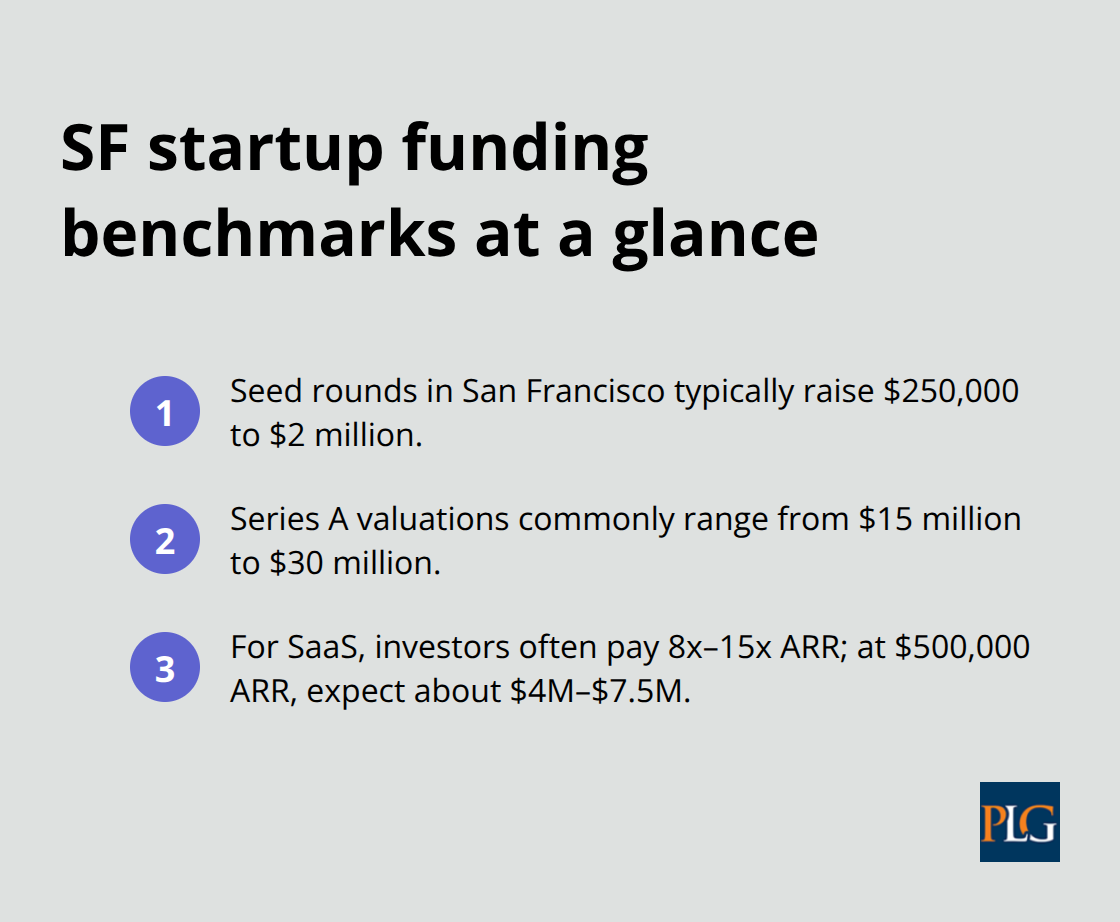
Most seed rounds in San Francisco run between $250,000 and $2 million, while Series A rounds typically land in the $15 to $30 million valuation range. The median seed round in 2024 hit $13.8 million, which tells you that early-stage companies need realistic expectations about valuation multiples. For SaaS companies specifically, investors typically pay 8 to 15 times annual recurring revenue, so if your ARR is $500,000, expect a valuation between $4 and $7.5 million.
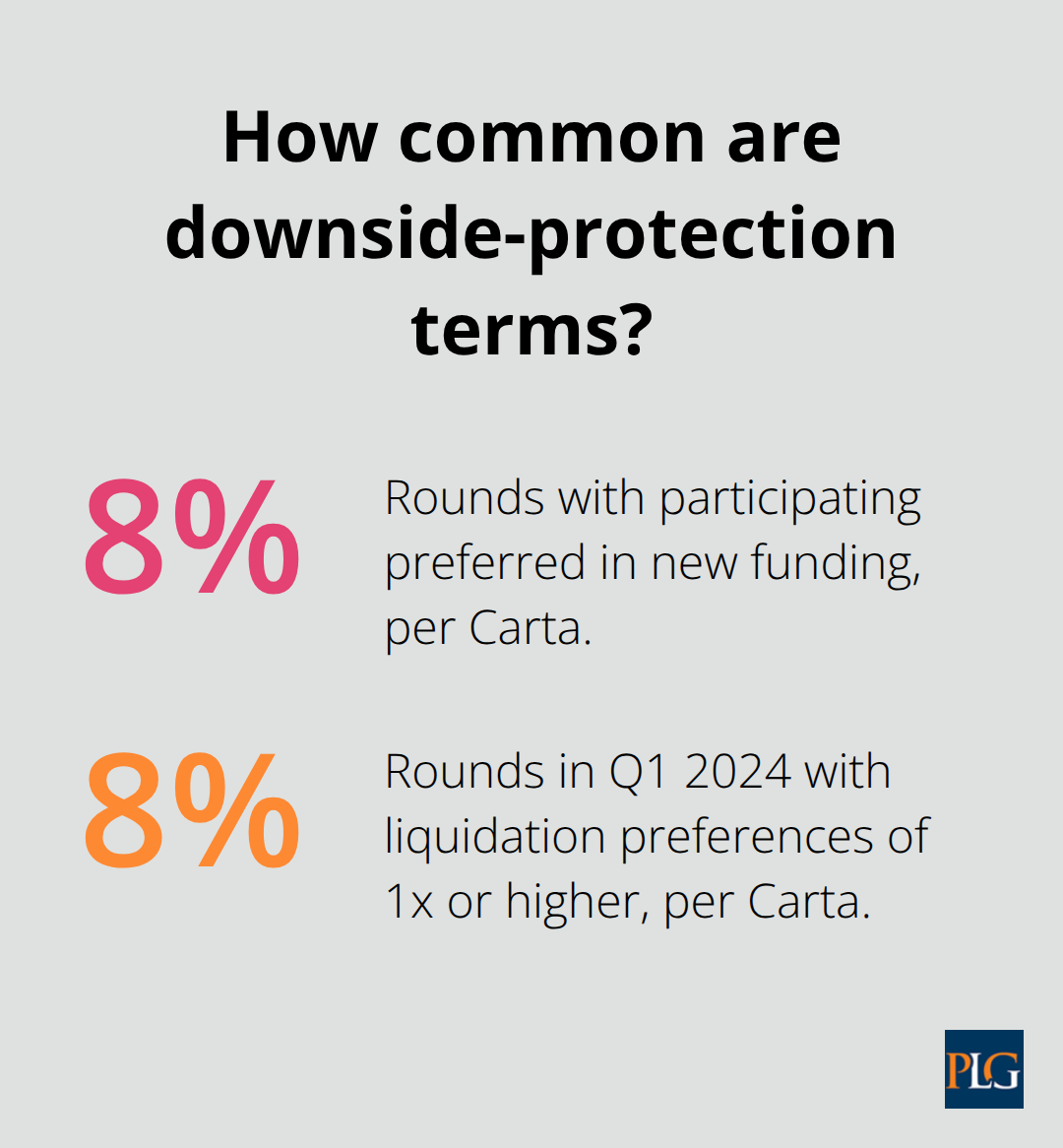
Preferred stock gives investors governance rights, board seats or observer status, and liquidation preferences that protect their downside. Push hard for 1x non-participating liquidation preference as your baseline. Participating preferred, where investors recoup their entire investment first and then share in remaining proceeds, appears in roughly 8% of new funding rounds according to Carta, but it shows up far more often in later-stage rounds where investors demand downside protection. If an investor insists on participating preferred, negotiate a hard cap, typically between 1.5x and 3x, so there’s a ceiling on what they can recover.
Convertible Notes and SAFEs: Speed Versus Precision
Convertible notes and SAFEs offer speed and simplicity, but they’re not always the right choice. A convertible note is a short-term debt instrument that converts into equity at a future funding round, typically at a discount to that round’s valuation. SAFEs, or Simple Agreements for Future Equity, work similarly but carry no interest or maturity date. Founders choose these structures when they want to close capital quickly without negotiating a full preferred stock round. The math is straightforward: if you raise on a convertible note with a $2 million cap and a 20% discount, and later close a Series A at a $10 million post-money valuation, your note converts at $8 million (20% discount applied).
The problem is that convertible notes and SAFEs delay the hard conversation about valuation and governance. Investors love them because they defer valuation risk, but founders often regret them because the final conversion terms, driven by Series A investors, can be punishing. Use convertible notes only for true seed rounds under $500,000 where speed matters more than precision. For anything larger, negotiate a proper SAFE with a clear valuation cap and MFN (most-favored-nations) clause so you’re protected if other investors get better terms.
Equity Dilution: The Math You Can’t Ignore
On equity splits and dilution, the math is unforgiving. Every new round dilutes existing shareholders. If you own 100% of a company and raise a Series A at a $15 million post-money valuation with a $5 million investment, you now own 75%. In a Series B at $50 million post-money with a $20 million investment, your stake drops to 45%. Plan for 20 to 30% dilution per round if you want room to negotiate terms and reserve equity for future employees.
Many founders underestimate how much equity they’ll need to reserve for an option pool. Investors typically demand a 15 to 20% pool reserved for future hires, and that comes out of your pocket. If you haven’t reserved it, investors will demand it be created at your expense, diluting you immediately. Understanding these mechanics before you enter negotiations puts you in a stronger position to structure a deal that supports growth without surrendering control.
The next section covers the specific terms that define VC investments-valuation, liquidation preferences, and anti-dilution clauses-and how each one shifts the balance of power between founders and investors.
What Your VC Valuation Actually Costs You
The Hidden Price Behind Headline Numbers
The valuation number on a term sheet tells only half the story. What matters far more is how that valuation interacts with liquidation preferences, anti-dilution clauses, and board control. A $20 million pre-money valuation sounds impressive until you realize the investor negotiated a 2x liquidation preference with full ratchet anti-dilution, which means they get paid twice their investment before you see a dime, and their cost basis adjusts downward in any future down round. San Francisco startups routinely accept unfavorable valuation multiples because founders focus on the headline number rather than the actual economic terms.
Price per share is calculated by dividing your post-money valuation by fully diluted shares outstanding, but this number means nothing without understanding what rights attach to those shares. If you’re raising at $10 million post-money with 10 million shares outstanding, the price per share is $1. That same $1 per share with a 1x non-participating liquidation preference is fundamentally different from $1 per share with a 2x participating preference and full ratchet anti-dilution.
Liquidation Preferences: Who Gets Paid First
In Q1 2024, Carta’s State of Private Markets showed that 8% of all new funding rounds included liquidation preferences of 1x or higher, but this figure climbs dramatically in Series B and later rounds where downside protection becomes standard. Early-stage founders should push hard for 1x non-participating as a baseline and walk away from any investor demanding 1.5x or higher without a compelling reason.
Participating preferred allows investors to recoup their full investment first, then share in remaining proceeds alongside common shareholders. This structure appears more frequently in later-stage rounds and can eviscerate founder returns in modest exits. If an investor insists on participating preferred, negotiate a hard cap between 1.5x and 3x so you know the maximum they can recover. Many founders don’t realize that a 2x participation cap on a $5 million Series A investment means that investor can pull out $10 million before the remaining proceeds flow to founders and employees. That single term can make the difference between a $50 million exit feeling like a win or a loss.
Anti-Dilution Clauses and Founder Ownership
Anti-dilution clauses protect investors from price decreases in future rounds, and the mechanics here directly harm founder ownership. Weighted-average anti-dilution, the market standard in early rounds, adjusts an investor’s conversion price based on the new round’s valuation and size. Full ratchet anti-dilution is far more punishing, resetting the investor’s cost basis to the new round’s price regardless of round size, which can wipe out founder equity in a down round. Jon O’Connell at Crowell & Moring notes that full ratchet appears occasionally in later-stage deals and severely dilutes founders when valuations decline. Tie anti-dilution protection to milestones or performance triggers whenever possible so the investor bears some risk if the company underperforms.
Board Control and Governance Rights
Board seats and observer rights determine who controls major decisions like hiring, fundraising, and M&A. Typical board structures split evenly between founders and investors plus one independent director, but this 50-50 split means the independent director holds deciding power. Founders should negotiate for majority control if possible, or at minimum ensure the independent director is someone you both trust. Investor observer rights let them track performance without voting power, which is often the better compromise than adding another voting seat. If you have multiple investors, their combined board representation can quickly marginalize founder control.
Negotiating the Terms That Matter Most
The real negotiation isn’t about winning every term, it’s about identifying which terms matter most to your business and which ones you can concede. Valuation gets attention, but liquidation preferences and anti-dilution clauses determine actual economics. Board control shapes your ability to execute strategy without investor veto. Get these three elements right and you’ll close a deal that funds growth without surrendering your company’s future. The next section covers the tax implications and legal considerations specific to San Francisco, where entity selection and tax-efficient structuring can save you hundreds of thousands of dollars before you even close your first institutional round.
Tax Structure Decisions That Cost Founders Millions
Delaware C-Corporation: The Only Choice That Works
Delaware C-Corporation incorporation is non-negotiable before you approach institutional investors. Investors won’t fund LLCs, and trying to convert an LLC to a C-Corp later triggers unnecessary tax complications and delays your fundraising timeline. Delaware incorporation costs roughly $200 and takes a few days, but the alternative-an investor walking away because your entity structure is wrong-costs everything. Founders waste months trying to retrofit their legal structure after choosing the wrong entity initially. The Delaware C-Corp gives you the statutory framework that institutional investors expect: clear stock classes, straightforward preferred stock mechanics, and tax treatment that aligns with venture funding rounds. Delaware law provides the liability protection and governance flexibility that other states don’t offer. If you operate in California as a sole proprietor or partnership, you expose personal assets to business liability and create a cap table nightmare when you fundraise.
Cap Table Planning From Day One
Your cap table planning must start at incorporation, not after your first investor arrives. Reserve 15 to 20 percent of your company equity for an employee option pool before you close any institutional funding round. If you haven’t reserved it, investors will demand it be created at your expense, diluting your ownership immediately and triggering a repricing event that costs money and time.
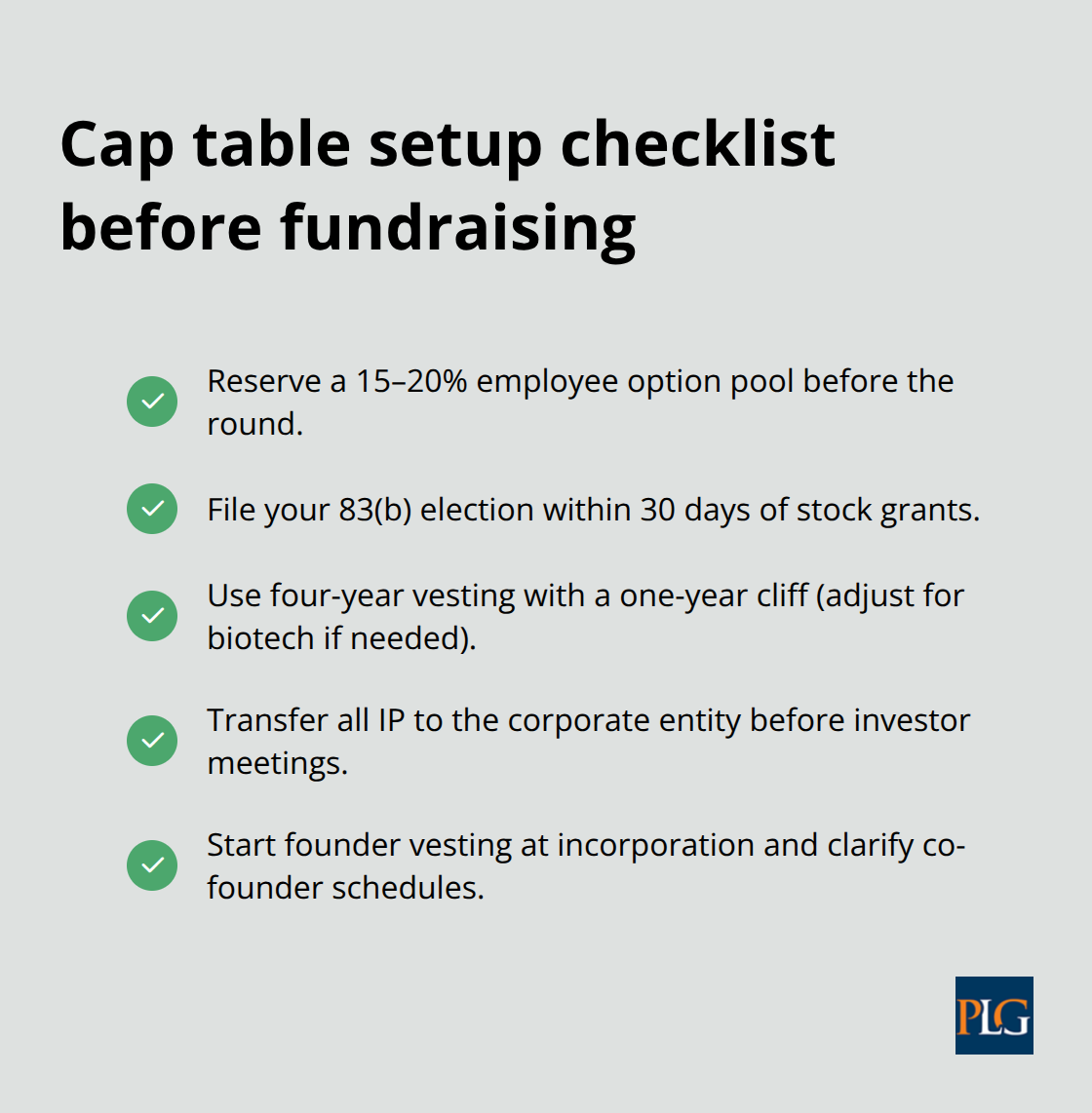
File your 83(b) election within 30 days of receiving stock grants, or the IRS will treat your equity as ordinary income rather than capital gain when you eventually exit. Four-year vesting with a one-year cliff remains the market standard in San Francisco, but biotech companies often justify longer vesting schedules tied to regulatory milestones. Transfer all intellectual property to your corporate entity before investor meetings-if your code, patents, or trade secrets remain in your personal name or an older entity, investors will demand you fix it during due diligence, and that process is expensive and time-consuming. Start founder vesting at incorporation to reflect your contributions from day one. If you’re a co-founder joining later, negotiate whether the earlier founder’s vesting schedule continues unchanged or whether you both reset to a unified schedule. Most investors accept preserving an existing vesting schedule, but clarity upfront prevents disputes later.
California Tax Burden and Multi-State Complexity
Tax-efficient structuring in California means understanding that the state’s 1.5 percent net worth tax and alternative minimum tax apply to C-Corporations, which many founders don’t anticipate. Your accountant should model the tax burden of different structuring approaches before you close funding. Multi-state operations add complexity that most founders underestimate. If you have employees or revenue in New York, Texas, or other states, you trigger state franchise taxes, sales tax obligations, and employment law compliance in each jurisdiction. Establish a registered agent in each state where you operate and maintain proper corporate records and minutes to protect your liability shield. Many founders operate in multiple states without realizing they’ve created tax exposure or failed to comply with state-specific employment laws. California’s Dynamex ruling and subsequent AB5 legislation treat independent contractors as employees unless you meet strict criteria, which affects how you structure vendor relationships and contractor agreements. The IRS has similar tests, and misclassifying contractors as independent will cost you back taxes, penalties, and interest.
Protecting Your Legal Foundation
Your initial legal structuring sets the foundation for how cleanly your funding rounds close. Get it right at the beginning, and you’ll move through subsequent rounds without the friction and delay that comes from fixing structural problems mid-fundraising. Investors scrutinize entity formation documents, cap tables, and tax filings during due diligence, and any gaps or inconsistencies slow down the process. A clean legal foundation means your investors can focus on the business opportunity rather than spending weeks untangling structural issues. The cost of fixing problems after they arise far exceeds the cost of getting the structure right upfront.
Final Thoughts
Getting VC investment structuring right comes down to three non-negotiable elements: clean legal entity formation, realistic valuation expectations tied to actual economic terms, and governance structures that preserve your ability to execute. Most founders focus on the headline valuation number and miss the terms that actually determine their economics at exit. A $20 million pre-money valuation with a 2x liquidation preference and full ratchet anti-dilution will cost you far more than a $15 million pre-money with 1x non-participating and weighted-average protection.
The pitfalls that cost founders millions are predictable and avoidable. Incorporating as an LLC instead of a Delaware C-Corporation delays institutional funding and triggers expensive conversions later. Failing to reserve an employee option pool upfront means investors will demand it be created at your expense, diluting you immediately. Accepting participating preferred without a hard cap can turn a $50 million exit into a loss for founders and employees.
Before you enter your next funding round, model how different term structures affect your ownership at exit. Run scenarios with 1x non-participating versus 2x participating, weighted-average versus full ratchet anti-dilution, and different board compositions. We at Primum Law Group help startups navigate VC investment structuring from initial entity formation through complex funding rounds and ongoing compliance.