

San Francisco stands as the global epicenter for venture capital financing, with over $63 billion invested in Bay Area startups during 2023 alone. The city’s unique ecosystem connects ambitious entrepreneurs with the world’s most influential investors.
We at Primum Law Group guide startups through the complex legal landscape of VC transactions. From seed rounds to Series C funding, understanding your financing options can make or break your company’s future.
Which Financing Stage Fits Your Startup
Pre-Seed and Seed Funding Basics
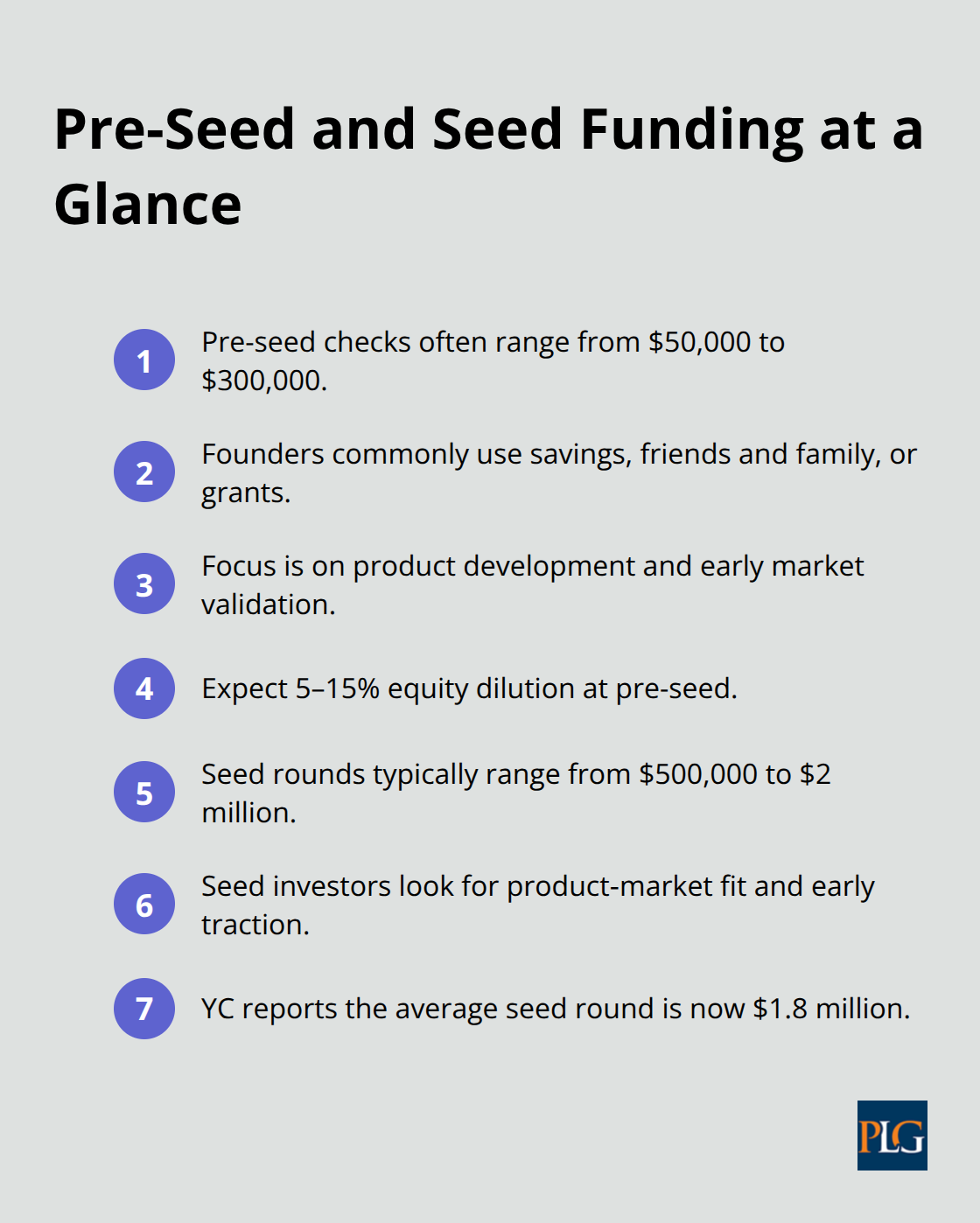
Pre-seed funding provides the earliest capital injection, typically ranging from $50,000 to $300,000. Founders at this stage often rely on personal savings, friends and family, or small business grants. The focus remains on product development and initial market validation.
Companies should expect to give up 5-15% equity at pre-seed levels. Seed funding follows with investments between $500,000 and $2 million, which requires demonstrated product-market fit and early traction metrics. Y Combinator reports that seed rounds now average $1.8 million (significantly higher than the $500,000 average from five years ago).
Series A Through C Progression
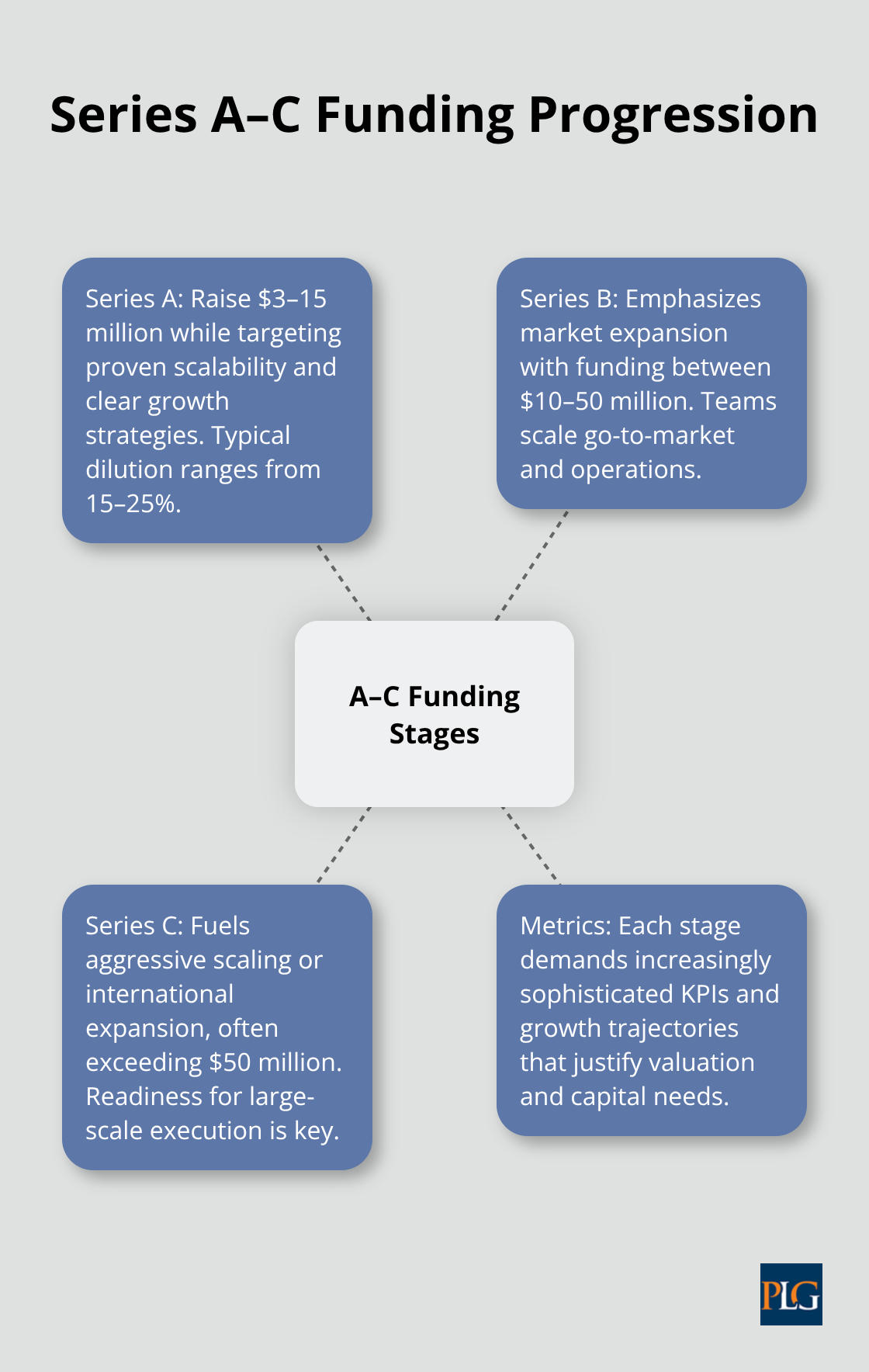
Series A rounds demand proven scalability and clear growth strategies. Companies typically raise $3-15 million while they surrender 15-25% equity. Menlo Ventures data shows Series A valuations in San Francisco average $25 million pre-money.
Series B focuses on market expansion, with funding ranges of $10-50 million. Series C targets companies ready for aggressive scale or international expansion, often exceeding $50 million. Each stage requires increasingly sophisticated metrics and growth trajectories.
Bridge Financing Solutions
Bridge financing serves as interim funding between major rounds, usually structured as convertible notes or SAFEs. These instruments delay valuation discussions while they provide immediate capital.
Convertible notes carry interest rates of 6-8% and conversion discounts of 15-25%. The median time between Series A and Series B has extended to 24 months according to PitchBook data, which makes bridge financing increasingly vital for growth momentum maintenance.
Understanding these financing structures becomes even more important when you consider the competitive landscape of San Francisco’s venture capital firms and their specific investment criteria.
Who Controls San Francisco’s VC Money
The Heavyweight Investment Firms
Andreessen Horowitz leads San Francisco’s venture capital landscape with $4.35 billion in total capital. The firm invests across mobile, enterprise software, and crypto sectors. Sequoia Capital manages $4.12 billion and focuses on early to mid-stage investments, with successful exits that include PayPal and Square.
Menlo Ventures controls $5.5 billion in capital and has backed over 800 companies since 1976, with portfolio companies like Uber and Roku. These three firms dominate deal flow and set valuation benchmarks across the Bay Area.
General Catalyst has completed over 1,400 investments since 2000. The firm focuses heavily on applied AI and resilient business models. Bessemer Venture Partners brings 112 years of experience with over 1,470 investments in enterprise, consumer, and healthcare sectors. Coinbase Ventures targets crypto and web3 companies exclusively, while Craft Ventures concentrates on B2B SaaS startups with hands-on operational support.
Angel Networks That Move Markets
Super angels in San Francisco typically write checks between $25,000 and $250,000 per deal. Former executives from Google, Facebook, and Salesforce dominate this space. They bring both capital and industry connections to startups.
Naval Ravikant, Reid Hoffman, and Marc Benioff represent the tier of angels who can single-handedly validate a startup for institutional investors. Angel groups like Band of Angels and Golden Seeds conduct monthly pitch meetings with 50-100 member investors.
These networks require warm introductions and typically invest $500,000 to $2 million collectively per company. The median angel round in San Francisco reached $750,000 in 2023 (according to PitchBook data).
Accelerator Programs Worth Your Attention
Y Combinator remains the gold standard. The accelerator has backed nearly 3,000 companies with combined valuations that exceed $300 billion. Their 3-month program concludes with Demo Day presentations to over 1,000 investors.
Acceptance rates hover around 1.5%, which makes YC more selective than Harvard Business School. Techstars operates multiple programs in San Francisco and focuses on specific verticals like fintech and healthcare technology.
500 Startups runs admissions with $150,000 investments for 6% equity. Plug and Play connects startups directly with corporate partners for pilot programs and strategic investments. These accelerators provide the foundation that prepares startups for the complex legal frameworks they’ll encounter when they advance to formal venture capital rounds.
What Legal Hurdles Will Derail Your VC Deal
Term Sheet Negotiations That Actually Matter
The liquidation preference clause determines who gets paid first during an exit. Non-participating preferred shares limit investor returns to their liquidation preference or their pro-rata share of proceeds (whichever is greater). Participating preferred shares allow investors to receive their liquidation preference plus their pro-rata share of remaining proceeds. This difference can cost founders millions during acquisitions.
Anti-dilution provisions protect investors when companies raise down rounds. Weighted average anti-dilution adjusts the conversion price based on the size and price of the new round, while full ratchet anti-dilution resets the conversion price to the new round price regardless of size.
Vesting acceleration terms become critical during acquisitions or leadership changes. Single trigger acceleration vests shares upon a company sale, while double trigger acceleration requires both a sale and termination within a specified period. Board composition typically grants investors one seat per major round, with founders maintaining control through Series A.
Due Diligence Documentation Standards
Investors demand comprehensive financial records that span three years minimum. Cap table management through platforms like Carta or Pulley becomes essential for tracking ownership percentages and option grants. Patent filings and IP assignments require meticulous documentation, with provisional patents filed within 12 months of public disclosure.
Employment agreements must include proper invention assignment clauses and non-compete provisions where legally enforceable. Customer contracts that exceed $100,000 annually require individual review during due diligence. Material agreements (including office leases, supplier contracts, and partnership deals) need organized storage in virtual data rooms.
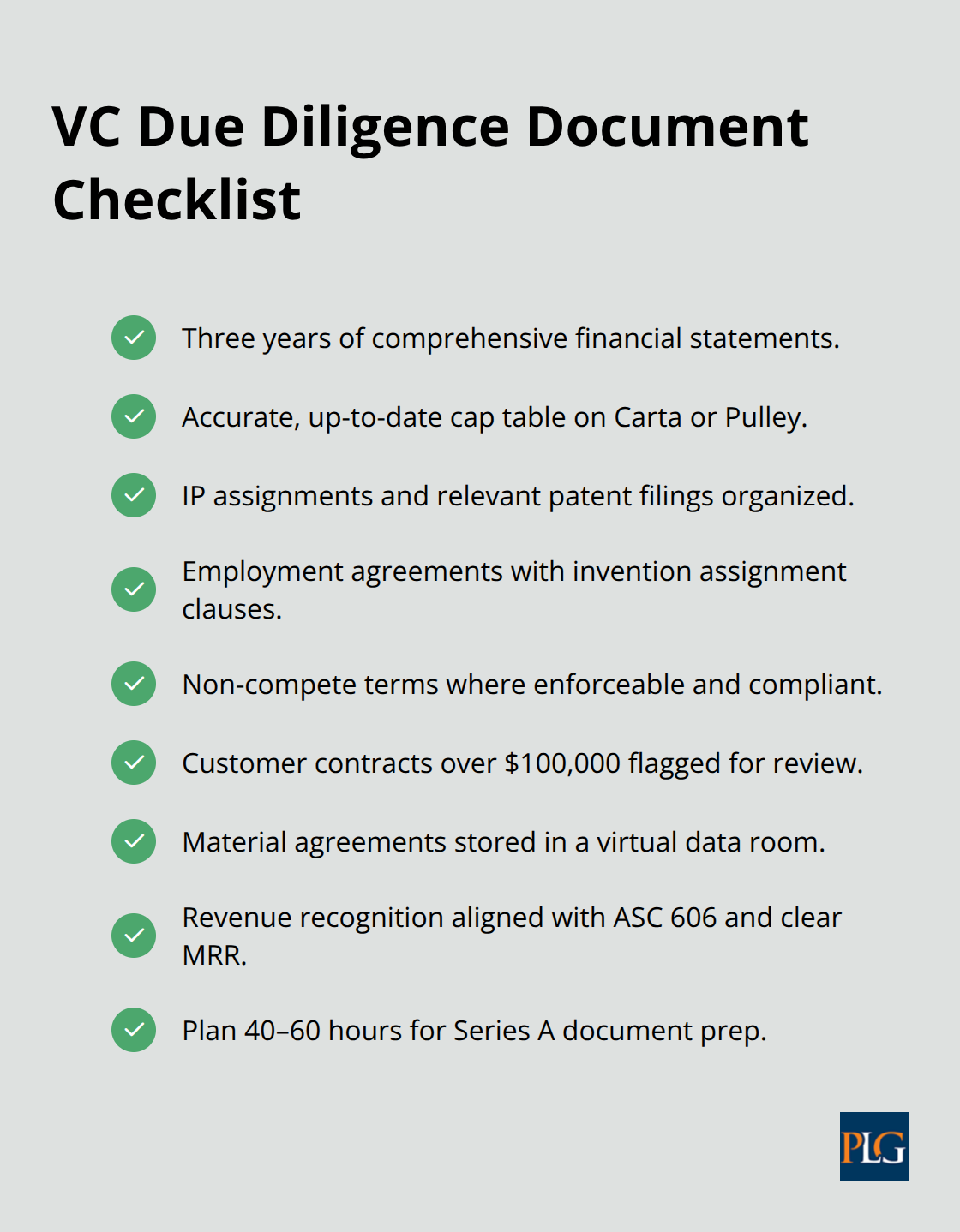
Revenue recognition practices must align with ASC 606 standards, with monthly recurring revenue calculations clearly documented. Companies typically spend 40-60 hours preparing due diligence materials for Series A rounds, with requirements expanding significantly for later stages.
Securities Law Compliance Requirements
Rule 506(b) exemptions allow unlimited accredited investors but limit non-accredited investors to 35 per offering. Rule 506(c) permits general solicitation but requires verified accredited investor status for all participants. Form D filings with the SEC occur within 15 days of first sale, with state blue sky law compliance varying by jurisdiction.
Bad actor disqualifications prevent offerings when company principals have recent securities violations. Pay-to-play provisions strip anti-dilution rights from investors who don’t participate in future rounds. These terms create powerful incentives for continued investor support but can complicate future fundraising when existing investors lack capacity.
Final Thoughts
San Francisco’s venture capital financing landscape offers unparalleled opportunities for ambitious startups, with over $63 billion invested locally in 2023. The ecosystem spans from $50,000 pre-seed rounds to $50+ million Series C investments, supported by powerhouse firms like Andreessen Horowitz and Sequoia Capital. Success requires strategic timing and preparation that aligns with investor expectations.
Startups must demonstrate clear traction metrics before they approach Series A investors, while they maintain organized cap tables and IP documentation throughout their growth journey. The median 24-month gap between funding rounds makes bridge financing increasingly vital for sustained momentum. Legal complexity escalates with each funding stage as term sheet negotiations determine founder outcomes during exits.
We at Primum Law Group understand that venture capital financing transactions require both strategic vision and meticulous legal execution. Our startup counseling services help founders structure deals that protect their interests while they attract top-tier investors. The right legal guidance transforms complex VC negotiations from potential roadblocks into stepping stones toward successful exits.