

San Francisco’s venture capital landscape demands pitch decks that cut through the noise. With over $63 billion invested in Bay Area startups in 2023, competition for funding remains fierce.
We at Primum Law Group have seen countless founders struggle with their venture capital pitch deck presentations. The difference between securing funding and walking away empty-handed often comes down to execution details that many entrepreneurs overlook.
What Makes Your Pitch Deck Stand Out to VCs
Your pitch deck needs three core elements that Bay Area investors examine within their typical 2-minute review window. The problem statement must demonstrate genuine market pain that affects thousands of potential customers, not just a minor inconvenience. DoorDash succeeded by showing restaurants lost $240 billion annually due to delivery inefficiencies, while failed pitches often present problems that affect only small niche markets.
Market Opportunity That Commands Attention
Present your Total Addressable Market with bottom-up calculations rather than top-down estimates. Sequoia Capital portfolio companies consistently show TAM calculations based on customer acquisition costs and unit economics. Your Serviceable Obtainable Market should represent 0.1% to 1% of TAM within five years – anything higher signals unrealistic expectations to San Francisco VCs.
Include geographic expansion timelines and regulatory barriers that could limit market penetration. Airbnb’s original deck showed a $2 billion market opportunity, which seemed conservative but proved achievable through methodical execution.
Revenue Model That Investors Trust
Your business model slide must show multiple revenue streams and clear path to profitability within 36 months. Include customer acquisition costs, lifetime value ratios, and monthly recurring revenue growth rates (these metrics matter more than vanity metrics like total users). Financial projections should show 10x revenue growth over three years with gross margins above 70% for software companies.

Avoid hockey stick projections that show minimal growth followed by explosive expansion. Investors prefer steady 20-30% monthly growth patterns that compound consistently over time.
Team Credentials and Execution Ability
San Francisco VCs invest in teams that can execute, not just impressive backgrounds on paper. Show how your team solved similar problems before or built relevant products in adjacent markets. Include advisors who opened doors, secured partnerships, or provided technical guidance that accelerated your progress.
However, even the strongest pitch deck requires proper legal structure and compliance frameworks that protect both founders and investors during the fundraising process.
Why Most Pitch Decks Fail to Secure Funding
Most San Francisco pitch decks fail because founders make three fatal errors that immediately signal inexperience to investors. These mistakes destroy credibility before investors reach the financial slides.
Problem Statements That Confuse Instead of Convince
The first mistake involves transformation of simple problems into complex narratives that confuse rather than convince. Successful companies like YouTube presented their problem in one sentence: people couldn’t easily share videos online. Failed pitches often spend multiple slides on intricate market dynamics, customer personas, and theoretical pain points that investors struggle to follow.
Your problem statement should pass the grandmother test – if your grandmother can’t understand the problem in 30 seconds, neither will busy VCs who review hundreds of decks monthly. Clear problem identification separates funded startups from rejected applications.
Financial Projections That Destroy Credibility
Financial projections kill more deals than any other slide because founders consistently overestimate growth while they underestimate costs. Venture capitalists expect software startups to show gross margins above 70% and customer acquisition costs that allow profitability within 18 months (yet most pitch decks present hockey stick projections with minimal data support).
The average successful Series A company shows 15-25% monthly revenue growth, not the 50-100% growth rates that appear in rejected decks. Include unit economics, customer lifetime value calculations, and realistic plans that account for San Francisco salary levels of $165,000 for engineers. Investors immediately spot unrealistic projections when startups claim they’ll capture 10% market share within two years while they show minimal budgets.
Competition Analysis That Ignores Market Reality
The weakest pitch decks either claim no competition exists or dismiss established players as irrelevant legacy companies. Acknowledgment of strong competitors actually increases credibility because it demonstrates market validation and deep industry understanding. Uber’s original deck directly addressed taxi companies, car rental services, and public transportation as competitors while it explained specific advantages.
Smart founders position their company within the competitive landscape rather than above it. They show how they’ll win customers from solutions through superior technology, better prices, or enhanced customer experience. This honest assessment builds investor confidence and sets the foundation for successful presentation strategies that resonate with Bay Area venture capital firms.
How Do You Present to San Francisco VCs
San Francisco investors evaluate pitch decks differently than VCs in other markets, with specific preferences that determine success. Bay Area investors allocate just 2-3 minutes per deck during initial reviews, which means your opening slides must immediately address market size, team credibility, and traction metrics.
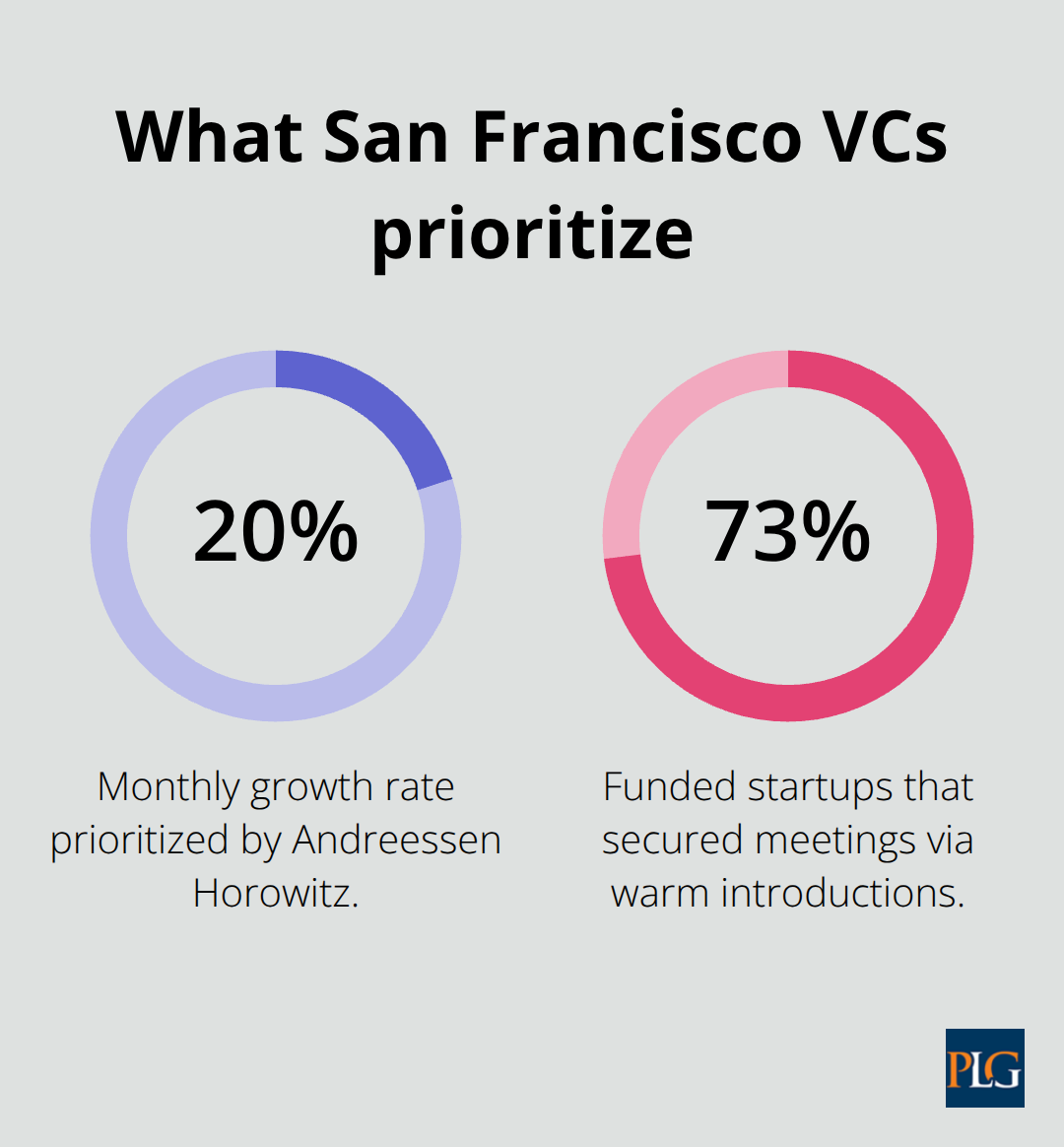
Andreessen Horowitz partners prioritize companies that show 20% monthly growth rates with clear paths to $100 million annual revenue. Sequoia Capital focuses on businesses that can scale to billion-dollar valuations within seven years. Present your deck in person whenever possible since 73% of funded startups in San Francisco secured meetings through warm introductions rather than cold emails.
Optimal Presentation Schedule
Schedule your pitch presentations between Tuesday and Thursday at 10 AM or 2 PM when VCs maintain highest attention levels and decision-making capacity. Avoid Monday mornings when investors review weekend deal flow or Friday afternoons when attention shifts to portfolio companies.
The optimal presentation length spans exactly 12 minutes with 8 minutes for Q&A, which allows investors to probe deeper into financials and competitive positions. Greylock Partners data shows that successful pitches average 11.3 slides presented at 1.1 minutes per slide, with founders who spend 40% of time on market opportunity and business model validation.
Follow-Up Actions That Drive Results
Send follow-up materials within 24 hours that include detailed financial models, customer references, and competitive analysis documents that investors request during Q&A sessions. Include specific metrics that address concerns raised during your presentation rather than generic materials that add no value.
Benchmark Capital portfolio companies that secured Series A funding sent an average of 3.2 follow-up communications over 6 weeks. Each message contained new traction data, partnership announcements, or customer acquisition updates (not recycled pitch content). Track investor engagement through document analytics and schedule second meetings within 10-14 days while you maintain momentum from initial presentations.
Final Thoughts
Your venture capital pitch deck success in San Francisco depends on three fundamental elements: clear problem identification, realistic financial projections, and honest competitive analysis. Bay Area investors funded only 1% of pitches in 2023, which makes execution precision absolutely essential for access to the $63 billion in available startup capital. The legal framework that supports your fundraising efforts requires equal attention to your presentation materials.
Securities regulations, investor accreditation requirements, and equity structure decisions impact both your current funding round and future growth opportunities. We at Primum Law Group guide San Francisco startups through these complex legal requirements while founders focus on perfection of their investor presentations. Your next steps involve three immediate actions: refine your pitch deck based on investor feedback patterns, establish proper legal structures for equity distribution, and build relationships with Bay Area VCs through warm introductions.
Schedule practice sessions with other founders, validate your financial assumptions with actual customer data, and prepare comprehensive due diligence materials that investors will request after successful presentations. The combination of compelling storytelling, solid legal foundations, and persistent execution separates funded startups from thousands of rejected applications (this distinction proves vital in competitive markets). Primum Law Group provides the legal infrastructure that allows founders to concentrate on investor relationships and close funding rounds that fuel long-term business growth.