

The Corporate Law Conference 2025 brought together legal professionals and corporate leaders to discuss the most pressing challenges facing the industry today. We at Primum Law Group followed the major announcements and sessions closely to bring you the insights that matter most.
From regulatory shifts to cutting-edge technology, this year’s conference covered ground that will shape how businesses operate in the months ahead. This post breaks down the key takeaways you need to know.
What Corporate Leaders Actually Discussed at the 2025 Conference
The Corporate Law Conference 2025 attracted senior in-house counsel from Microsoft, ING Americas, Capgemini, and Prudential Financial alongside partners from leading firms like Paul Weiss and Blank Rome. Conversations moved past theory and focused on Delaware’s sweeping Section 144 amendments, which now codify safe harbors for conflict transactions when disinterested directors or stockholders approve them. This shift changes how boards handle going-private transactions and controlling shareholder deals. Companies are already reworking their conflict-governance procedures to leverage these safe harbors and reduce loyalty-liability exposure.

The amendments also streamlined Section 220 stockholders’ books-and-records inspections by narrowing scope and clarifying which documents must be produced-a change that affects how in-house teams manage disclosure requests and confidentiality protections.
AI governance moved from abstract to operational
Companies that treat AI as a compliance checkbox will lose competitive advantage. Instructure’s general counsel and privacy officer presented practical frameworks for deploying AI in legal operations while managing privilege and due diligence risks. Attendees learned that governance requirements for AI deployment now include liability allocation, transparency mechanisms, and ongoing monitoring-not optional add-ons. Financial services firms like Prudential Financial emphasized that regulatory investigations into AI systems are accelerating, making it critical to document decision-making processes and risk assessments before implementation, not after. The practical takeaway: draft AI policies that specify which functions require human review, establish incident response protocols, and map liability between vendors and your organization.
Global supply chain and data protection collide
Multinational attendees from Deutsche Bank and Agricultural Bank of China stressed that 2025 demands integrated approaches to supply chain contracts and data protection. The European Green Deal drives mandatory carbon footprint measurement and sustainability reporting, while data breaches under GDPR enforcement continue to trigger commercial penalties. Companies operating across jurisdictions need unified compliance playbooks that address both logistics agreements and data governance simultaneously. Performing regular contractual risk reviews for digital platforms and establishing data protection impact assessments for high-risk processing are no longer optional-they’re baseline expectations for avoiding regulatory penalties and supply chain disruptions.
What emerged from these discussions was clear: the legal landscape in 2025 requires boards and in-house teams to act on multiple fronts at once. The next section explores how specific regulatory changes are reshaping corporate governance and compliance obligations across industries.
Regulatory Shifts That Change Board Responsibilities Right Now
Delaware’s Section 144 Safe Harbor Demands Immediate Action
Delaware’s Section 144 amendments represent the most consequential governance shift in years, and boards must act now. The safe harbor codification means that conflict transactions-going-private deals, controlling shareholder transactions, and related-party arrangements-now have a clear approval pathway that eliminates loyalty-liability exposure if structured correctly. A disinterested committee with at least two directors, acting in good faith without gross negligence, can approve these transactions and shield directors from liability. Alternatively, a majority vote from disinterested stockholders achieves the same result.
Companies that fail to follow these procedures remain exposed to derivative suits and breach-of-fiduciary-duty claims. The amendments took effect February 17, 2025, making retroactivity a live issue for deals completed between announcement and the effective date. Delaware courts have already accepted certified questions challenging the constitutionality of retroactive application, creating uncertainty for pending transactions.
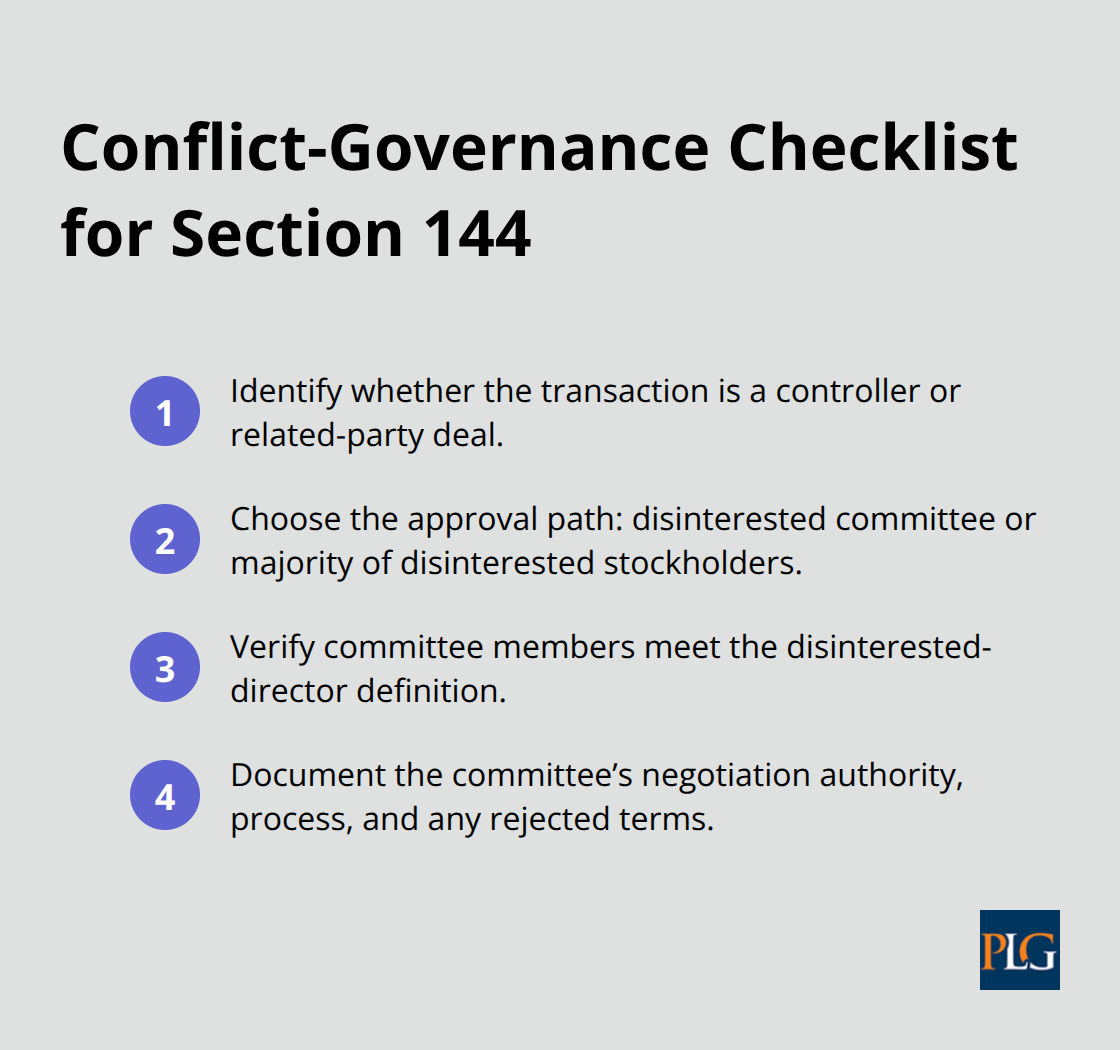
Your board needs a conflict-governance checklist now: identify whether a transaction qualifies as a controller deal, determine which approval mechanism fits your structure, ensure committee members meet the disinterested-director definition, and document the negotiation and rejection authority the committee actually exercised.
Section 220 Tightens Inspection Rights While Clarifying Production Rules
Section 220 changes simultaneously tightened stockholders’ inspection rights while giving corporations clearer production rules. Demands must now show reasonable particularity and demonstrate a nexus between the sought records and the stated purpose. Authorized documents include three years of annual financials, stockholder agreements, board minutes, and D&O independence questionnaires for public companies.
Corporations can condition production on confidentiality agreements and redact information unrelated to the stockholder’s stated purpose. In-house teams managing disclosure requests should map which documents fall within scope, establish redaction protocols aligned with the new standards, and train staff on what triggers a proper demand versus an overreaching one.
Data Protection and Sustainability Compliance Converge Into One Operational Reality
Data protection and sustainability compliance have merged into a single operational reality that multinational corporations cannot compartmentalize. The European Green Deal mandates carbon footprint measurement, sustainability reporting, and transition timelines for renewable energy; non-compliance triggers commercial penalties that function like regulatory fines. Simultaneously, GDPR enforcement continues to accelerate, with data breaches generating penalties that routinely exceed 2% of annual revenue for serious violations.
Companies operating across jurisdictions face a dual burden: supply chain contracts must address logistics, sustainability obligations, and data-handling practices in a single coherent framework. A single weak vendor agreement on data processing can expose your organization to both GDPR penalties and supply chain disruption when that vendor fails to meet sustainability standards.
Building Integrated Compliance Infrastructure Across Procurement and Operations
Performing contractual risk reviews for digital platforms and marketplaces is now mandatory due diligence. Data protection impact assessments for high-risk processing must happen before implementation, not after a breach forces remediation. Appoint a single owner responsible for integrating data governance and sustainability compliance across procurement, operations, and legal. This person should maintain a current inventory of all third-party data processors and supply chain partners, verify their compliance posture against both GDPR and relevant sustainability standards, and establish incident response protocols that address both data breaches and supply chain failures simultaneously.
Companies treating these as separate compliance tracks will face enforcement action from multiple regulators operating independently. The convergence of these regulatory demands means your next step involves mapping how technology choices-particularly AI systems and automation tools-interact with both data governance and sustainability obligations across your organization.
Technology and Compliance Risk Management
AI Governance Requires Documentation Before Implementation
AI systems in legal operations now carry regulatory weight that demands governance infrastructure before implementation. Financial services firms at the conference emphasized that regulators actively investigate how organizations use AI for contract review, due diligence, and compliance monitoring. Your AI governance framework must document which functions require human review, establish incident response protocols specific to AI failures, and map liability between your organization and vendors.
Instructure’s general counsel presented a framework that addresses privilege protection when AI systems analyze sensitive documents. This matters because AI systems can waive attorney-client privilege if not properly structured. Companies that treat AI deployment as a technology procurement decision rather than a governance decision face regulatory penalties and litigation exposure.
Start with an audit: identify every legal function currently handled by humans that your organization plans to automate, then assign a single owner to conduct a privilege and due diligence assessment before any system goes live. Document the risk assessment, the approval decision, and the monitoring mechanisms you establish. This documentation becomes your defense if regulators later question the deployment.
Blockchain Creates Compliance Transparency Across Supply Chains
Smart contract technology and blockchain applications show practical value in supply chain and vendor management, particularly for organizations managing complex international transactions. Rather than replacing traditional contracts, blockchain creates an immutable record of contract execution, amendments, and performance milestones-useful for organizations operating under both GDPR and sustainability reporting requirements.
The European Green Deal compliance burden means your contracts now track carbon footprint data, renewable energy transition timelines, and sustainability certifications alongside traditional performance metrics. Blockchain creates a transparent audit trail that regulators can access without requiring your organization to reconstruct transaction histories from scattered email and document repositories.
Deutsche Bank and Agricultural Bank of China emphasized that multinational corporations managing supply chains across jurisdictions benefit from blockchain’s ability to timestamp compliance checkpoints and verify vendor certifications in real time. If your organization uses blockchain for vendor management, ensure the system captures data protection and sustainability compliance checkpoints alongside payment and delivery obligations. This approach consolidates compliance monitoring into a single operational system rather than forcing your in-house team to maintain parallel tracking mechanisms for regulatory compliance and vendor performance.
Final Thoughts
The Corporate Law Conference 2025 made one thing unmistakable: boards and in-house teams cannot treat governance, compliance, and technology as separate problems anymore. Delaware’s Section 144 amendments demand immediate action on conflict-transaction procedures. Data protection and sustainability compliance have merged into a single operational reality that regulators will enforce simultaneously. AI systems require governance infrastructure before deployment, not after problems surface.
Your organization needs to act on three fronts right now. Audit your current governance procedures against the Section 144 safe harbor requirements and identify which transactions qualify for the new approval pathways. Map your compliance obligations across data protection, sustainability reporting, and supply chain management to identify gaps where separate regulatory tracks create operational friction. Conduct a privilege and due diligence assessment of any AI systems your legal team uses or plans to implement, then document the risk assessment and monitoring mechanisms before going live.
We at Primum Law Group work with startups, investors, and executives navigating these exact challenges. Whether you need help restructuring your corporate governance and compliance programs, drafting AI governance frameworks, or integrating data protection into your supply chain contracts, the time to act is now. The regulatory environment in 2025 rewards organizations that move decisively and punishes those that wait.