

San Francisco’s legal landscape demands efficient technology solutions. Corporate law software has become indispensable for firms managing complex transactions and regulatory compliance.
We at Primum Law Group understand how the right platform transforms daily operations. Modern legal technology streamlines case management, improves client communication, and reduces administrative overhead significantly.
Which Software Features Drive Corporate Law Success
Document Management Systems
Corporate law software must handle complex transactions worth millions while maintaining regulatory compliance. The most effective platforms integrate three fundamental capabilities that directly impact firm profitability and client satisfaction.
Document management systems form the backbone of corporate law operations. Firms that handle merger and acquisition deals process an average of 50,000 documents per transaction (according to Thomson Reuters data). Advanced platforms like NetDocuments automatically control document versions and track changes across multiple stakeholders.
Smart tagging systems categorize contracts by deal type, jurisdiction, and risk level. These systems reduce document retrieval time by up to 65%. Integration with email systems captures all client communications within case files and creates comprehensive audit trails that satisfy regulatory requirements.

Time Tracking and Billing Integration
Time tracking becomes automatic when lawyers access documents. This eliminates manual entry errors that cost firms approximately $50,000 annually in lost billable hours. Client portals provide secure access to deal documents while they maintain attorney-client privilege.
Modern platforms use AI to identify potential conflicts across documents. They flag issues before these become costly problems. The most sophisticated systems integrate billing directly with document access and automatically generate invoices based on document review time and complexity levels.
Client Communication Tools
Advanced communication features transform how corporate law firms interact with clients during high-stakes transactions. These tools streamline collaboration while they maintain security standards that corporate clients demand for their most sensitive deals.
Which Platforms Lead Corporate Law Technology
Clio Dominates Practice Management
Clio commands the practice management landscape with over 150,000 legal professionals across 100+ countries who rely on its comprehensive suite. The platform integrates case management, time tracking, and client communication in a single dashboard that reduces administrative tasks by 39% (according to their 2023 efficiency study). Clio’s automated billing feature captures billable time directly from document access and email interactions, which eliminates the manual entry errors that cost firms $50,000 annually. Corporate law firms benefit from Clio’s conflict checking system that scans across all cases and clients to prevent ethical violations before they occur.
LexisNexis Powers Research Excellence
LexisNexis transforms legal research through its AI-powered search capabilities that deliver results 24.5% faster than traditional methods according to National Legal Research Group data. The platform’s Lexis+ service provides predictive analytics that forecast case outcomes with 80% accuracy based on historical judge and jurisdiction data. Corporate lawyers who handle securities compliance find the real-time regulatory updates particularly valuable, as the system automatically flags relevant changes across federal and state regulations. The document review tools identify key clauses and potential issues 40% faster than manual review processes.
NetDocuments Secures Complex Transactions
NetDocuments handles the document-heavy nature of corporate law with military-grade security that satisfies the most demanding corporate clients. The platform processes an average of 50,000 documents per M&A transaction while it maintains version control across multiple stakeholders and time zones. Smart tagging systems automatically categorize contracts by deal type, jurisdiction, and risk level, which reduces document retrieval time by 65%. The integration with Microsoft Office and Adobe creates seamless workflows that corporate law teams require for due diligence processes.
These platforms address different aspects of corporate law practice, but selection requires careful evaluation of your firm’s specific requirements and workflow patterns. When navigating complex international business transactions or venture capital deals, specialized legal expertise becomes essential alongside the right technology stack.
Which Software Fits Your Corporate Law Practice
Corporate law firms waste an average of $75,000 annually on software that doesn’t match their workflow requirements according to Legal Executive Institute research. The selection process requires three critical evaluations that determine whether technology investment generates positive returns or becomes expensive overhead.
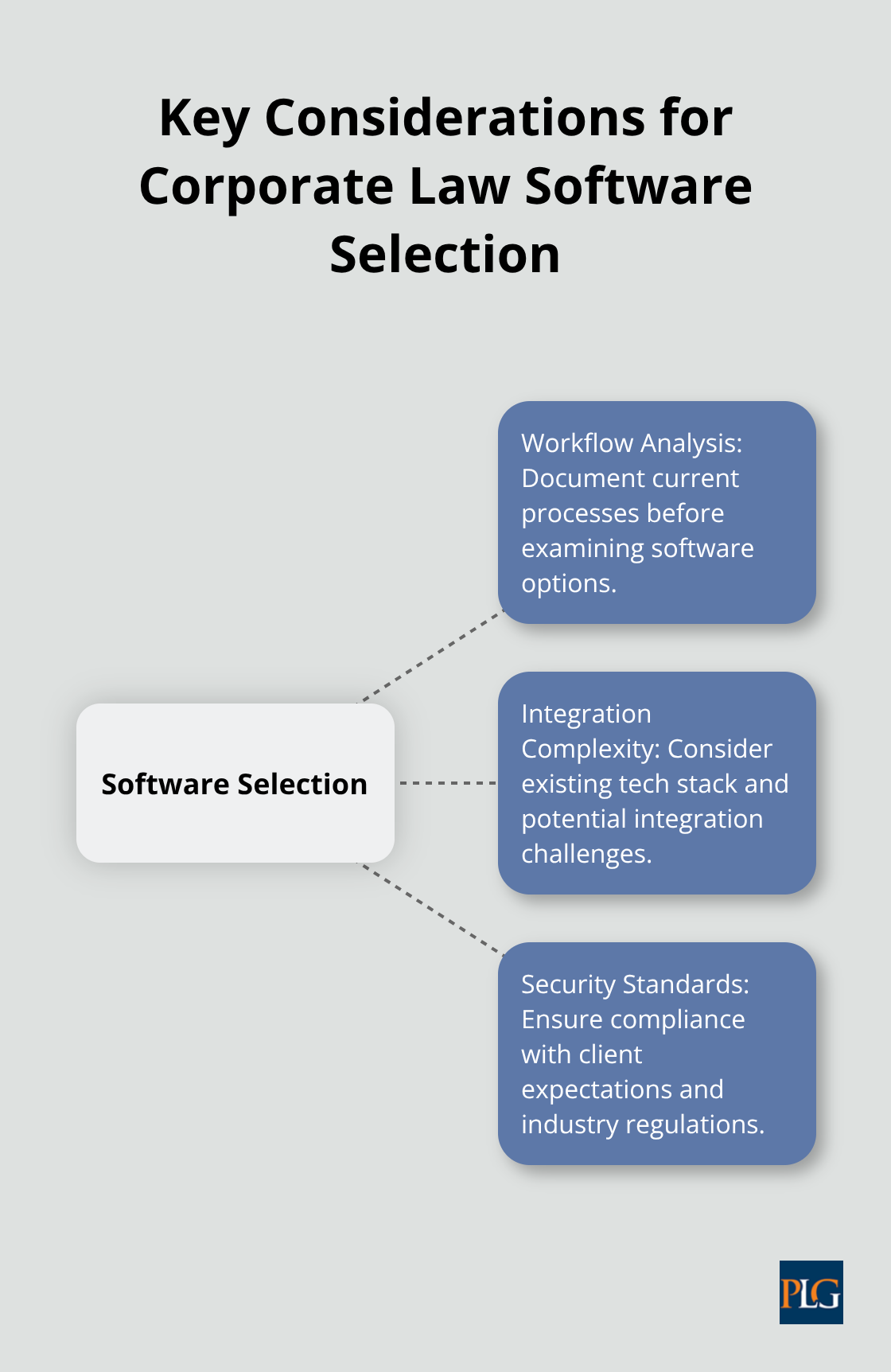
Start With Workflow Analysis Before Budget Planning
Document your firm’s current processes for deal management, client communication, and regulatory compliance before you examine any software options. Thomson Reuters data shows that firms process more than 10 M&A transactions annually need advanced document management capabilities, while smaller practices benefit more from integrated billing and time tracking systems.
Corporate law practices that handle securities compliance require real-time regulatory update features that cost $200-500 monthly per attorney. Firms focused on contract negotiations can operate effectively with basic document collaboration tools priced at $50-100 per user.
The most expensive mistake involves purchase of comprehensive platforms when your practice only uses 30% of available features. Budget allocation should reflect actual usage patterns rather than aspirational feature sets.
Integration Complexity Determines Implementation Success
Existing technology stacks create integration challenges that can derail software adoption within 90 days. Firms that use Microsoft Office 365 find seamless compatibility with platforms like NetDocuments and Clio, while practices built around Google Workspace require different integration approaches.
Legacy accounting systems present the biggest obstacles, as 67% of law firms still use QuickBooks (according to American Bar Association technology surveys). Modern platforms offer API connections, but custom integrations cost $10,000-25,000 for complex workflows.
Single sign-on capabilities reduce password management issues and improve security compliance for corporate clients who demand enterprise-grade access controls.
Security Standards Must Match Client Expectations
Corporate clients increasingly require SOC 2 Type II compliance and bank-level encryption for all legal technology platforms. The cost of data breaches averages $4.45 million according to IBM Security research, which makes security investment non-negotiable for corporate law practices.
Cloud-based solutions offer superior security compared to on-premise systems, but require careful vendor evaluation of data residency, backup procedures, and incident response protocols. Multi-factor authentication becomes mandatory when you handle sensitive corporate transactions.
Platforms without granular permission controls create liability exposure during large deals that involve multiple law firms and corporate teams.
Final Thoughts
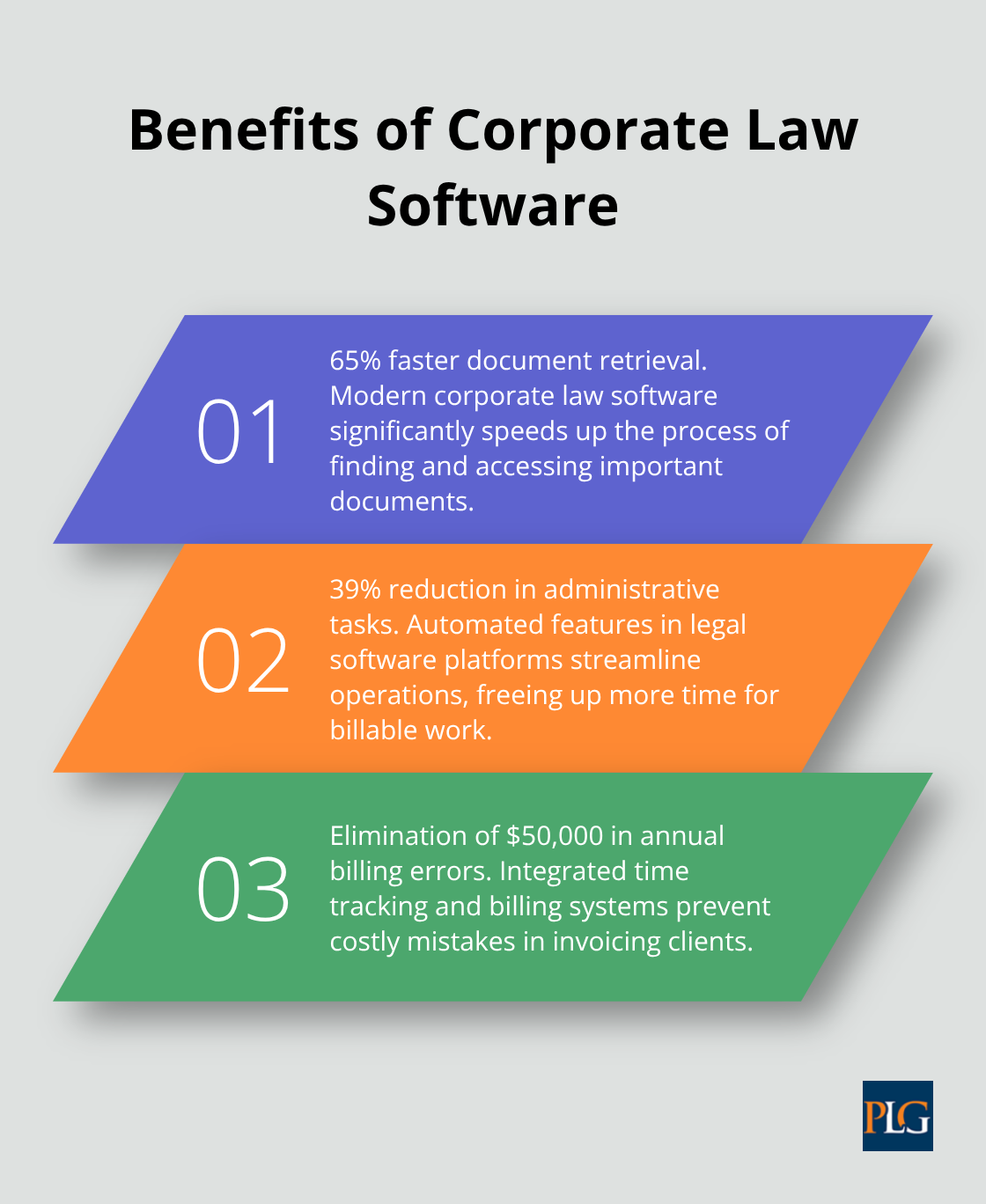
Corporate law software transforms how San Francisco firms handle complex transactions and client relationships. The data shows clear benefits: 65% faster document retrieval, 39% reduction in administrative tasks, and elimination of $50,000 in annual billing errors. These improvements directly impact profitability and client satisfaction in competitive markets.
Technology investment separates leading firms from those who struggle with manual processes. Corporate clients increasingly demand enterprise-grade security and real-time collaboration capabilities that only modern platforms provide. Firms without proper technology infrastructure lose deals to competitors who can process transactions faster and more efficiently.
Implementation success requires careful planning and staff training (start with workflow analysis, evaluate integration requirements, and prioritize security compliance). The most effective approach involves gradual rollout with comprehensive user education rather than immediate full deployment. We at Primum Law Group help startups and investors navigate complex legal challenges with the right technology solutions.