

San Francisco businesses expanding globally face complex challenges that can impact their bottom line. Currency volatility, regulatory differences, and political shifts create significant obstacles for international operations.
Risk in international business management requires proactive planning and strategic thinking. We at Primum Law Group understand these challenges and help companies navigate the legal complexities of global expansion.
What Are the Hidden Risks of Global Operations?
Currency volatility poses the most immediate threat to international business profitability. The US dollar fluctuates 15-20% annually against major currencies according to Federal Reserve data, which eliminates entire profit margins overnight. San Francisco companies that operate internationally should implement forward contracts and maintain 30-40% of working capital as multi-currency reserves.
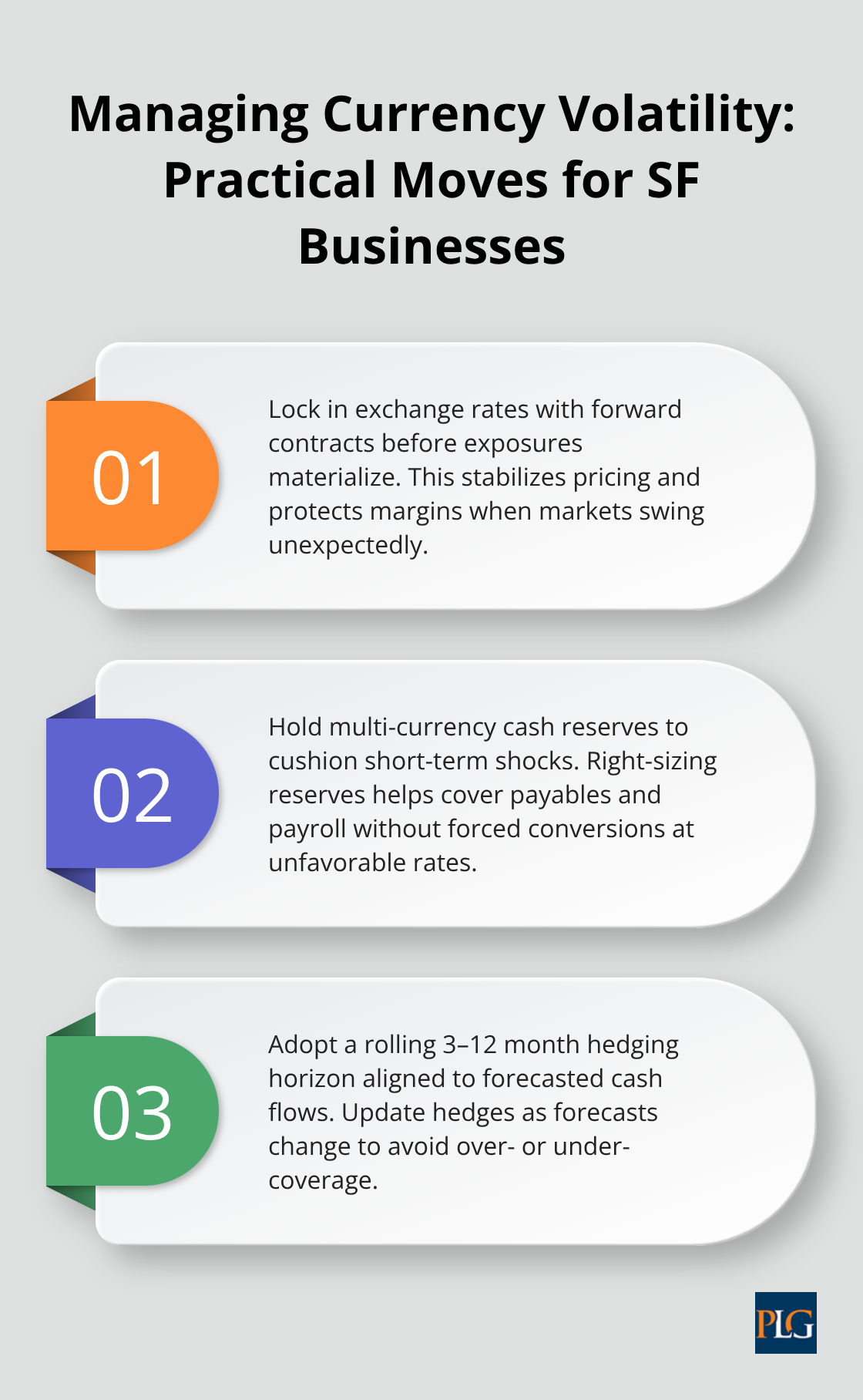
Smart businesses lock in exchange rates 3-12 months ahead through hedging strategies to protect against sudden market shifts that cost millions in unexpected losses.
Regulatory Compliance Creates Operational Nightmares
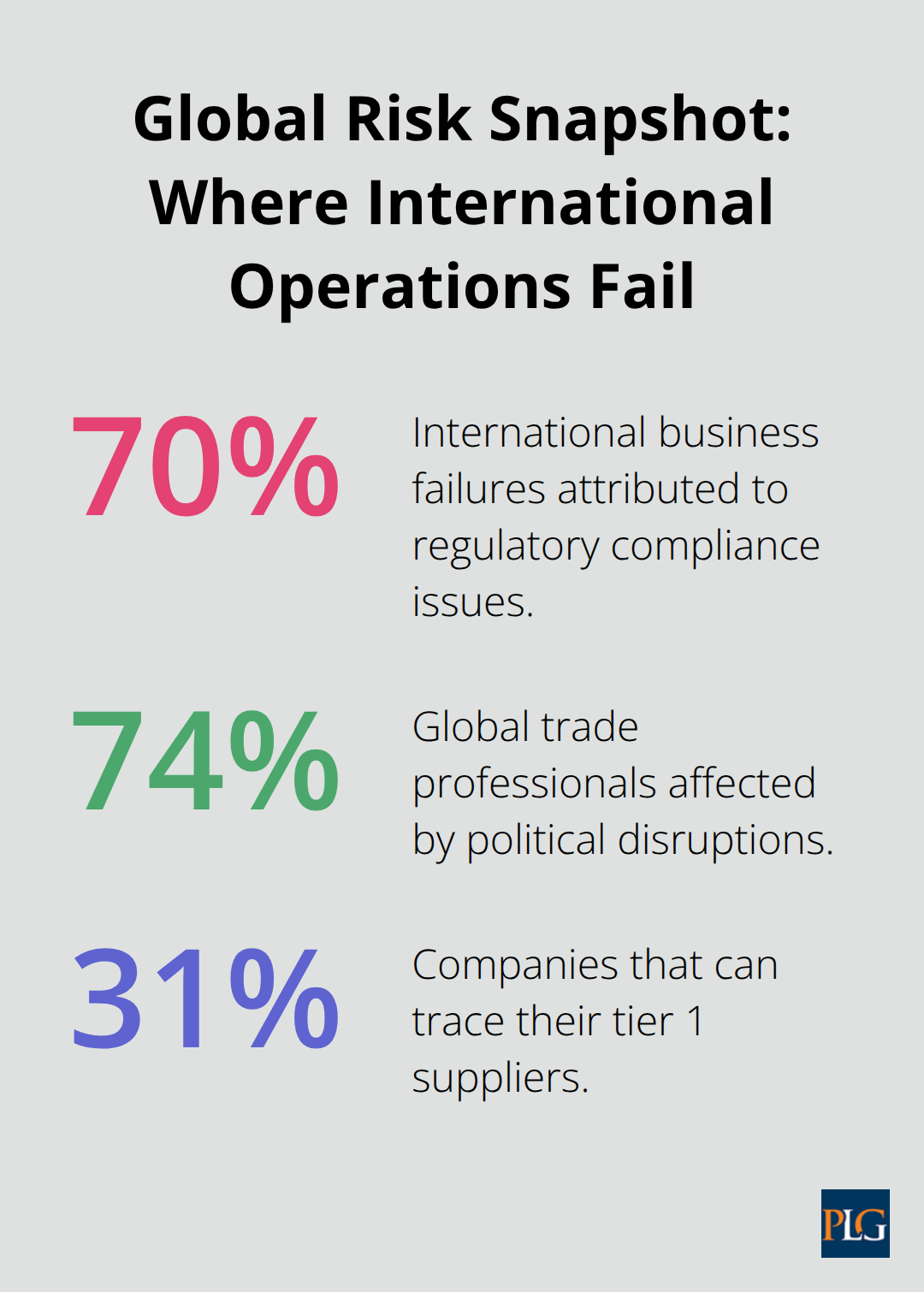
Regulatory compliance issues cause 70% of international business failures according to McKinsey research. San Francisco firms face vastly different legal frameworks across jurisdictions, from the Foreign Account Tax Compliance Act that requires reporting of foreign accounts exceeding $10,000 to transfer pricing regulations with penalties that reach 40% of understated tax amounts. Companies must establish documented compliance frameworks within the first 90 days of expansion rather than retrofit after problems arise. The complexity increases exponentially with each new market, which makes professional legal guidance essential for avoiding costly violations.
Political Shifts Disrupt Supply Chains Instantly
Political instability and trade policy changes create unpredictable operational disruptions that affect 74% of global trade professionals. Retaliatory tariffs particularly impact US and Asia-Pacific businesses due to ongoing trade disputes, while export control laws affect over 52% of international operations. Geopolitical tensions force companies to diversify supply chains rapidly, often at significant cost. Organizations must develop contingency plans that include alternative suppliers and shipping routes to maintain operations when political relationships deteriorate without warning.
Supply Chain Transparency Gaps Expose Legal Vulnerabilities
Only 31% of companies can trace their tier 1 suppliers according to KPMG research, which creates massive compliance blind spots. The International Labour Organization reports that 25 million people globally work in forced labor conditions (with 152 million children in child labor situations per the U.S. Department of Labor). Companies face severe reputational and legal risks when their supply chains involve unethical practices. Organizations must implement blockchain technology and AI-powered risk assessment tools to track products from source to consumer and identify potential violations before they escalate into costly legal battles.
These operational risks require sophisticated assessment frameworks and response strategies that protect your business from financial losses and legal exposure.
How Do You Build Bulletproof Risk Management Systems?
International businesses must implement quantitative risk assessment frameworks that measure exposure across all operational dimensions. San Francisco companies should conduct monthly risk assessments with standardized matrices that evaluate currency exposure, regulatory changes, and supply chain vulnerabilities on a 1-10 scale. Organizations that establish risk thresholds with automatic triggers achieve 40% faster response times when crises emerge.
The framework must include real-time monitoring systems that track key indicators like exchange rate movements that exceed 5%, regulatory announcements in target markets, and supplier performance metrics. Companies should assign dedicated risk officers who report directly to executive leadership and maintain updated risk registers with mitigation strategies for each identified threat.
Financial Protection Through Strategic Hedging
Forward contracts and currency hedging strategies protect profit margins from exchange rate volatility that eliminates business value overnight. SWIFT wire transfers cost $25-50 and take 3-5 business days, while alternatives like Wise Business offer same-day processing for $5-15 (reducing operational costs by 60-70%). Smart organizations maintain multi-currency cash reserves equal to 30-40% of working capital and establish banking relationships in target markets within 90 days of expansion.
Companies should implement comprehensive insurance portfolios that include political risk coverage, cyber liability protection, and trade credit insurance. These financial safeguards create operational stability when market conditions deteriorate rapidly.
Operational Contingency Plans
Successful international operations require documented response protocols that activate within 24 hours of risk trigger events. Organizations must develop alternative supplier networks with pre-negotiated contracts and maintain inventory buffers of 60-90 days for critical components. Companies should establish crisis communication systems with clear escalation procedures and decision-making authority distributed across geographic regions.
Regular stress tests of contingency plans through simulated disruption scenarios identify operational weaknesses before real crises strike. The most resilient businesses update their response protocols quarterly and conduct annual reviews with legal counsel to address evolving regulatory requirements (particularly as international regulations become more complex).
These risk management systems form the foundation for legal compliance frameworks that protect your business across multiple jurisdictions.
What Legal Compliance Traps Destroy International Operations?
Cross-border tax obligations represent the highest regulatory risk for international operations. The Foreign Account Tax Compliance Act mandates strict reports for foreign accounts that exceed $10,000.
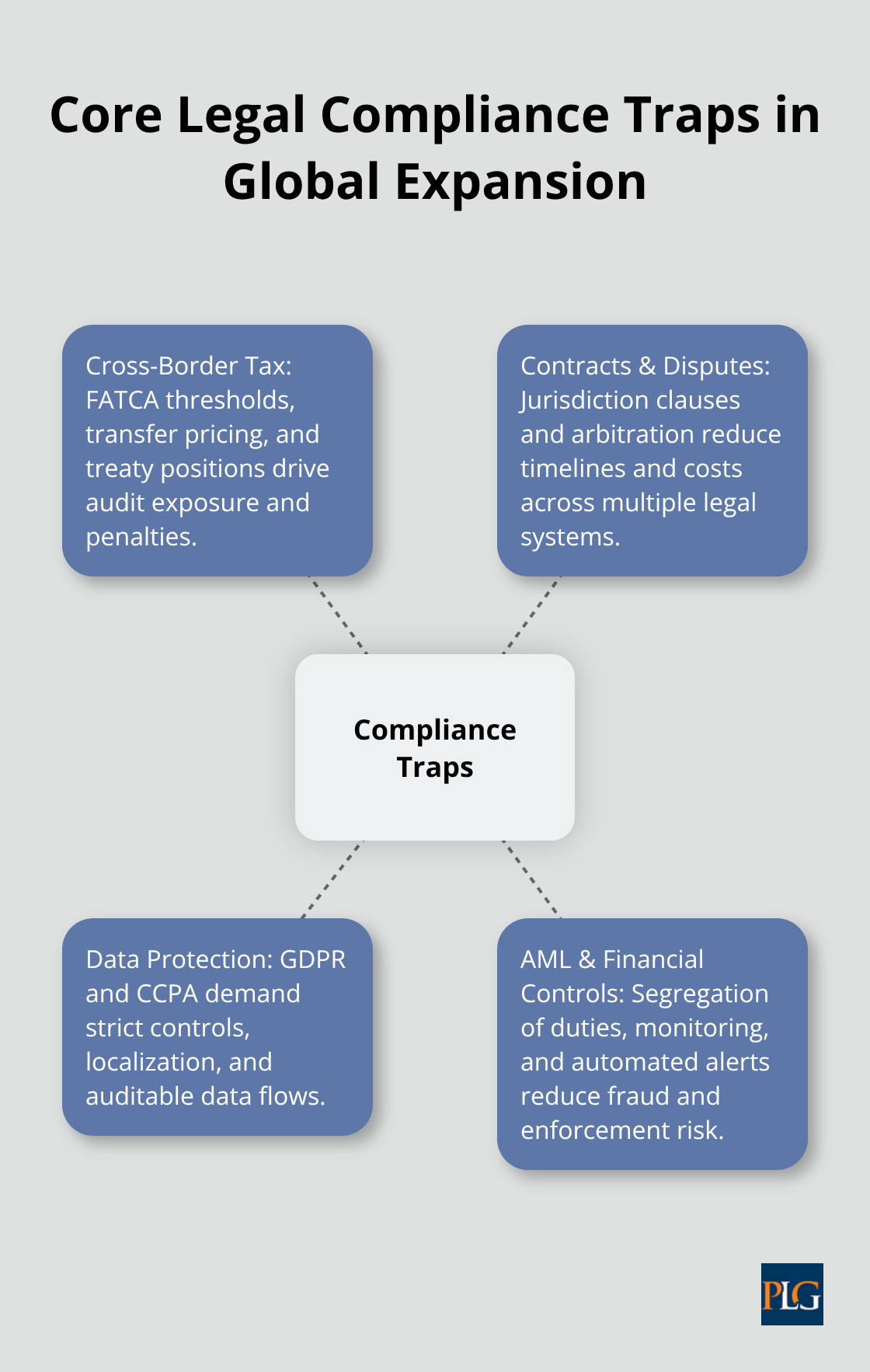
Transfer pricing rules require arm’s length transactions between related entities, with penalties that reach 40% of understated tax amounts (according to U.S. Department of Treasury documentation requirements). Smart organizations establish qualified intermediary status to reduce withholding taxes from 30% to 5-15% through formal tax treaty compliance. Companies must document all related-party transactions meticulously and maintain multi-currency systems that provide real-time financial reports within the first 90 days of expansion.
International Contract Disputes Cost Millions in Legal Fees
International contract law creates complex dispute resolution challenges that vary dramatically across jurisdictions. Documentation discrepancies cause delays that cost 2-3% of transaction value according to International Chamber of Commerce data. Arbitration clauses in international agreements reduce resolution time by 60% compared to traditional litigation. Organizations must establish law clauses that specify jurisdiction for disputes and include mandatory mediation requirements before arbitration. Smart businesses maintain relationships with local legal counsel in each jurisdiction and implement standardized contract templates that comply with multiple legal frameworks simultaneously.
Data Protection Violations Trigger Massive Financial Penalties
Cross-jurisdictional data protection requirements create operational complexity that most companies underestimate. The European Union’s General Data Protection Regulation imposes fines up to 4% of global annual revenue for violations, while California’s Consumer Privacy Act adds additional compliance layers for San Francisco businesses. Organizations must implement data localization strategies that store customer information within specific geographic boundaries and establish comprehensive privacy frameworks that meet the highest standards across all jurisdictions. Companies should conduct quarterly compliance audits and maintain detailed data procedures that track information flows across international operations to prevent costly regulatory violations.
Anti-Money Laundering Compliance Demands Constant Vigilance
The Bank Secrecy Act requires strict reports for transactions over $10,000, while international operations face additional scrutiny from multiple regulatory bodies. Financial institutions monitor cross-border transfers for suspicious activity patterns (with violations that result in severe penalties and operational shutdowns). Companies must establish robust internal controls with segregation of duties to prevent fraud, as average violations cost $1.5 million according to the Association of Certified Fraud Examiners. International businesses face evolving trade agreements and regulatory uncertainty that create new compliance challenges, making centralized financial operations with automated monitoring systems essential to save 40-50% on compliance costs.
Final Thoughts
San Francisco businesses that operate internationally face unprecedented challenges that demand immediate attention and strategic action. Currency volatility fluctuates 15-20% annually, regulatory compliance issues cause 70% of international business failures, and supply chain disruptions affect 74% of global trade professionals. These threats require comprehensive risk management approaches that protect operations and profitability.
Risk in international business management becomes manageable through proactive frameworks that include real-time monitoring systems, financial hedging strategies, and documented contingency plans. Organizations that implement these systems within the first 90 days of expansion achieve 40% faster crisis response times and reduce operational costs by 60-70%. The complexity of cross-border tax obligations, international contract law, and data protection requirements across multiple jurisdictions creates legal vulnerabilities that cost millions in penalties and lost revenue (with violations that can reach 40% of understated tax amounts).
Companies must establish robust compliance frameworks and maintain relationships with qualified legal counsel to navigate these challenges successfully. We at Primum Law Group provide comprehensive legal guidance for international corporate matters and business compliance. Our team helps San Francisco businesses develop risk management systems that protect against financial losses while maintaining operational efficiency across global markets.