

Entering the US market requires navigating a complex web of legal structures, compliance rules, and funding mechanisms. International companies often struggle with choosing the right entity type, understanding state-by-state regulations, and managing federal requirements.
We at Primum Law Group have guided countless international businesses through this process. This guide breaks down the legal pathways you need to know for successful US market entry.
Choosing Your US Entity Structure
The entity type you select determines your tax burden, personal liability protection, and operational flexibility. C-Corporations and LLCs serve fundamentally different purposes, and the wrong choice costs money and creates compliance headaches. International companies often waste tens of thousands annually because they pick an entity structure based on assumptions rather than their actual business model. The decision hinges on three factors: how quickly you plan to raise capital, whether you want to minimize taxes immediately or defer them, and how much operational autonomy you need.
C-Corporations for Venture-Backed Growth
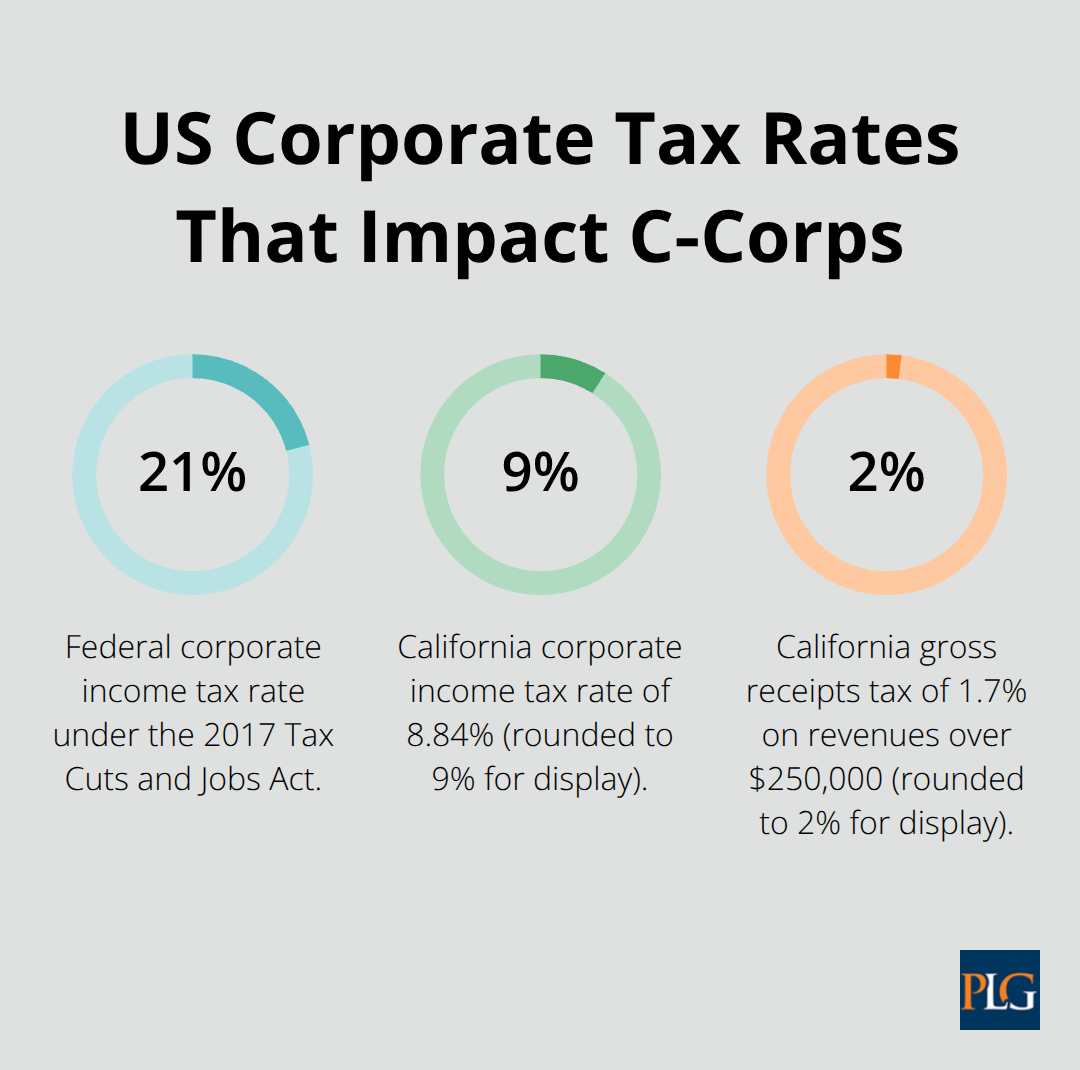
C-Corporations become the only sensible choice if you plan to raise institutional venture capital. VCs require C-Corp structures because they need preferred stock classes, liquidation preferences, and anti-dilution protections that LLCs cannot cleanly accommodate. Delaware C-Corporations dominate this space because Delaware courts have developed extensive case law around corporate governance, and most VC funds have template documents tailored to Delaware structures. The federal corporate tax rate sits at 21% under the 2017 Tax Cuts and Jobs Act, while state taxes vary significantly: California charges 8.84% corporate income tax plus a 1.7% gross receipts tax on revenues over $250,000, making it expensive compared to states like Nevada or Wyoming with no corporate income tax. However, if you incorporate in Delaware while operating in California, you still owe California taxes on income generated there, so the state choice matters less than companies assume.
The real advantage of the C-Corp emerges when you issue stock options to employees without immediate tax consequences, which matters enormously for startups competing for talent. You also gain clean tax treatment for future acquisitions, since buyers prefer acquiring C-Corps because the structure allows for tax-free reorganizations under Section 368 of the Internal Revenue Code.
LLCs for Operational Simplicity and Pass-Through Taxation
LLCs make sense for bootstrapped companies, consulting operations, or businesses without immediate fundraising plans. An LLC taxed as a partnership passes income directly to owners, avoiding the double taxation problem where corporations pay 21% federal tax and then shareholders pay personal income tax on dividends. If you operate as a single-member LLC, the IRS taxes it as a sole proprietorship by default, meaning you file Schedule C on your personal return. Multi-member LLCs file partnership returns, and each member reports their share of profits and losses.
For a San Francisco-based international company generating $500,000 in annual profits, this structure saves roughly $10,500 in federal taxes compared to a C-Corp earning the same amount (assuming a combined federal and state rate of 42%). LLCs also require less formal governance: no board meetings, no annual shareholder votes, no stock option plans. California does impose a minimum $800 annual LLC tax regardless of income, plus a variable fee based on gross revenues that maxes out at $11,790 for businesses with revenues over $250,000.
The Conversion Problem
The downside surfaces when you want to raise capital or sell the company: converting an LLC to a C-Corp for acquisition purposes triggers tax recognition events, and VCs simply will not invest in LLC structures because the math gets complicated with multiple members and pass-through taxation. This structural mismatch means you cannot easily transition from one entity type to another without tax consequences. Understanding these constraints upfront prevents costly restructuring later. Your next decision involves mapping out the compliance and regulatory landscape that applies regardless of which entity you choose.
Compliance Requirements That Actually Matter for International Companies
Federal Trade Commission Enforcement and Marketing Claims
The Federal Trade Commission enforces unfair or deceptive practices under Section 5 of the FTC Act, which means your marketing claims, privacy policies, and data handling practices face real scrutiny. If you make statements about your product that you cannot substantiate, the FTC issues cease-and-desist orders and demands corrective advertising that costs six figures to execute. California’s Business and Professions Code Section 17200 goes further than federal law-it allows private parties to sue for unfair competition, which means your competitors can challenge your business practices directly. International companies underestimate this exposure because their home countries typically lack equivalent private right of action statutes. The practical implication: document every material claim about your product’s performance, safety, or benefits with testing data before you launch. A San Francisco software company claiming their tool reduces customer churn by 40% needs third-party validation or internal case studies from named clients, not theoretical projections.
California Employment Law: The Strictest Standard
Employment law compliance varies wildly by state, but California imposes the strictest requirements in the country, making it the template you should follow regardless of where you operate. California requires meal and rest breaks totaling five hours per day for eight-hour shifts and classifies most workers as employees rather than independent contractors under the ABC test from Dynamex Operations West Inc. v. Superior Court. The state also mandates transparent salary ranges in job postings under the Equal Pay Act amendments effective 2024. The contractor misclassification risk is severe: misclassifying 50 workers as contractors instead of employees exposes you to back wages, payroll taxes, penalties, and litigation costs exceeding $500,000.
Data Protection and Payment Card Compliance
Data protection adds another layer of obligation that applies across all states. The California Consumer Privacy Act grants residents the right to know what personal data you collect, delete it, and opt out of sales, with civil penalties reaching $2,500 per violation or $7,500 per intentional violation. The federal Health Insurance Portability and Accountability Act applies if you handle health information, imposing breach notification requirements and penalties up to $100 per record. If you handle credit card payments, PCI DSS compliance is mandatory regardless of company size, requiring encrypted transmission, secure storage, and annual third-party audits.
Building Your Compliance Calendar
Start with your specific industry because financial services face SEC and FINRA rules, healthcare companies navigate FDA requirements, and ecommerce businesses must comply with state tax nexus laws that changed dramatically after South Dakota v. Wayfair. Map these deadlines at launch: California salary transparency requirements, EEOC reporting thresholds at 50 employees, and annual privacy policy audits.

The compliance burden is real, but companies that treat it as a cost center rather than a business function typically face penalties that dwarf the cost of getting it right from day one. Once you lock down your compliance framework, the next critical decision involves structuring how you fund and finance your US operations.
Funding Your San Francisco US Entry Without Destroying Your Cap Table
International companies moving to San Francisco face a brutal funding reality: US venture capital operates under completely different rules than most global markets, and the wrong financing structure locks you into obligations that persist for years. Angel investors and venture firms expect specific cap table structures, liquidation preferences, and governance rights that fundamentally reshape your company. Series A rounds typically raise $2 million to $15 million and require you to surrender 15-25% equity while accepting a board seat for the investor, according to data from PitchBook covering 2024-2025 funding trends. Series B rounds follow 18-24 months later, raising $10 million to $50 million while diluting founders another 15-25%. The cumulative effect means founders who raised Series A and B often own 50-60% of their company despite building it from scratch.
How Dilution Compounds Against Founders
A San Francisco software company that raised $3 million in Series A at a $12 million post-money valuation surrendered 25% equity, then raised $15 million in Series B at an $80 million post-money valuation, diluting their original stake to approximately 56%. The math compounds against you unless you structure your financing rounds with precision. Most international founders underestimate how quickly their ownership percentage shrinks across multiple rounds. The practical reality: each funding round reduces your control and your eventual proceeds from an exit, making the terms of each round matter far more than the headline valuation.
Venture Capital Control Mechanisms and Anti-Dilution Traps
Venture capital firms impose control mechanisms that international founders frequently underestimate. Standard US term sheets include anti-dilution protection, meaning if your next funding round values the company lower, earlier investors automatically receive additional shares at no cost. This protection destroys later-stage fundraising because it forces you to raise at higher valuations or face massive dilution.
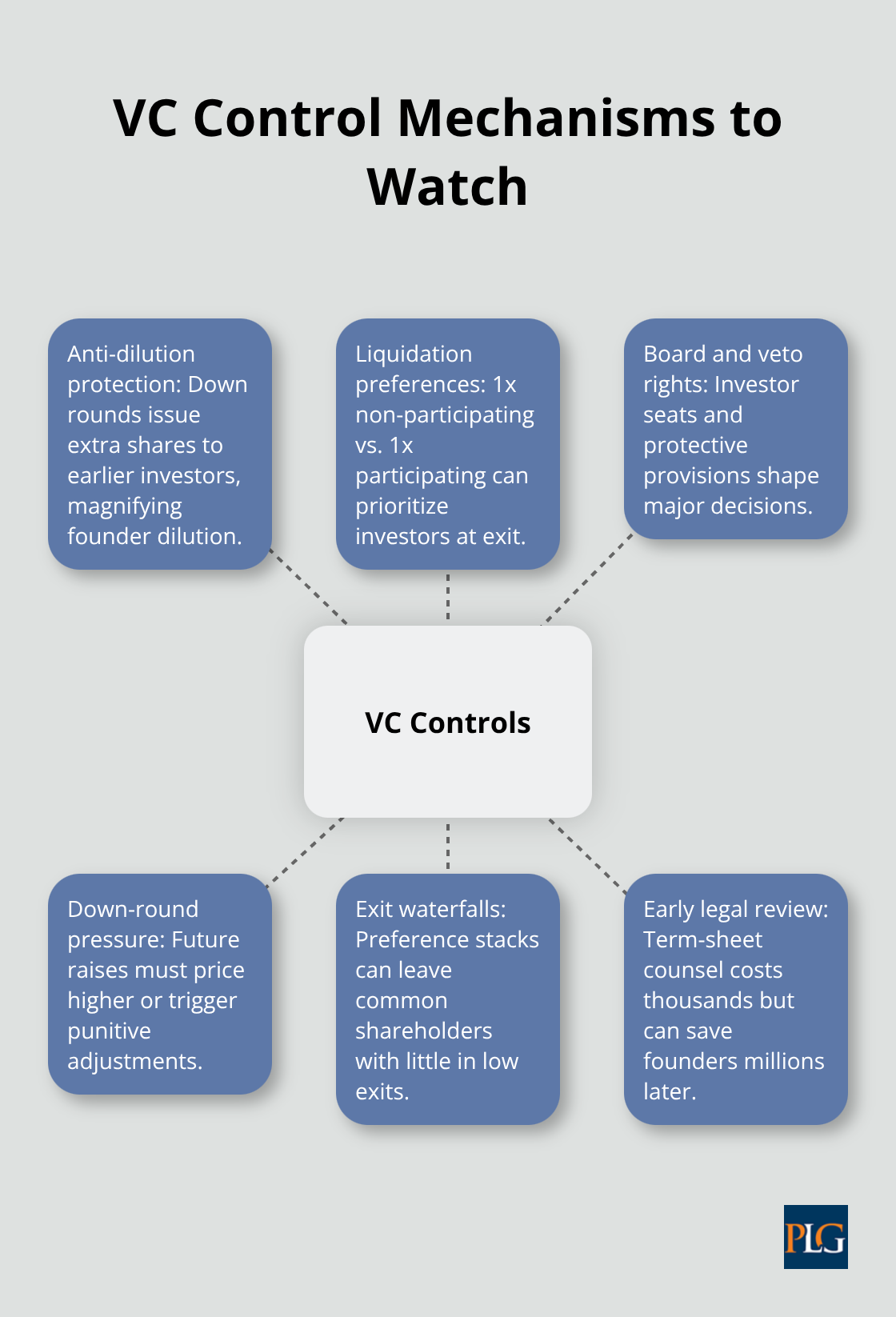
Acquisition structures matter equally: VCs typically demand 1x non-participating preferred stock or 1x participating preferred stock, which determines how proceeds get distributed if you sell the company for less than the investors hoped. A $50 million acquisition sounds substantial until your Series A investor with 1x participating preferred receives $50 million before common shareholders see anything, leaving founders with minimal proceeds despite building the business.
Strategic Acquisitions and Earnout Negotiations
Acquisition by a strategic buyer (another software company, for example) typically involves earnouts where you receive payments over 2-3 years based on hitting revenue targets, creating extended financial obligation. International companies often lack experience with earnout negotiations and accept unfavorable terms because they want speed to exit. The practical move involves hiring counsel before you talk to any investor, not after you have a term sheet. The cost of proper legal review at term sheet stage runs $5,000-$15,000, which sounds expensive until you realize a badly negotiated anti-dilution clause or liquidation preference can cost founders millions in a future exit. Beyond cap table mechanics, building a strong team with fair employment contracts protects your business interests and ensures you attract talent aligned with your long-term vision.
Final Thoughts
Entering the US market requires you to coordinate three interconnected decisions: selecting the right legal entity, building a compliance framework that protects your business, and structuring your funding to preserve founder control. International companies that treat these decisions independently face expensive restructuring later, while companies that integrate all three from day one avoid costly mistakes. Your entity choice determines everything downstream-C-Corporations unlock venture capital but impose immediate tax burdens and governance complexity, while LLCs offer simplicity and tax efficiency but close off institutional funding pathways.
Compliance requirements vary dramatically by state and industry, but California’s strict employment law, data protection rules, and FTC enforcement standards apply pressure that forces you to build robust systems regardless of where you operate. Series A and B rounds dilute founders predictably, but anti-dilution clauses and liquidation preferences can eliminate your proceeds entirely in a lower-value exit. The founders who retain meaningful ownership and exit proceeds are the ones who negotiated term sheets carefully before signing anything.
International companies often assume US market entry follows the same playbook as their home country, then discover that California employment law, venture capital term sheets, and tax implications operate under completely different rules. The cost of getting US market entry counsel involved at the beginning runs thousands of dollars, while the cost of fixing structural mistakes after the fact runs hundreds of thousands. We at Primum Law Group work with international companies navigating this exact complexity, handling entity selection, compliance frameworks, and venture capital transactions for founders entering the US market.