

Raising venture capital in San Francisco requires understanding how investors think and what they’re looking for. The VC funding process involves multiple stages, each with distinct challenges and opportunities.
We at Primum Law Group have guided countless founders through this journey. This guide walks you through each phase, from crafting your pitch to negotiating your term sheet.
What VCs Actually Look for in Your Startup
VCs in San Francisco don’t evaluate startups based on a single metric. Investors assess three interconnected dimensions simultaneously: whether your market is large enough to generate venture-scale returns, whether your team has the skills and track record to execute, and whether your business model generates profitable unit economics. Getting even one wrong tanks your chances, regardless of how strong the other two look. The 2025 funding landscape shows that AI startups captured over 25% of global VC funding, but only those with clear paths to profitability and measurable traction secured commitments. You must demonstrate strength across all three areas from your first interaction with investors.
Market size determines your funding ceiling
VCs need your addressable market to exceed $1 billion within five years. Anything smaller and the math doesn’t work for them, regardless of how profitable you become. San Francisco Bay Area startups attracted over $63 billion in 2023, but that capital concentrated on companies addressing massive markets. For Series A valuations typically ranging from $15 million to $30 million, you need to show a credible path to capturing 1-3% of a billion-dollar market. This isn’t about being optimistic-it’s about being mathematically sound. If your TAM is $500 million, even a 5% capture rate won’t justify Series B funding at the valuations VCs expect.
Growth potential matters as much as current size. VCs want to see month-over-month growth of 15-20% in your traction metrics, whether that’s revenue, user acquisition, or engagement. If your growth is flat or declining, investors assume you’ve hit a ceiling and move to the next opportunity.
Team composition predicts execution capability
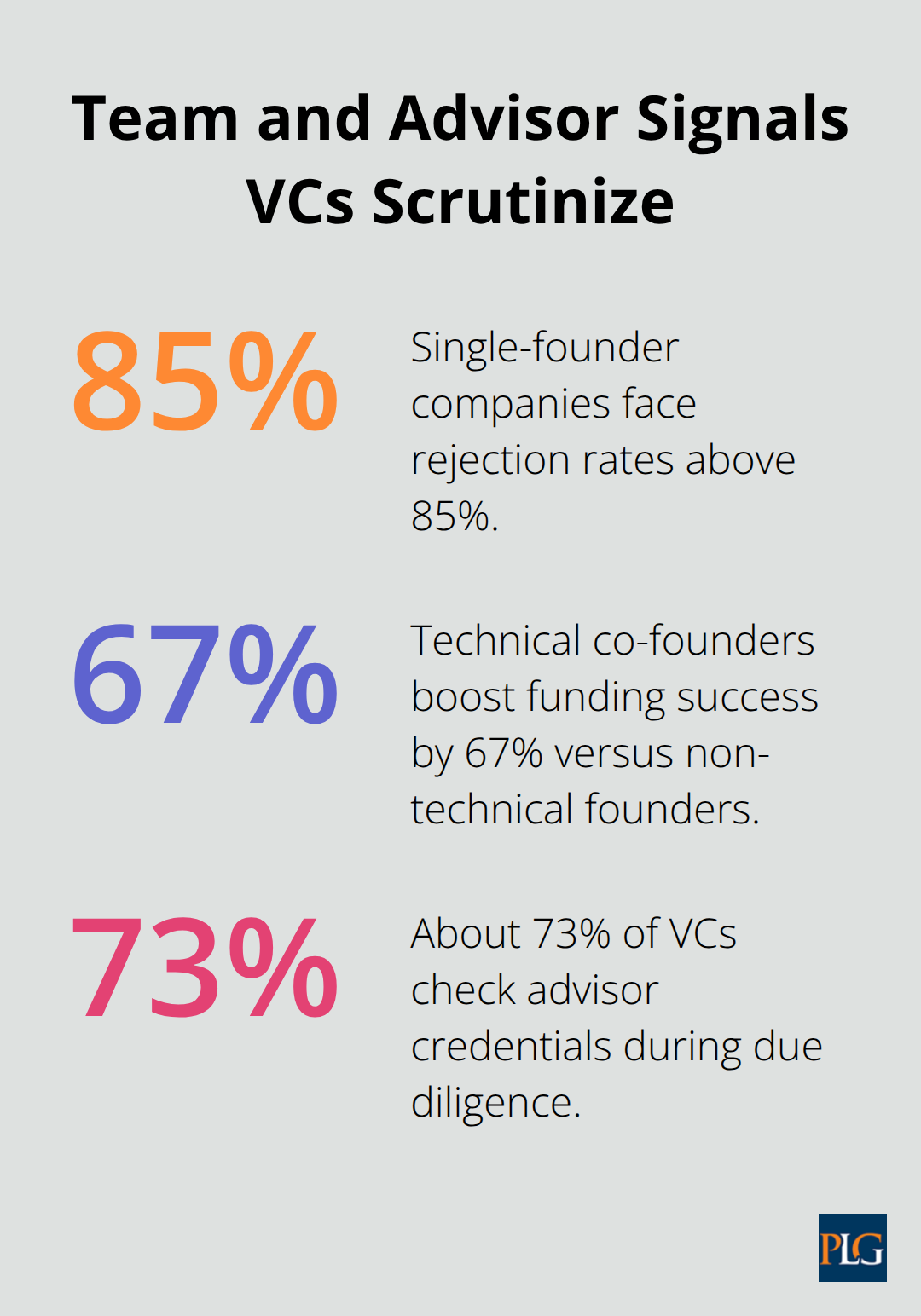
Single-founder companies face rejection rates above 85%. VCs invest in teams, not individuals. Technical co-founders boost funding success by 67% compared to non-technical founders, per First Round Capital research.
If you’re a solo founder without technical depth, you need to demonstrate either that you’ll hire a technical co-founder immediately or that you possess rare domain expertise that compensates.
Teams with complementary skills across technical development, sales, and operations attract higher valuations than teams with gaps. If everyone on your team comes from the same background-all engineers, all business people-investors see single-point-of-failure risk. The quality of your advisory board matters more than you think. About 73% of VCs check advisor credentials during due diligence. An advisor from Salesforce, Google, or another tier-one company signals that experienced operators believe in your vision.
Unit economics reveal whether your business scales profitably
VCs scrutinize customer acquisition cost (CAC) and lifetime value (LTV) relentlessly. If your LTV is only 3x your CAC, you’re operating in a tight margin that doesn’t support venture-scale growth. Try for an LTV that reaches 5x or higher your CAC, and show these numbers explicitly in your pitch materials. About 69% of investors hesitate to fund companies with high net debt to EBITDA ratios, which means your burn rate matters alongside revenue.
If you’re burning $200,000 monthly and generating $50,000 in revenue, you have roughly 10 months of runway. Investors want to see a clear path to cash flow positivity or a specific funding milestone that extends your runway meaningfully. Your financial projections should cover three years with monthly detail for the first year, then quarterly for years two and three. Conservative assumptions perform better than aggressive ones. If you project 200% year-over-year growth but your current growth is 40%, investors assume you’re either inexperienced or dishonest.
Projections must align with your actual performance
You need to demonstrate that your projections align with your historical performance and market conditions. Investors spot inflated forecasts immediately and lose confidence in your judgment. The numbers you present shape how VCs perceive your entire business, so accuracy and realism matter far more than optimism. When you move into pitch preparation, the strength of these three dimensions-market, team, and unit economics-determines whether investors even want to meet with you.
How to Structure Your Pitch and Investor Research
Build a 10-slide deck that tells your story
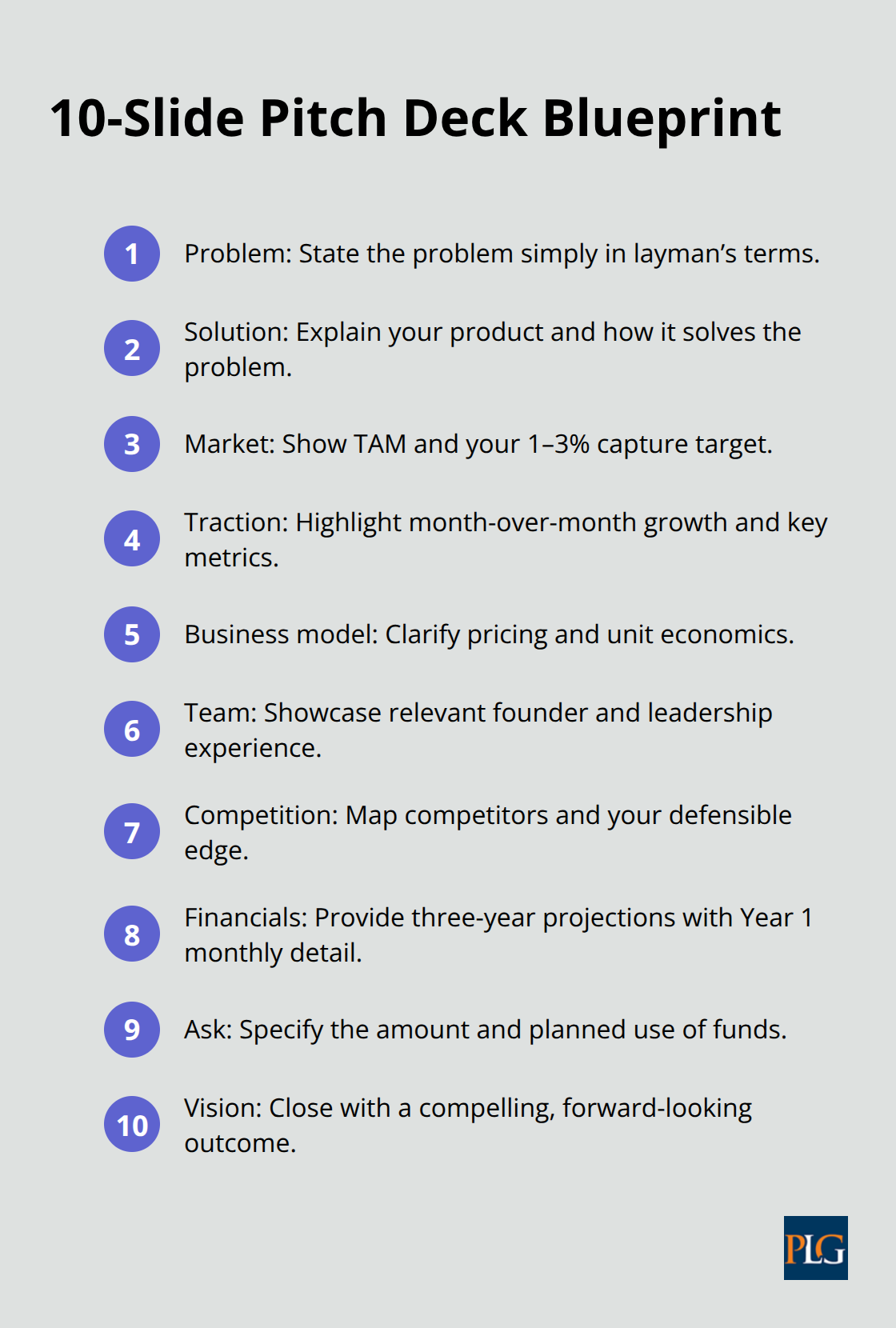
Your pitch deck needs to be exactly 10 slides, no more and no fewer. Investors in San Francisco see hundreds of decks annually, and anything longer signals you don’t understand how to distill your story. Each slide should take roughly 90 seconds to present. Your opening slide covers the problem your startup solves in one sentence that a non-technical person understands. Slide two presents your solution, slide three shows your market size and the 1-3% capture target you calculated, slide four demonstrates traction with month-over-month growth rates, slide five explains your business model and unit economics, slide six introduces your team with relevant backgrounds, slide seven addresses competition honestly, slide eight covers your financial projections for three years, slide nine states your funding ask and how you’ll spend it, and slide ten closes with a forward-looking vision.
The specific order matters because it builds narrative momentum.
Share your deck without demanding an NDA upfront
When you’re ready to share your deck, don’t insist on an NDA beforehand. About 73% of successful seed and Series A rounds begin with warm introductions from mutual connections, and investors won’t take a first call seriously if you’re withholding information. You can request an NDA when you open your data room during due diligence, but at the initial pitch stage, accessibility wins over caution.
Target the right VCs in San Francisco’s three corridors
Your investor research determines which VCs actually fit your business. San Francisco’s VC ecosystem splits into three corridors: Sand Hill Road houses Sequoia Capital and Andreessen Horowitz, SOMA concentrates emerging funds, and Mission Bay hosts tech-focused investors. Newer funds focus heavily on AI and fintech, so your sector shapes which investors to target. Pull recent investments on Crunchbase or PitchBook and identify VCs who funded companies similar to yours within the past 12 months. Target 15-20 VCs actively investing in your space rather than 100 random firms.
Use warm introductions instead of cold outreach
When you reach out, use warm introductions through mutual connections instead of cold email, which yields under 2% response rates according to First Round Capital research. Your initial outreach should condense what you do into 1-2 layman terms, include 3-5 key takeaways highlighting your traction, then offer to share your deck.
Project conservatively and align numbers with reality
Financial projections in your deck should show monthly detail for year one, then quarterly for years two and three. Conservative assumptions outperform aggressive ones every time. If your current growth is 40% year-over-year but you project 200%, investors assume inexperience or dishonesty. Your projections must align with your historical performance and market conditions, not with what you hope to achieve. Once you’ve refined your pitch materials and identified your target investors, the actual pitch meeting becomes your moment to demonstrate that your market, team, and unit economics work together as a cohesive whole.
What Happens When You Get a Term Sheet
A term sheet arrives as a document outlining the investor’s offer to fund your startup. It specifies valuation, liquidation preferences, board composition, anti-dilution provisions, and dozens of other terms that shape your company’s future. Most founders treat term sheets as final documents to sign quickly. This is a mistake. The terms you accept now determine how much equity you retain, what control you exercise, and whether future funding rounds dilute you excessively. You have leverage during term sheet negotiation because investors have already decided to fund you. Once you sign, that leverage disappears.
Understand the core terms before negotiating anything
A typical Series A term sheet in San Francisco includes a valuation (the number determining how much equity the investor receives), a liquidation preference (usually 1x non-participating, meaning investors get their money back first in an exit but participate in remaining proceeds), weighted average anti-dilution protection (protecting investors if you raise future rounds at lower valuations), and board structure with equal founder and investor seats plus one independent member. The liquidation preference matters far more than founders realize. A 2x non-participating preference means the investor gets 2x their investment before founders see anything.
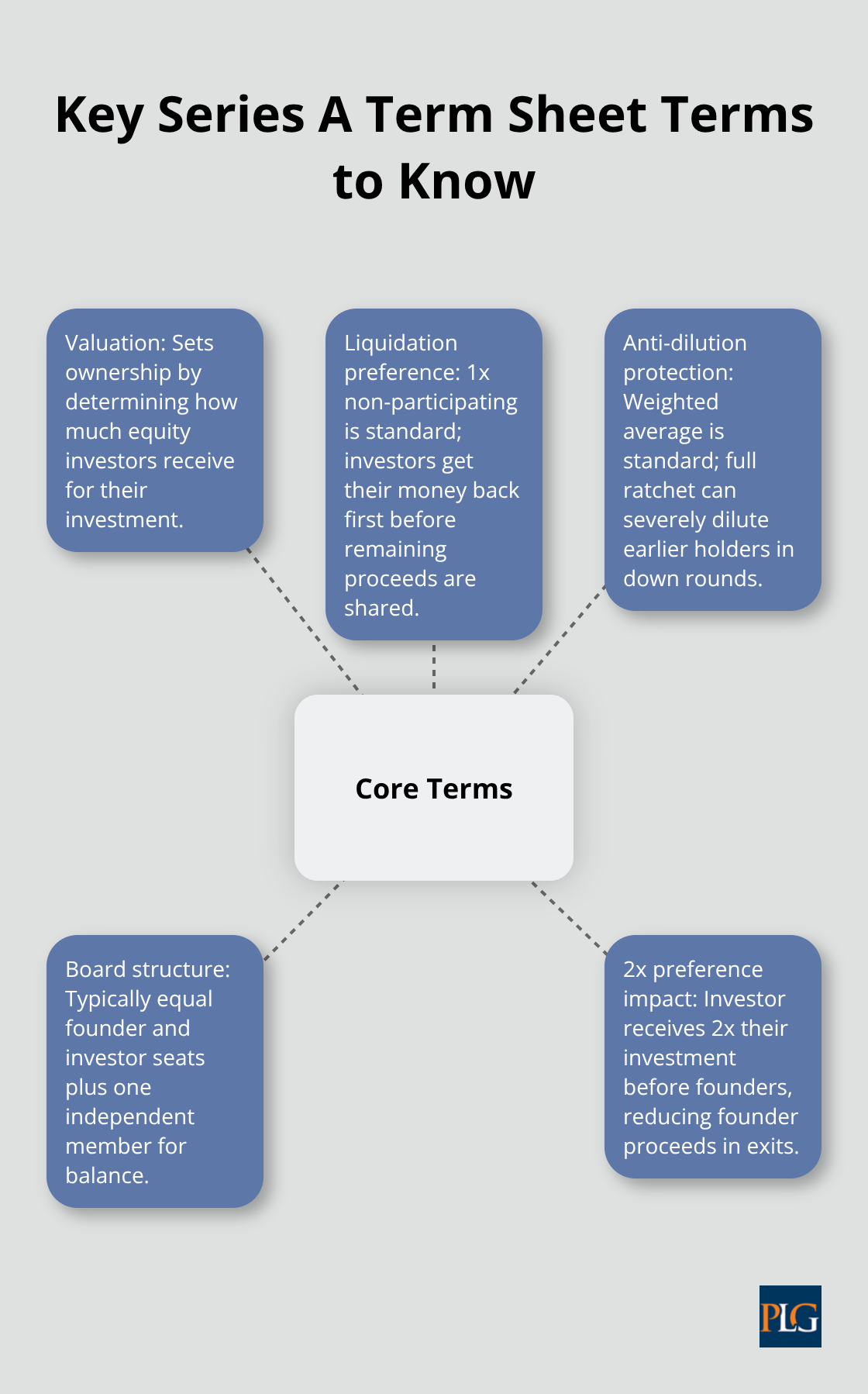
A down round with full ratchet anti-dilution can wipe out earlier investors’ returns and trigger aggressive negotiations that slow your funding.
Ask your investor directly: what liquidation preference are you offering, and is it participating or non-participating? If they hesitate or deflect, that signals problematic terms ahead. The Venture Deals book by Brad Feld and Jason Mendelson remains the definitive resource for understanding term sheet mechanics. Read it before negotiating.
Your valuation determines your dilution percentage. If you raise $5 million at a $20 million post-money valuation, the investor owns 20% and you retain 80%. That same $5 million at a $15 million post-money valuation means the investor owns 33% and you retain 67%. The difference compounds across multiple rounds. A founder who accepts lower valuations early can lose 60-70% equity ownership by Series C, even with strong performance.
Identify red flags in liquidation preferences and anti-dilution
Participating preferences are red flags. These allow investors to get their investment back plus participate in remaining proceeds. A 1x participating preference is aggressive and signals an investor who doesn’t believe in your upside. Most standard Series A deals use 1x non-participating. If an investor pushes for participating preferences, push back hard or walk.
Full ratchet anti-dilution is another red flag. If you raise Series B at a lower valuation, full ratchet reprices all earlier preferred shares downward proportionally, massively diluting founders. Weighted average anti-dilution (the standard) is much fairer. It adjusts earlier share prices based on the weighted average of old and new valuations, limiting dilution while protecting investors.
Pay-to-play provisions force existing investors to participate in future rounds or lose anti-dilution protection. These appeared in 8% of deals in Q1 2024, up from historical levels. A pay-to-play clause can trap you with investors who won’t support follow-on funding but won’t let you raise from others without penalty. Avoid these entirely.
Board composition matters because it determines who controls major decisions. An equal board with one independent seat gives founders meaningful control. A board weighted toward investors (two investor seats, one founder seat) gives investors veto power over hiring, budget, and strategy. Insist on equal founder representation or walk.
Use lawyers strategically and push back on unreasonable terms
Hire a lawyer experienced in venture deals before you negotiate. A good lawyer identifies problematic terms, explains their long-term implications, and gives you language to propose alternatives. Don’t try to negotiate term sheets alone. Investors expect founders to have counsel and often respect the process more when lawyers are involved.
When you receive a term sheet, your lawyer should have you review it within 2-3 days. If the investor pressures you to sign immediately, that’s a warning sign. Legitimate investors give founders time to review with counsel.
If you have competing term sheets, use that leverage explicitly. Tell the leading investor you have other offers and need their best terms to move forward. Competitive tension improves terms significantly. Most founders get 10-15% better economics when they have genuine alternatives. If you only have one term sheet, don’t lie about alternatives. Investors talk to each other, and dishonesty destroys trust permanently.
Instead, ask your investor what flexibility they have on specific terms. Say something like: we’d like to move forward, but we need weighted average anti-dilution instead of full ratchet. Can you adjust? Many investors will negotiate on specific points if you ask directly.
Focus your negotiation on what matters most
Don’t negotiate every term. Pick 2-3 issues that matter most to your situation. If anti-dilution and board composition are critical, focus there. Don’t fight about minor details like the number of director and officer liability insurance. You’ll lose credibility fighting every point and won’t win the ones that actually matter.
After you sign the term sheet, expect due diligence to continue for 6-12 weeks. Investors still verify your financials, check references, review your technology architecture, and conduct background checks. This period feels grueling but it’s standard. Stay responsive and organized. Prepare a shared document logging all investor questions and your answers to avoid scattered email threads. Rapid responses signal control and reliability, which builds investor confidence during the final weeks before funding closes.
Final Thoughts
The VC funding process from pitch to term sheet demands clarity on three fronts: your market opportunity, your team’s ability to execute, and your unit economics. Founders who excel at all three secure commitments, while those who stumble on any dimension face rejection. Your pitch deck, investor research, and financial projections form the foundation of early conversations, and warm introductions yield dramatically higher response rates than cold email.
When a term sheet arrives, treat it as a negotiation starting point, not a final offer. Liquidation preferences, anti-dilution provisions, and board composition shape your company’s trajectory for years, so your lawyer should review every term before you sign. Competitive tension from multiple offers gives you leverage to improve economics, and 1x non-participating preferences with weighted average anti-dilution represent the standard for Series A deals.
After signing, due diligence continues for 6-12 weeks, and you must stay organized while responding promptly to investor questions. The founders who move fastest through this process combine preparation with decisiveness, and they know their numbers cold before they pitch. We at Primum Law Group help founders navigate venture capital transactions and structure their companies for institutional funding from day one, starting with proper legal groundwork that prevents costly mistakes later.