

Expanding your business across borders demands more than ambition-it requires a solid grasp of global corporate law. Contract enforcement, tax rules, and labor standards shift dramatically from one country to the next, and missteps can cost you millions.
At Primum Law Group, we’ve guided countless companies through these complexities. This guide walks you through the real challenges you’ll face and how to handle them.
How Jurisdictions Shape Your Legal and Tax Obligations
Contract Enforcement Varies Dramatically Across Borders
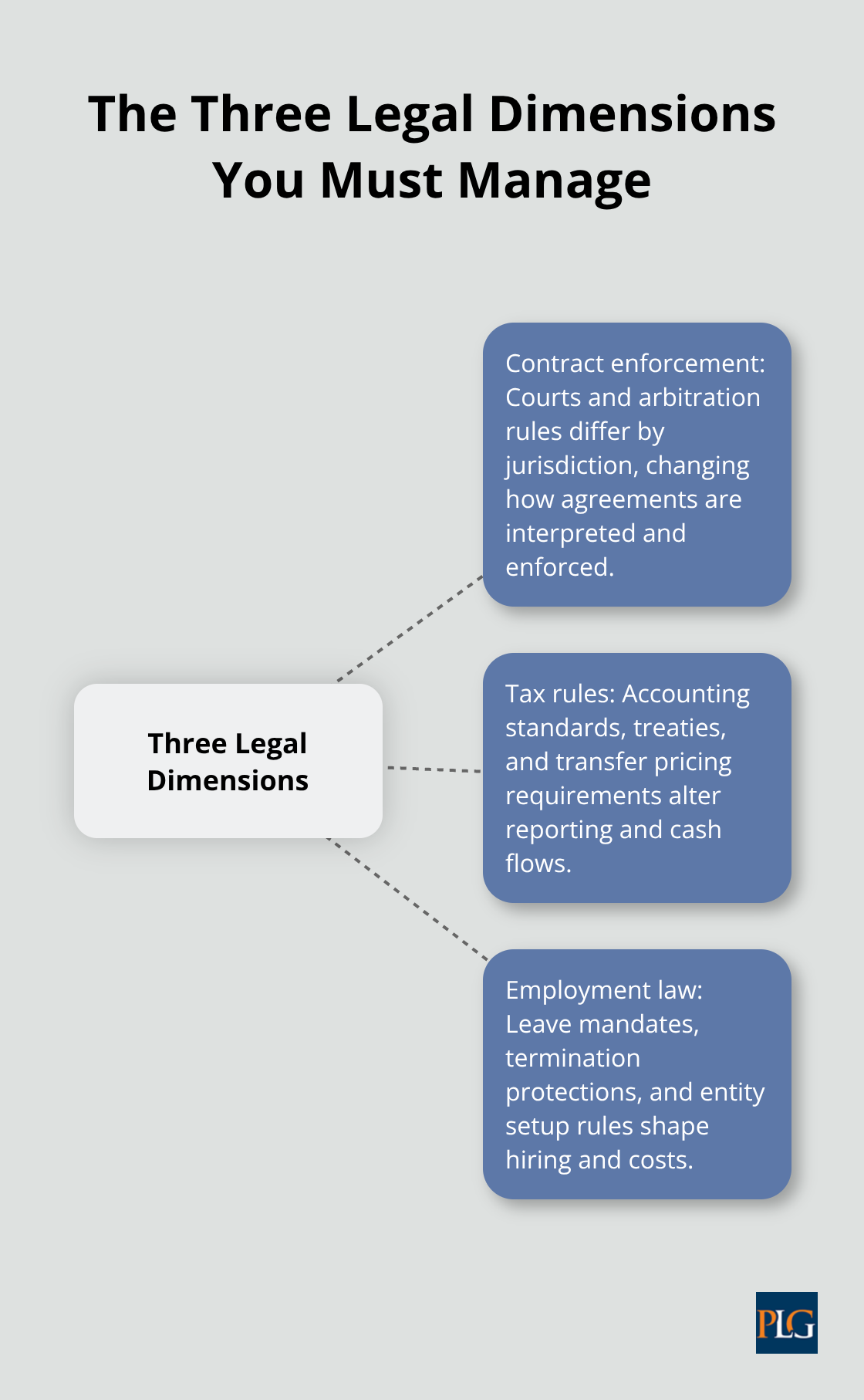
Contract enforcement differs wildly across borders, and this difference alone can derail your expansion plans. In the U.S., courts typically enforce contracts as written, but in many civil law countries like France and Germany, judges hold broader discretion to rewrite terms they deem unfair. The World Bank’s Rule of Law Index ranks contract enforcement from 0 to 1, with Denmark and Norway scoring above 0.9 while countries like Venezuela and Chad score below 0.3. A poorly drafted contract in a low-enforcement jurisdiction may leave you with no recourse if your partner breaches. You need jurisdiction-specific contract language that accounts for local court behavior.
Arbitration under the New York Convention offers more predictable outcomes than litigation in unpredictable courts. Over 170 countries have signed this treaty, making it a reliable option for cross-border disputes. When you enter a new market, your first move should be determining whether you’ll use local courts or international arbitration, then structure your contracts accordingly.
Tax Obligations Create Immediate Reporting Challenges
Tax obligations compound the complexity significantly. While IFRS accounting standards apply in over 140 countries, the U.S. still uses Generally Accepted Accounting Principles, creating immediate reporting differences for any company with both U.S. and international operations. Transfer pricing rules under OECD guidelines require you to price intercompany transactions at arm’s length, and non-compliance carries penalties up to 50% of the adjustment amount in some jurisdictions.
Double taxation treaties exist between countries to prevent you from paying tax twice on the same income, but they’re country-specific. A U.S.-UK treaty differs from a U.S.-Singapore treaty. A posted worker temporarily assigned to the EU faces tax obligations in both their home country and host country unless a tax treaty exempts them, making payroll planning critical.
Employment Law Shifts Dramatically Across Regions
Employment law varies significantly from one jurisdiction to another. The EU requires employers to provide 20 days of paid leave annually as a minimum, while the U.S. has no federal mandate for paid vacation. Wrongful termination protections in Germany are significantly stronger than in at-will employment states, meaning severance costs can spike unexpectedly.
When you hire your first employee abroad, local labor law determines notice periods, severance, benefits, and dispute resolution procedures. Setting up a local legal entity to hire employees can take up to 20 weeks and cost over $20,000 in initial fees and compliance costs. An Employer of Record service offers an alternative-it handles hiring, payroll, taxes, and compliance in the host country while you avoid misclassification risks and accelerate market entry.
Navigating the Three Dimensions Together
These three dimensions (contract enforcement, tax rules, and employment law) operate independently across each jurisdiction you enter. Overlooking any one creates cascading problems that compound as your operations scale. The next section addresses how to structure your international business entity to manage these jurisdictional differences systematically.
Structuring Your International Entity
Subsidiaries vs. Branch Offices: The Foundation of Your Tax Strategy
Setting up abroad means choosing between a subsidiary and a branch office, and this decision locks in your tax liability for years. A subsidiary is a separate legal entity incorporated in the host country, giving you liability protection and potential tax advantages but requiring separate accounting, governance, and compliance. A branch is an extension of your home company with no separate legal status, meaning profits face taxation immediately in your home country while the branch also owes taxes locally, creating double taxation. Most companies expanding into developed markets choose subsidiaries to avoid this trap.
In the U.S., forming a Delaware corporation costs around $500 in filing fees but requires annual compliance and franchise taxes running $300 to $3,000 depending on revenue. The real cost emerges in accounting and legal work to maintain the subsidiary’s separate books and governance. Setting up a local legal entity abroad runs 15 to 20 weeks and costs over $20,000 in initial fees and compliance expenses, according to World Bank data. If you’re entering a market short-term or testing demand, an Employer of Record handles hiring and payroll in the host country without forcing you to incorporate, cutting setup time to weeks instead of months. For long-term operations with significant revenue, a subsidiary almost always wins because it compartmentalizes risk and creates tax planning opportunities.
Double Taxation Treaties and Transfer Pricing Compliance
Double taxation treaties between countries prevent you from paying tax twice on the same income, but they’re highly specific. The U.S. maintains roughly 70 income tax treaties, each with different provisions for dividends, interest, and capital gains. A U.S. company with a subsidiary in France faces different withholding rates than one with a subsidiary in Singapore. France taxes capital gains at roughly 34% including social contributions, Hong Kong imposes zero capital gains tax, and the U.S. generally taxes at 21% federally.
The number 0% seems to be not appropriate for this chart. Please use a different chart type.
Transfer pricing rules under OECD guidelines require you to price transactions between your subsidiary and home company at arm’s length, as if the two were unrelated. The IRS audits transfer pricing aggressively, and penalties for non-compliance reach 50% of the adjustment in some jurisdictions. Many countries now require transfer pricing documentation proving your intercompany prices are defensible, adding compliance cost and complexity.
Foreign Investment Regulations and Ownership Restrictions
Foreign investment regulations layer on additional requirements depending on your sector and the host country. India restricts foreign direct investment in multi-brand retail to 51% ownership maximum. The U.S. screens foreign acquisitions through CFIUS when they touch defense, infrastructure, or sensitive technology. China limits foreign ownership in telecommunications and media. These restrictions mean your subsidiary structure must comply with local ownership caps, often forcing you to partner with a local investor or accept minority control.
Before you incorporate, map the host country’s foreign investment rules, capital repatriation limits, and sector-specific ownership restrictions. Skipping this step means discovering halfway through that you cannot structure the deal as planned, forcing costly restructuring or exit. Once you’ve locked in your entity structure and tax framework, the next challenge surfaces: identifying and vetting the local partners and advisors who will help you navigate regulatory compliance and cultural expectations in your new market.
Common Pitfalls in Cross-Border Transactions
Most companies stumble not because they misunderstand tax law or entity structures, but because they rush partner selection, ignore how business actually operates in their target market, and treat currency risk as an afterthought. Partner choice determines whether you succeed or lose years and millions in a deteriorating relationship. The U.S. Department of Justice FCPA Resource Guide emphasizes that due diligence on partners includes ongoing monitoring for sanctions and anti-corruption compliance, yet most companies conduct a single background check and move forward.
Inadequate Due Diligence on Local Partners
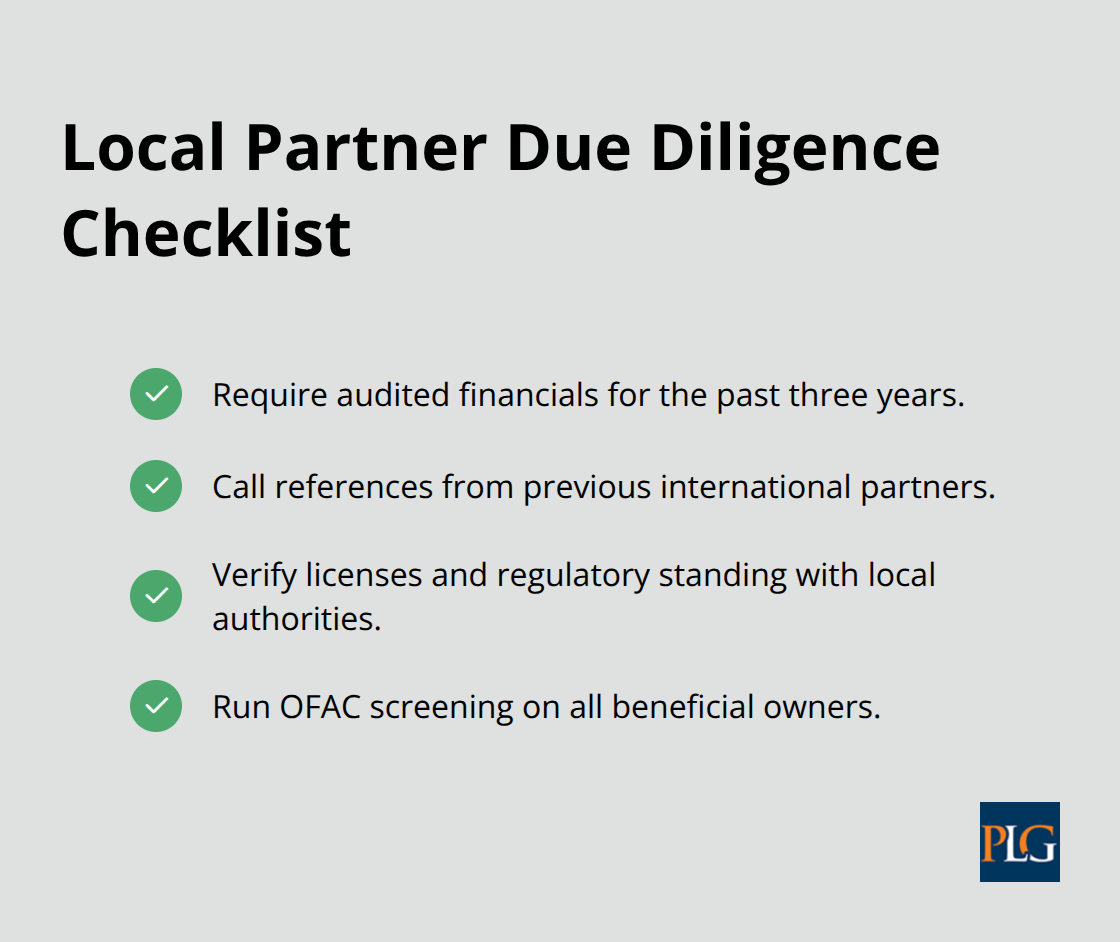
You need to investigate your potential partner’s ownership structure, track record with previous foreign partners, regulatory history, and any ties to sanctioned entities or individuals. A partner with strong local connections but weak governance creates massive liability when they violate export controls, engage in bribery, or mishandle customer data. Set up a formal vetting process: require audited financials for the past three years, conduct reference calls with their previous international partners, verify their licenses and regulatory standing through local authorities, and run OFAC screening against all beneficial owners. This takes weeks but prevents entering a partnership that unravels six months in.
Overlooking Cultural and Regulatory Differences
Cultural and regulatory differences operate simultaneously and create compounding friction if you treat them as separate problems. A decision-making process that works in the U.S. may violate local corporate law or alienate your partner in a relationship-driven market. Research shows that contract interpretation failures often stem from misaligned expectations about how agreements should be applied across different business cultures.
China values consensus and relationship-building before formal agreements; pushing for rapid signatures signals disrespect and damages trust. Germany expects detailed documentation and precise role definitions; vague governance structures create legal exposure and operational paralysis. Southeast Asia often requires decision approval from multiple stakeholders including government liaisons; treating your partner as the sole decision-maker creates delays and frustration. Before you finalize your partnership agreement, map how decisions actually flow in your target market, then structure your governance to reflect reality rather than impose your home-country norms.
Failing to Plan for Currency and Payment Issues
Exchange rate fluctuations between your home currency and the local currency create profit volatility and disputes over who bears the loss when rates move. If you price intercompany payments in USD but your subsidiary earns revenue in local currency, a 20% currency swing wipes out your subsidiary’s profit or forces your subsidiary to pay inflated prices to the parent company, creating transfer pricing audit risk. Set your intercompany pricing in the local currency to match your subsidiary’s revenue stream, then use forward contracts to lock in exchange rates for material cross-border payments.
Document your transfer pricing methodology with reference to OECD guidelines so you can defend your pricing if audited. Payment terms create additional friction: your partner may expect 60-90 day terms while your home company operates on net-30, and remitting profits across borders involves withholding taxes, banking delays, and currency conversion fees that few companies quantify upfront. Before you wire the first payment, establish a payment protocol that specifies currency, timing, withholding tax responsibility, and how you’ll handle currency fluctuations. This prevents disputes mid-year when your partner claims they never agreed to bear currency risk.
Final Thoughts
Cross-border expansion succeeds when you treat global corporate law as an integrated system rather than isolated compliance tasks. Contract enforcement, tax obligations, employment law, entity structure, partner selection, and currency management interact continuously. Overlooking any dimension creates cascading problems that multiply as your operations scale. The companies that expand successfully map their target jurisdiction’s legal framework upfront, structure their entity to minimize tax exposure, conduct rigorous partner due diligence, and plan for currency volatility before they encounter it.
Your immediate priorities demand action across six fronts. Determine your jurisdiction’s contract enforcement standards and decide whether you’ll use local courts or international arbitration. Map tax obligations including transfer pricing rules and double taxation treaties specific to your target country, then research employment law requirements and calculate whether a subsidiary or Employer of Record service fits your timeline and budget. Investigate foreign investment regulations and ownership restrictions that may force partnership or limit control, then vet your potential partner through audited financials, reference calls, regulatory standing checks, and OFAC screening. Align your governance structure with how decisions actually flow in your target market rather than imposing home-country norms.
We at Primum Law Group help companies navigate these complexities through outsourced general counsel, international corporate structuring, and business transactions tailored to your specific market and timeline. Our team coordinates regulatory compliance across multiple jurisdictions, helping you avoid penalties and delays while structuring deals that attract investors and protect your assets. Schedule a consultation to map your target jurisdiction’s requirements and build your expansion strategy.