

San Francisco businesses face complex federal, state, and local tax obligations that require careful navigation. The city’s unique business environment creates additional compliance challenges beyond standard corporate requirements.
We at Primum Law Group have developed this corporate tax law outline to address the most pressing issues facing Bay Area companies. This guide covers essential strategies and compliance requirements that directly impact your bottom line.
What Are San Francisco’s Three Tax Layers?
Federal Corporate Tax Structure
San Francisco corporations pay a 21% federal corporate tax rate on all taxable income, established by the Tax Cuts and Jobs Act. This flat rate applies regardless of income level and makes tax planning more predictable than previous graduated systems. The IRS requires quarterly estimated payments when annual tax liability exceeds $500.
C corporations pay this federal rate on net income, while S corporations pass income through to shareholders who report it on individual returns. The federal government collected $425 billion in corporate taxes during fiscal year 2023 (according to Treasury Department data).
California State Requirements
California imposes an 8.84% corporate tax rate on net income plus a minimum franchise tax of $800 annually. Every corporation that operates in California must pay this $800 minimum even with zero income, though newly incorporated companies receive a first-year exemption if they conduct no business activities.
The California Franchise Tax Board requires annual filings by the 15th day of the third month after the tax year ends. Foreign corporations that conduct business in California must file a Statement and Designation by Foreign Corporation along with a certificate of good standing from their home state. California collected $18.3 billion in corporate taxes in 2023, which represents the state’s second-largest revenue source after personal income taxes.
San Francisco Local Business Taxes
San Francisco levies multiple local taxes that significantly impact corporate operations. The Gross Receipts Tax ranges from 0.075% to 0.65% depending on business type and revenue levels, with technology companies that face rates up to 0.56% on receipts that exceed $25 million.
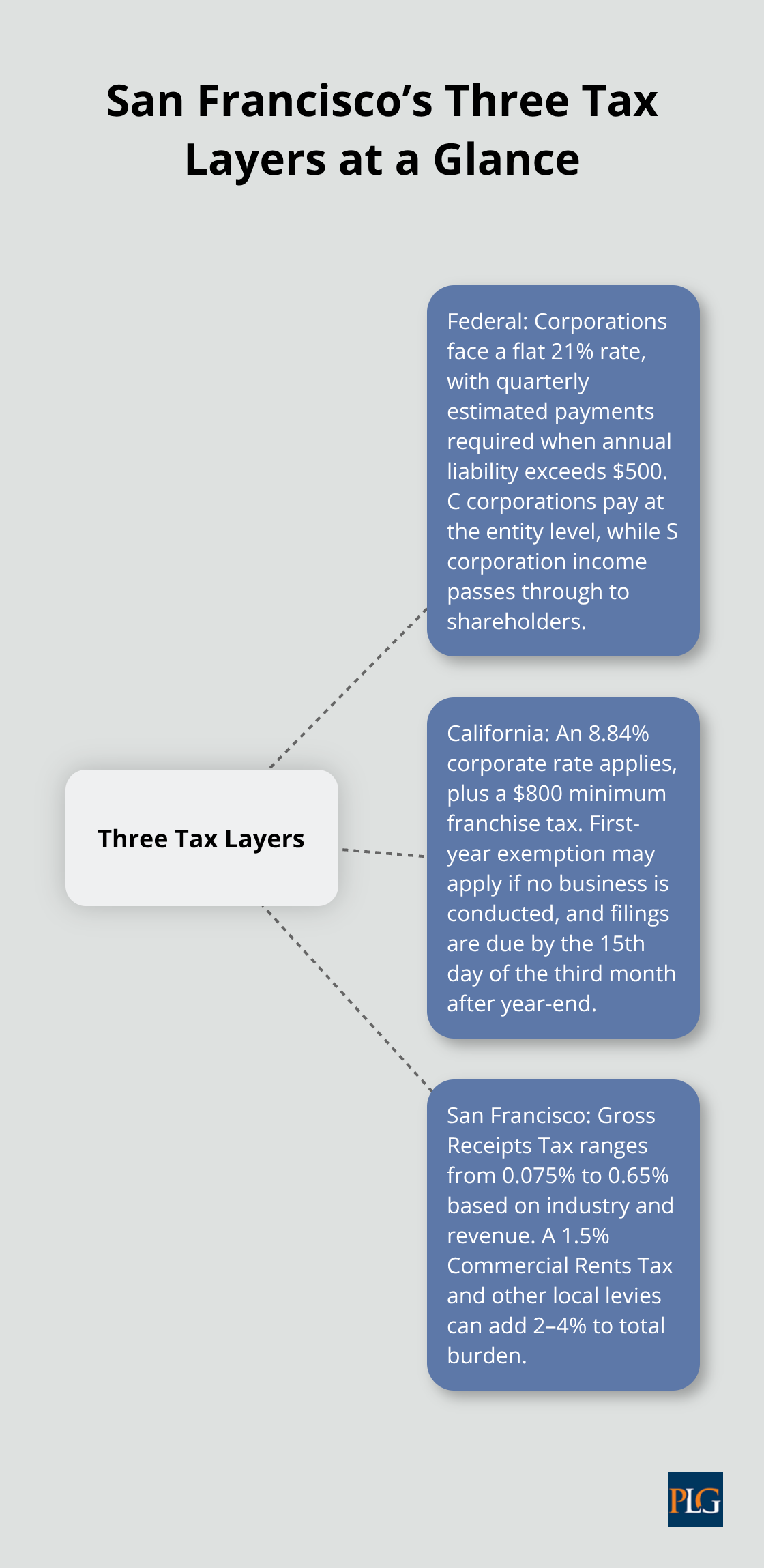
The Commercial Rents Tax adds 1.5% on annual rent payments above $250,000. Additionally, the city imposes an Administrative Office Tax, Payroll Expense Tax for companies with over $2.25 million in annual payroll, and various utility taxes. These combined local taxes can add 2-4% to a corporation’s total tax burden beyond federal and state obligations.
These three tax layers create a complex compliance environment that requires strategic planning to optimize your company’s tax position across all jurisdictions. Companies that operate in San Francisco must navigate California state taxes alongside federal obligations, then layer foreign tax requirements on top.
How Can San Francisco Corporations Optimize Their Tax Strategy?
San Francisco corporations reduce their effective tax rate by 15-20% through strategic plans that target all three tax jurisdictions simultaneously. Startups should immediately elect S corporation status to avoid double taxation during early loss years, while growth companies benefit from income recognition timing and accelerated deductions before they hit higher revenue thresholds.
California Research and Development Credits
California offers more generous R&D incentives than federal programs and allows companies to claim both federal and state credits on the same expenses. The California R&D tax credit provides a 15% credit on qualified research expenses, with unused credits that carry forward indefinitely. The state credit applies to wages paid to research employees, supplies used in qualified research, and 65% of contract research payments.
Companies that conduct software development, biotechnology research, or clean technology innovation typically see the highest returns. The California Franchise Tax Board approved $1.2 billion in R&D credits during 2023, with software companies that claimed 40% of total credits.
Employment Tax Incentives
Technology companies can claim the California New Employment Credit worth $3,000-$5,000 per qualified employee in designated census tracts. This credit targets businesses that hire workers in economically disadvantaged areas and provides immediate tax relief for expansion plans. Companies must maintain employment levels for at least three years to retain full credit benefits.
International Tax Structure Optimization
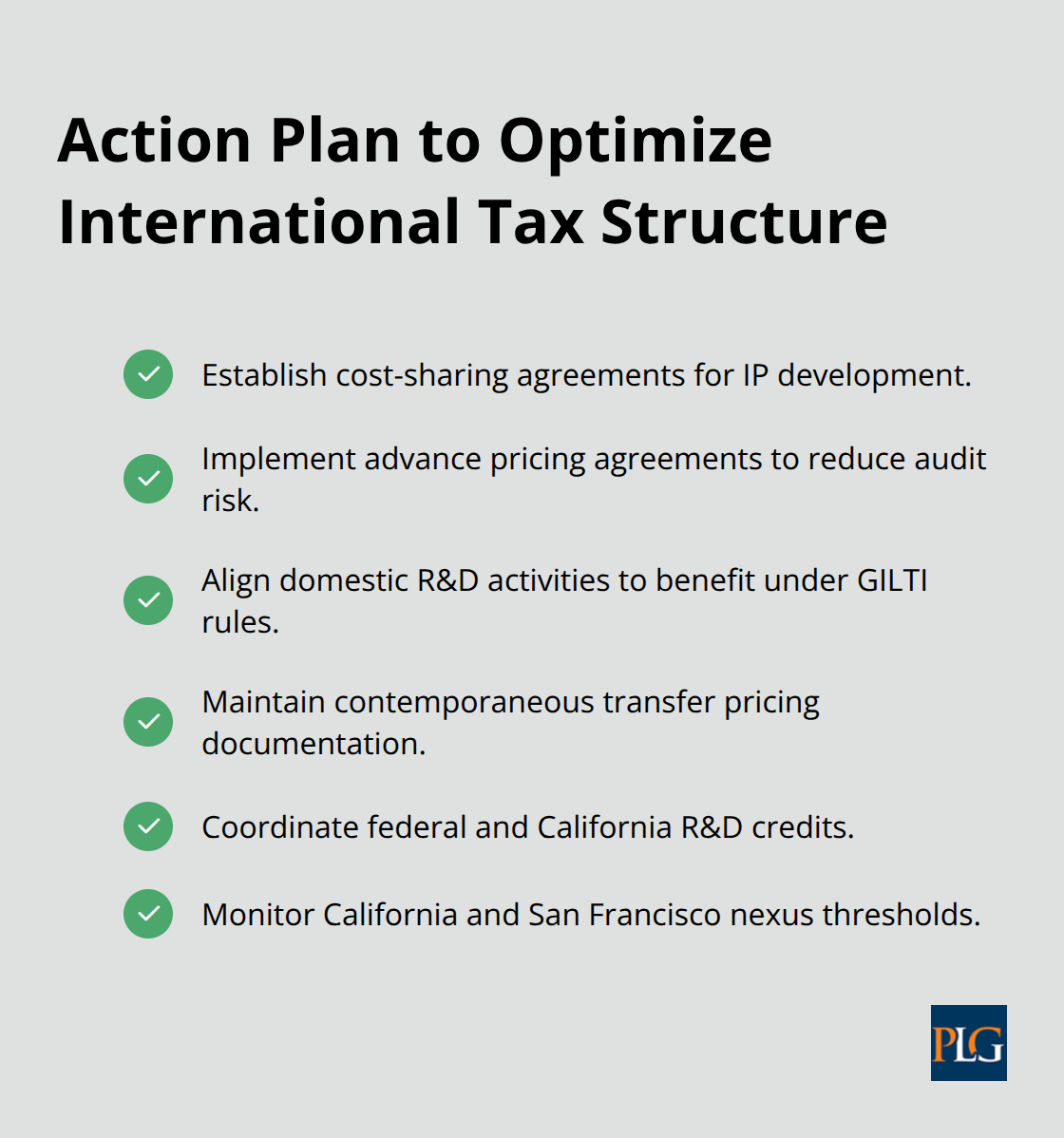
Global operations require careful entity structures to minimize worldwide tax exposure. Transfer pricing documentation becomes mandatory when intercompany transactions exceed $50 million annually, and the IRS imposes penalties up to 40% of underpayments for inadequate documentation (making compliance a high priority for multinational corporations).
Companies should establish cost-sharing agreements for intellectual property development and implement advance pricing agreements to reduce audit risk. The Tax Cuts and Jobs Act created the Global Intangible Low-Taxed Income provision that taxes foreign profits at 10.5%, which makes domestic research activities more attractive than offshore arrangements.
These optimization strategies work best when companies coordinate federal, state, and local tax benefits, but implementation requires careful attention to compliance requirements that can create significant penalties when businesses fail to meet documentation standards. Professional tax law services help navigate these complexities while ensuring full compliance with all regulatory requirements.
What Compliance Traps Catch Most San Francisco Corporations?
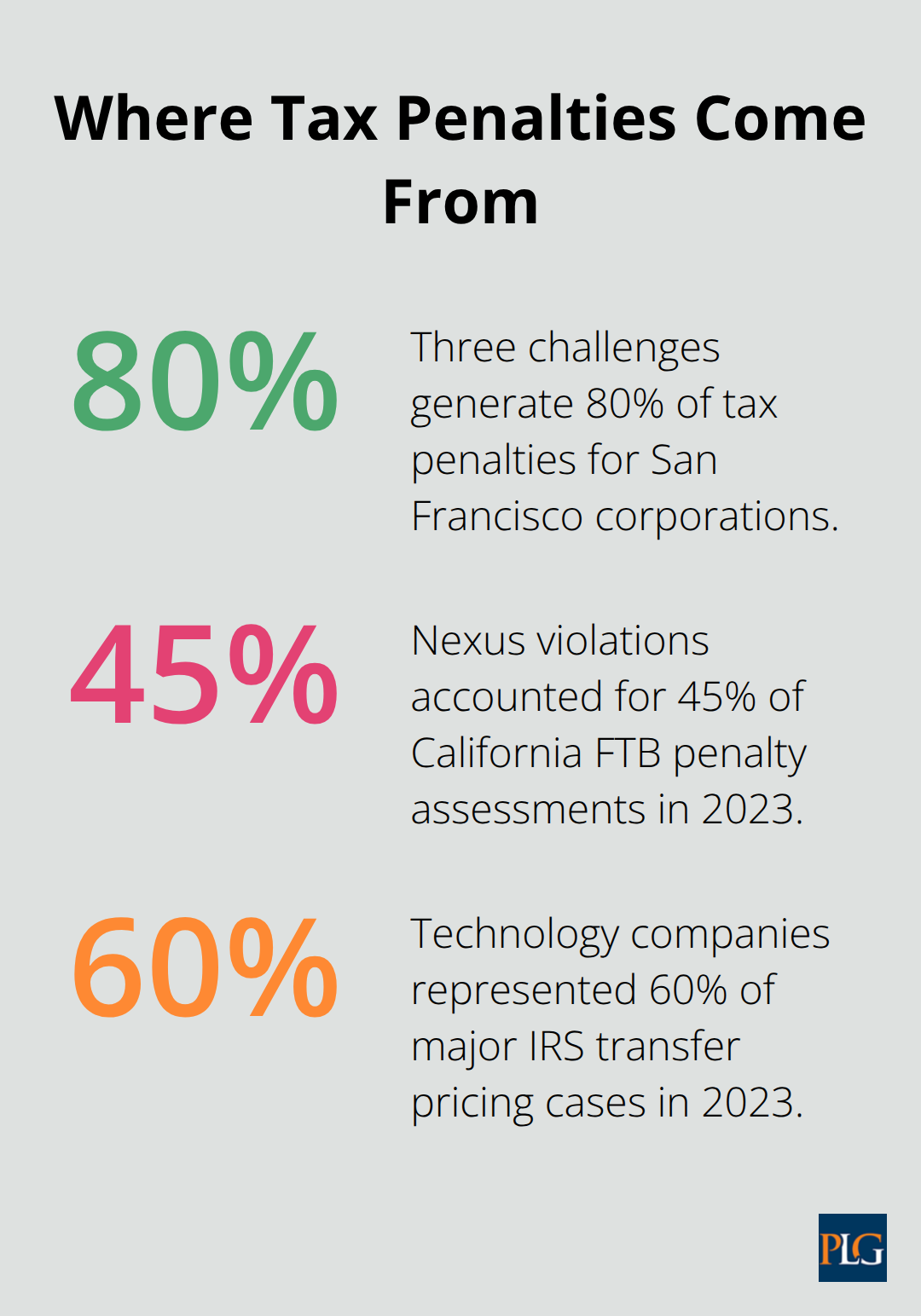
San Francisco corporations face three compliance challenges that generate 80% of tax penalties: nexus determination errors, inadequate transfer pricing documentation, and poor audit preparation. The California Franchise Tax Board issued $347 million in penalties during 2023, with nexus violations that accounted for 45% of total assessments according to their annual enforcement report.
Multi-State Nexus Creates Hidden Tax Obligations
Economic nexus rules now trigger state tax obligations when companies reach $500,000 in annual sales to California customers, regardless of physical presence. The Supreme Court’s Wayfair decision allows states to impose tax collection requirements on remote sellers, and California enforces these thresholds through automated compliance systems.
Companies that sell software, conduct remote services, or maintain cloud infrastructure often create nexus without awareness of their exposure. The Franchise Tax Board cross-references federal tax returns with state sales data to identify non-compliant businesses, and discovery typically results in three-year assessments plus 25% penalties.
Corporations should register for state tax accounts immediately when they approach nexus thresholds rather than wait for enforcement actions. This proactive approach prevents penalty accumulation and demonstrates good faith compliance efforts.
Transfer Pricing Documentation Prevents Massive Penalties
The IRS requires contemporaneous documentation for intercompany transactions that exceed $50 million annually, and inadequate records trigger penalties equal to 20-40% of tax underpayments. Transfer pricing studies must establish arm’s length rates through comparable company analysis, and documentation must exist before tax return deadlines.
Companies that develop intellectual property, provide management services, or conduct intercompany finance need advance agreements to reduce audit risk. The IRS collected $4.7 billion in transfer pricing adjustments during 2023, with technology companies that represented 60% of major cases.
Audit Defense Requires Strategic Preparation
Tax audits demand immediate response protocols and comprehensive record organization. The IRS selects corporations for examination based on return anomalies, industry benchmarks, and random selection processes (with technology companies facing higher scrutiny rates than traditional industries).
Successful audit defense requires complete transaction documentation, clear business purpose explanations, and consistent position maintenance throughout the examination process. Companies should designate audit coordinators, establish document retention policies, and maintain privilege protection through attorney-client relationships when possible.
Final Thoughts
Corporate tax compliance in San Francisco requires businesses to navigate federal rates of 21%, California’s 8.84% corporate tax plus $800 minimum franchise fee, and multiple local taxes that add 2-4% to total burden. This corporate tax law outline shows how three-layer taxation creates complex obligations that demand strategic coordination across all jurisdictions. The compliance challenges we’ve outlined generate millions in penalties annually for unprepared businesses, with California’s Franchise Tax Board collecting $347 million in penalties during 2023.
Most violations stem from inadequate planning rather than intentional non-compliance. Nexus determination errors, transfer pricing documentation gaps, and poor audit preparation account for 80% of tax penalties that San Francisco corporations face. Professional legal guidance becomes essential when companies manage these interconnected requirements (particularly for businesses with multi-state operations or international transactions).
We at Primum Law Group provide comprehensive business legal services that address corporate tax strategy, compliance protocols, and audit defense for San Francisco companies. Your next step involves conducting a comprehensive tax position review that identifies current exposures and optimization opportunities. This proactive approach prevents costly penalties while positions your corporation for sustainable growth within San Francisco’s competitive business environment.