

Bay Area startups face legal challenges that generic national firms simply don’t understand. From navigating Silicon Valley’s investor expectations to protecting your technology, you need a Bay Area startup attorney who knows this ecosystem inside and out.
At Primum Law Group, we’ve built our practice around the specific needs of early-stage companies in this region. This guide walks you through the legal support that actually matters for your growth.
Why Local Legal Knowledge Actually Matters
Silicon Valley’s Unique Investor Expectations
Silicon Valley operates on rules that don’t apply anywhere else. Venture capitalists here expect specific equity structures, investor rights, and liquidation preferences that differ from standard templates used by national firms. San Jose and the surrounding Bay Area attract a major share of U.S. venture capital funding, with this concentration creating a hyperlocal ecosystem where deal terms, investor behaviors, and founder expectations follow patterns unique to the region.
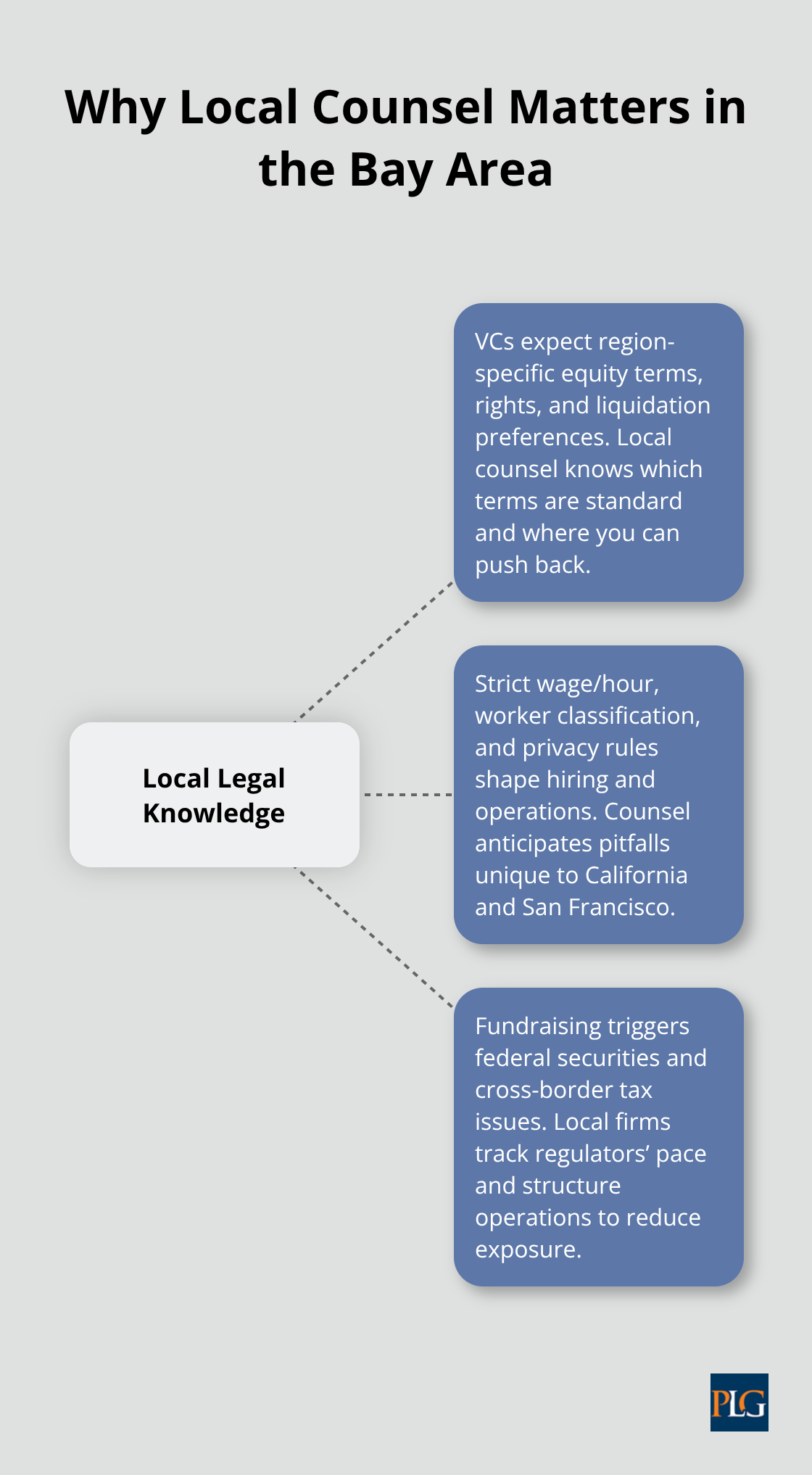
When you work with a firm that understands this environment, you avoid negotiating against yourself. A national firm might draft a standard Series A agreement, but it won’t reflect what local VCs actually demand or where you can hold firm. Local counsel knows exactly where investors will push back and where you retain negotiating room. This knowledge saves you months of back-and-forth and prevents costly mistakes that weaken your position before you’ve even closed a round.
California’s Complex Regulatory Landscape
Regulatory compliance in California operates at a different speed and complexity level than most states. The state imposes strict wage and hour laws, worker classification rules that directly affect gig economy companies, and robust data privacy requirements that intersect with your hiring practices and technology operations.
Bay Area employment law focuses heavily on IP ownership for employee inventions, which matters enormously if your team develops core technology. Beyond employment, you face San Francisco-specific requirements for office leases, environmental reviews for any physical space, and zoning restrictions that can delay real estate deals by months if not handled correctly from the start.
Multi-Level Compliance Demands
Federal securities compliance during fundraising rounds and cross-border tax considerations (if you have international operations) multiply the complexity fast. A local firm tracks these requirements in real time, knows which regulators move slowly and which ones don’t, and structures your operations to avoid the regulatory exposure that trips up companies managed from across the country.
This isn’t theoretical compliance work. The difference between closing your Series A in four months versus nine months often comes down on how early you address these requirements. The same applies to keeping your employee IP agreements enforceable versus watching them fall apart in court. When you move to the next section, you’ll see exactly which legal services address these challenges head-on.
The Three Legal Foundations Every Bay Area Startup Needs
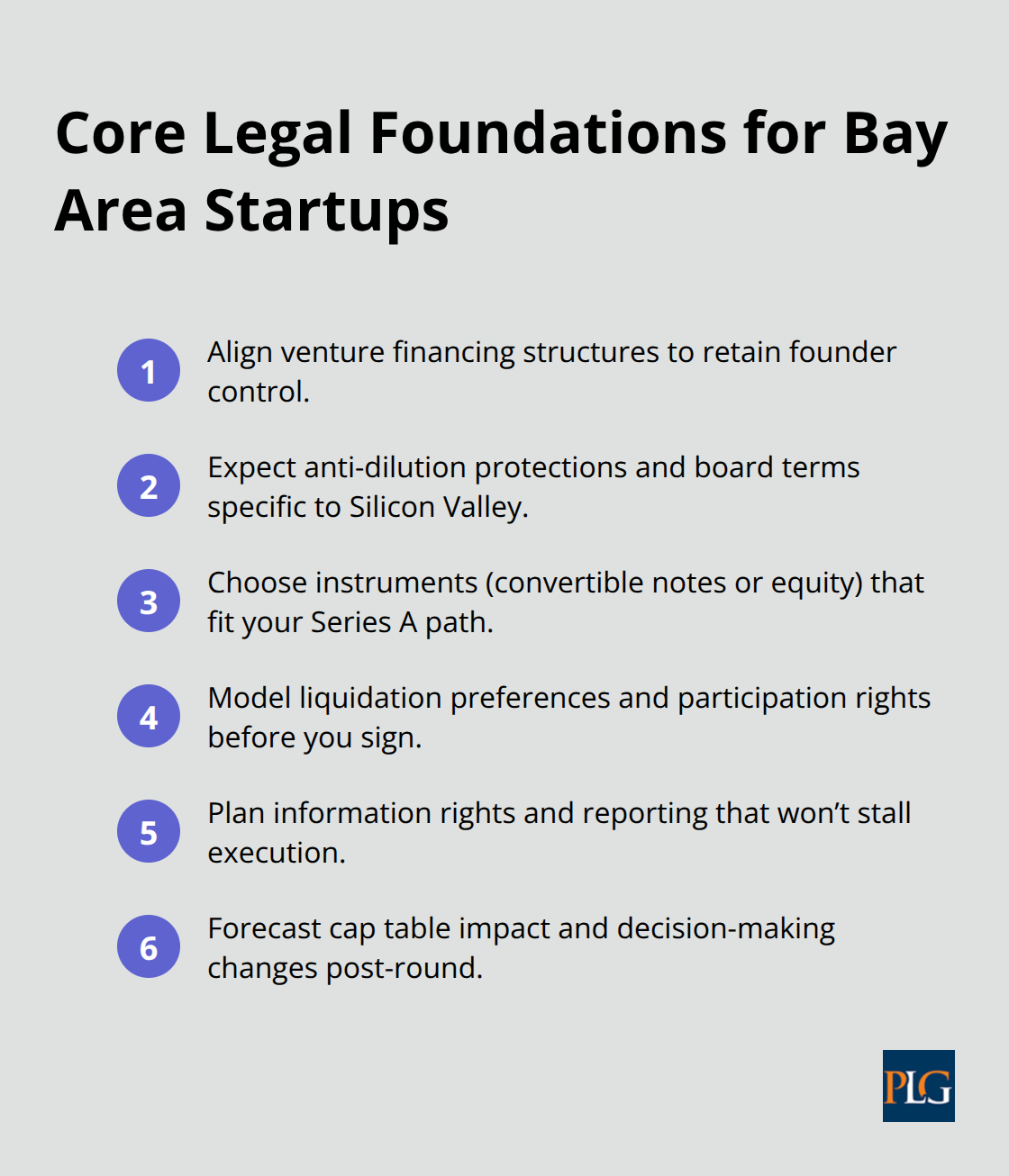
Venture capital funding drives Bay Area startups forward, but the legal structures behind that funding determine whether you retain control or hand it over unknowingly. Silicon Valley investors expect specific equity arrangements, anti-dilution protections, and board composition terms that differ sharply from what founders negotiate in other regions. A Series A round typically involves convertible notes or equity agreements with liquidation preferences, participation rights, and information rights that reshape your cap table and decision-making authority.
Structuring Equity to Protect Founder Control
Local counsel understands exactly how much negotiating room exists with Sand Hill Road investors and where you should push back hard. Founders often accept broad anti-dilution provisions without realizing these clauses trigger automatic equity adjustments in future funding rounds, diluting their ownership stake far more than the new investment warrants. The right legal structure protects your position while keeping your funding timeline on track.
Beyond Series A, employee equity compensation requires separate legal architecture. Stock options and restricted stock units follow Section 409A of the Internal Revenue Code, and mistakes in how you grant, vest, or document these awards create tax liability for your employees and expose the company to IRS penalties. California law adds another layer: employee invention assignment agreements must comply with California Labor Code Section 2870, which restricts what you can claim as company IP if employees develop it outside work hours using their own resources.
Avoiding Equity Documentation Mistakes
Many national firms draft boilerplate equity documents without understanding these California-specific constraints, leaving founders with unenforceable agreements or angry employees. The cost of fixing these problems after the fact far exceeds the investment in getting them right from the start.
Building Your IP Defense Strategy
Intellectual property protection demands the most aggressive legal posture of all three areas. Patents, trademarks, trade secrets, and licensing agreements protect your technology from competitors and signal credibility to investors evaluating your defensibility. Venture-backed tech startups with filed patents attract significantly more follow-on funding than those without documented IP strategies.
Filing patents costs money and takes time, so prioritization matters enormously. Your core algorithms and unique processes deserve patent applications, while your brand name needs trademark registration in the jurisdictions where you operate or plan to expand. Trade secret documentation protects proprietary information through confidentiality agreements, access controls, and proper employee training.
Managing Third-Party Technology and Licensing
Licensing agreements clarify IP ownership when you build on third-party technology, use open-source code, or partner with universities. One misstep-such as integrating unlicensed open-source software into your product without proper attribution or GPL compliance-exposes you to costly litigation or forced product modifications months into development. The legal groundwork you establish now determines how freely you can scale your technology later, which directly impacts your ability to attract investors and partners who evaluate your IP position as part of their due diligence.
Finding the Right Bay Area Startup Attorney
Choosing a startup attorney in the Bay Area requires evaluating three concrete factors that directly impact your legal outcomes and burn rate. First, look for a firm that has closed actual funding rounds with early-stage companies, not just advised on them. Ask potential counsel how many Series A agreements they drafted in the past 24 months, what the average time to close was, and whether they’ve negotiated with specific Sand Hill Road investors your company targets. A firm claiming broad experience but unable to name recent deals or average closing timelines lacks the operational depth you need.
Verify Track Record with Real Funding Rounds
Request references from founders who closed funding within the past 18 months, not just general startup clients. Ask those founders whether the attorney anticipated problems before they arose, how the firm handled scope creep during due diligence, and whether they’d hire the same counsel again. A strong reference describes specific situations where legal advice prevented costly mistakes or accelerated a critical negotiation. Weak references use vague language about being helpful or responsive without concrete examples.
Assess Technology Knowledge and Sector Depth
Second, evaluate whether your attorney understands the specific technology your company builds and the regulatory landscape it operates within. If you’re building AI infrastructure, the attorney should understand data center compliance, export control regulations on semiconductors, and how recent AI liability frameworks affect your product roadmap. If you’re in digital health, they need to know FDA approval pathways and how state-by-state telemedicine regulations impact your market expansion.
Test technology knowledge by presenting a real problem from your business and observing whether the attorney asks clarifying questions that reveal deep understanding or offers surface-level responses. If you’re in fintech and describe your payment processing architecture, the attorney should ask about your banking partner relationships, licensing requirements in specific states, and how your settlement procedures comply with Federal Reserve regulations. If they nod along without questions, they’re applying general startup knowledge rather than sector-specific depth. Generic startup counsel produces generic results.
Compare Fee Structures and Billing Models
Third, compare fee structures honestly. Many Bay Area firms bill hourly rates between $350 and $600 per hour for junior attorneys and $500 to $1,200 for partners, creating misaligned incentives where longer processes benefit the firm, not your company. Retainer-based models or project-based fees for specific work like equity documentation or IP registration force the attorney to work efficiently and finish on schedule.
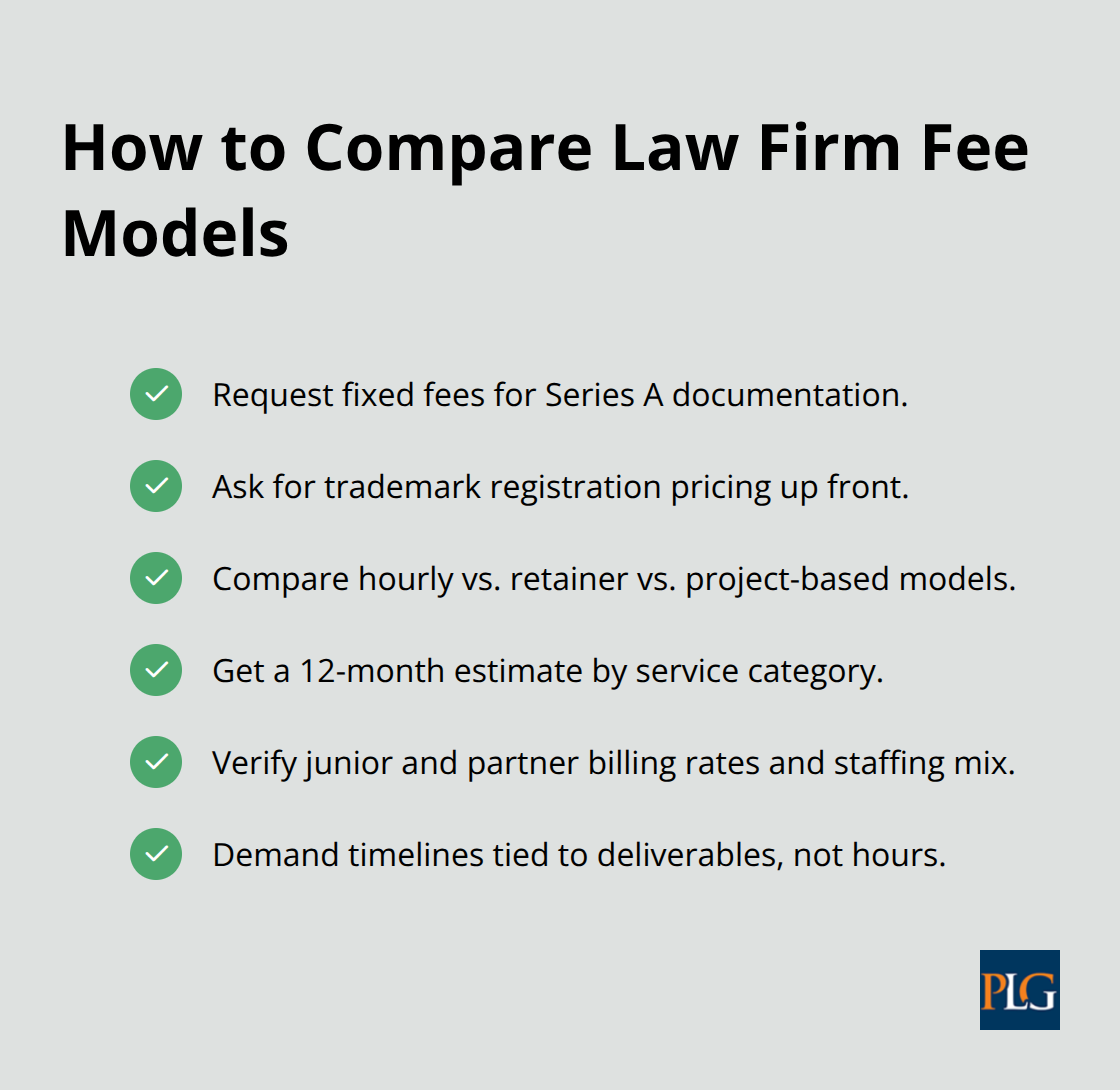
Ask whether the firm offers fixed fees for Series A documentation, trademark registration, or employment agreement packages. Firms that refuse to quote fixed prices often hide inefficiency behind hourly billing. Request a detailed estimate for the next 12 months of legal work, broken down by service category. Compare three firms on identical scopes: Series A preparation, employee equity documentation, trademark registration, and ongoing general counsel support.
Evaluate Value, Not Just Cost
The firm offering the lowest total cost isn’t always the best value if it accomplishes less or requires more founder time. The firm charging the highest fee isn’t automatically the strongest if you can’t articulate why their approach differs meaningfully from competitors. Look for a firm that structures engagement around fixed project costs wherever possible and maintains transparent retainer arrangements that scale with your actual legal needs, not billing hours. Primum Law Group, based in San Francisco and Silicon Valley, takes this approach to align incentives with your company’s success rather than billable hours.
Final Thoughts
Your Bay Area startup’s legal foundation determines whether you scale efficiently or waste months fixing preventable problems. Venture capital structuring, equity compensation, and intellectual property protection form the operational backbone that investors evaluate during due diligence and the framework that protects your technology from competitors. A Bay Area startup attorney who has closed actual funding rounds knows exactly where to negotiate hard and where to concede, saving you months of back-and-forth that drain founder energy and delay growth.
The right legal partnership scales with your company as early-stage needs transform into Series A requirements and beyond. Verify that your potential attorney has closed recent funding rounds with early-stage companies, understands the specific technology and regulatory landscape your business operates within, and structures fees around fixed project costs rather than billable hours. Request references from founders who closed funding in the past 18 months and ask concrete questions about how the attorney anticipated problems before they became expensive.
We at Primum Law Group work with startups, investors, and executives across San Francisco and Silicon Valley, providing outsourced general counsel, venture capital transactions, startup counseling, and business structuring tailored to your specific needs. Contact Primum Law Group to discuss how we can support your growth and build your legal foundation on solid ground.