

Most startups treat legal matters as an afterthought. This approach costs them dearly-through missed investor opportunities, equity disputes, and compliance failures that could have been prevented.
At Primum Law Group, we’ve seen how outsourced general counsel for startups transforms this dynamic. You get experienced legal guidance without the expense of a full-time hire, letting you scale your legal support alongside your business growth.
Why Legal Decisions Early Shape Your Startup’s Future
Most startups treat legal matters as an afterthought. This approach costs them dearly-through missed investor opportunities, equity disputes, and compliance failures that could have been prevented. The first 12 months of a startup determine whether you’ll have a defensible foundation or a legal minefield. Founders who wait until Series A to address cap tables, IP ownership, or employment agreements find themselves starting over. Companies that delayed basic legal work spend 3-6 months in due diligence cleaning up problems that took weeks to create.
The foundation gets built in the first 90 days
Your cap table structure, founder agreements, and IP assignments must lock in before you hire your first employee or take outside money. If two founders disagree on equity splits after six months of work, you’ve already lost months to negotiation and legal fees that could have been avoided with a clear written agreement upfront. Employment agreements matter just as much. Hiring a contractor without a proper services agreement or misclassifying an employee as a 1099 creates liability that compounds monthly. IP ownership is non-negotiable-if your developers don’t have signed assignment agreements, they technically own the code they wrote.
Investors will require clean documentation before writing a check, and fixing this retroactively costs thousands and delays funding. Getting these elements right in month one costs far less than unwinding them in month twelve. A misaligned cap table can kill a deal entirely. Unclear IP assignments mean investors won’t fund you. Misclassified contractors expose you to back taxes and penalties that drain runway.
Investor confidence flows from clean documentation
Investors don’t fund ideas-they fund companies with organized legal structures. Due diligence for Series A or seed rounds typically uncovers cap table errors, missing employment agreements, or unclear IP ownership. When these issues exist, investors either walk away or demand significant discounts to account for cleanup costs. Companies with clean documentation move through due diligence 2-3 times faster and negotiate from strength instead of desperation.
The difference between a founder who spent time on legal fundamentals and one who didn’t often shows up in valuation. A startup with organized corporate records, clear equity splits, and proper IP assignments signals maturity and reduces perceived risk. Investors see a team that understands business basics, not one scrambling to fix preventable problems. This foundation matters because it shapes how investors perceive your entire operation.
What happens when you address legal needs now
Founders who tackle legal structure early avoid the compounding costs of retroactive fixes. Clean cap tables, signed IP assignments, and proper employment agreements take weeks to establish when you start on day one. These same fixes take months and thousands of dollars when you address them during fundraising. The cost difference isn’t marginal-it’s the difference between spending $5,000 upfront and $50,000 in legal fees later.
Outsourced general counsel helps you build this foundation without the overhead of a full-time hire. You get access to experienced legal guidance that understands startup dynamics and can help you structure decisions correctly from the beginning. This approach lets you move faster through fundraising and focus your energy on product and growth instead of legal cleanup.
How Outsourced General Counsel Actually Works
The engagement model matches your actual needs
An outsourced general counsel operates as your remote legal leader, available on a schedule that matches your actual needs rather than a full-time payroll commitment. You don’t hire someone to sit in an office waiting for legal issues to arise. Instead, you engage a lawyer with 10+ years of in-house experience who handles your ongoing matters across formation, contracts, IP, employment, and compliance. The engagement model is flexible: some startups need one day per week, others require full-time coverage for two months during fundraising, then scale back to a few hours monthly. You pay for what you actually use, not for idle time or overhead costs. A typical arrangement costs around $10,000 per month on retainer, though day rates and project-based fees are negotiable depending on your situation. This contrasts sharply with a full-time general counsel, whose total compensation plus overhead runs $350,000 to $500,000 annually, or with fragmented law firms charging $300–$500 per hour for routine work that compounds across multiple vendors.
One point of contact owns your entire legal picture
The practical advantage lies in how an outsourced general counsel operates as a single point of contact who owns your entire legal picture. When contract disputes, employment issues, and IP questions arise simultaneously, your counsel sees the connections across matters and flags risks that siloed external firms would miss. If a specialty issue emerges-say, a complex patent prosecution or venture debt negotiation-your counsel coordinates with outside specialists while maintaining control of the relationship and reducing communication overhead. You avoid the inefficiency of explaining your business to three different firms.
Documentation stays organized through growth
Startups move through due diligence 2–3 times faster when they maintain clean documentation from day one, and an outsourced counsel keeps that documentation organized. The engagement also scales with your growth: as your company expands, your counsel adds capacity or brings in additional resources without forcing you into a full-time hire. This model works best for startups with consistent legal needs but insufficient volume to justify permanent headcount, giving you senior-level guidance and business judgment without the fixed costs or employment overhead.
With this foundation in place, you’re ready to address the specific legal challenges that trip up most startups-from cap table management to IP protection.
Legal Missteps That Drain Startup Runway
Cap table errors cost thousands to fix retroactively
Cap table errors rank among the most expensive mistakes startups make, yet they remain entirely preventable. When founders fail to document equity splits clearly from day one, disputes emerge months later that consume management time and legal fees. A common scenario plays out like this: two co-founders agree verbally on a 50-50 split, but one leaves after eight months expecting acceleration of unvested shares while the other disagrees on the vesting schedule itself. Without a written founder agreement specifying vesting terms, acceleration triggers, and cliff periods, you negotiate under pressure while trying to fundraise.
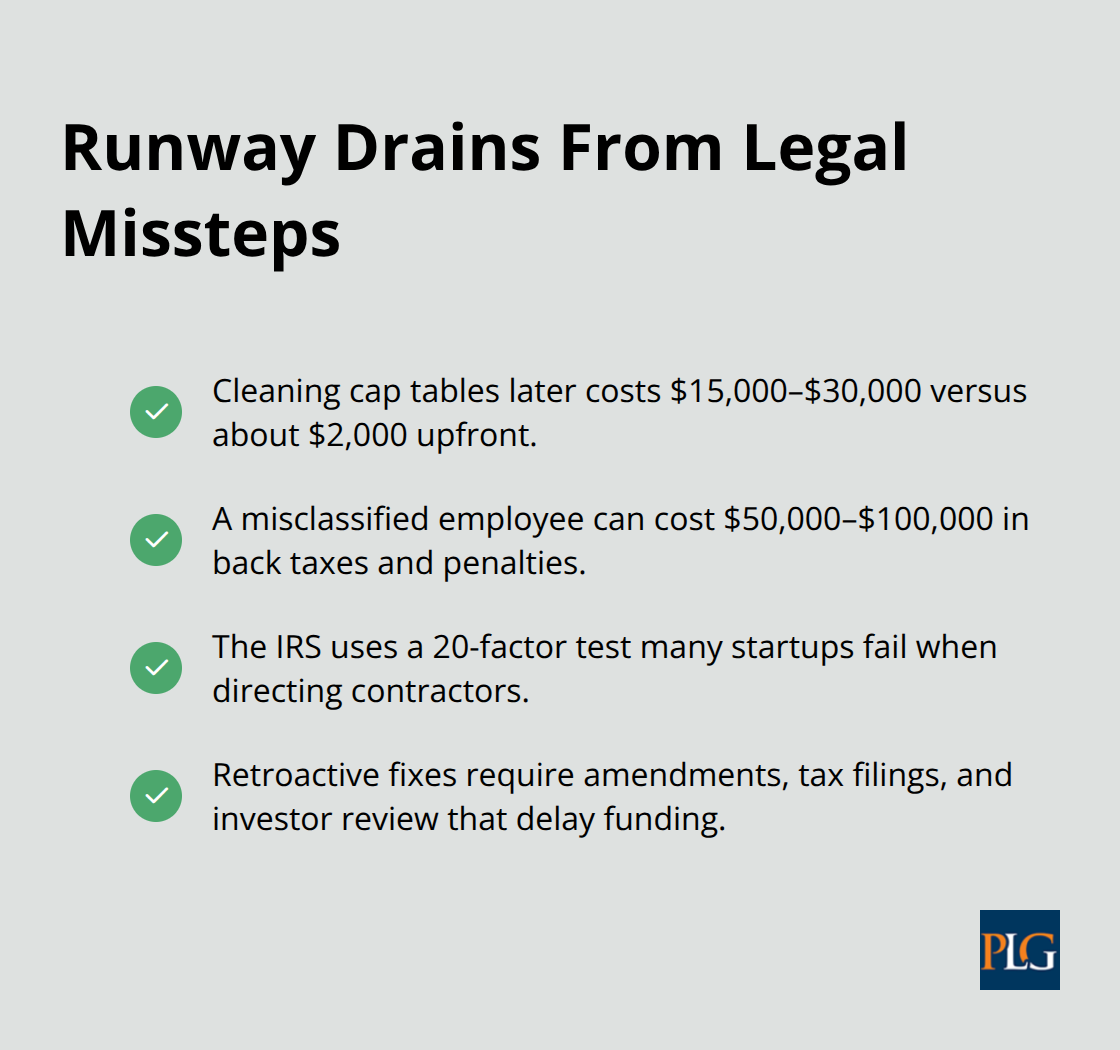
Startups spend $15,000 to $30,000 retroactively cleaning up cap table issues that would have cost $2,000 to structure correctly upfront. The fix requires amendments, potential tax filings, and investor review before any funding closes.
Worker misclassification creates compounding liability
Employment classification errors create similar damage. Misclassifying a full-time developer as a 1099 contractor saves money short-term but exposes you to back payroll taxes, penalties, and wage claims that accumulate monthly. The IRS applies a 20-factor test to determine worker status, and startups routinely fail it by providing tools, training, or direction to contractors who should be employees. A misclassified employee discovered during due diligence costs $50,000 to $100,000 in back taxes and penalties depending on tenure and salary. This liability compounds the longer the misclassification persists.
IP ownership determines your company’s value
IP assignment agreements are non-negotiable because they determine who owns the code, designs, and processes your company depends on. If your first engineer fails to sign an IP assignment agreement before writing a single line of code, they technically own their work product. Investors will not fund a company where ownership of core technology remains unclear, and fixing this retroactively requires signatures from former employees who may demand equity or refuse entirely. The cost of resolving unclear IP ownership often exceeds the cost of preventing it.
Outsourced counsel prevents problems through proactive structure
Outsourced general counsel prevents these problems through proactive structuring and documentation. Your counsel drafts founder agreements that specify equity percentages, vesting schedules, acceleration triggers for departures, and buy-sell provisions before any money changes hands. They prepare employment agreements and contractor agreements that correctly classify workers based on actual working relationships and IRS guidance, reducing audit risk. IP assignment agreements get signed during onboarding, not months later when memory fades and leverage disappears. An outsourced counsel also maintains a cap table that tracks all equity issuances, option grants, and conversions so you have accurate records for due diligence. When investors request cap table details, you provide verified records instead of reconstructing them from email threads.
Your counsel coordinates with your accountant and payroll provider to confirm proper tax withholding and classification, catching misclassification issues before they become liabilities. For startups navigating multiple jurisdictions or hiring remote employees, outsourced counsel maintains compliance with state employment laws and contractor regulations that vary significantly. They establish document management systems with version control and approval workflows so contracts stay organized and accessible as your team grows.
Final Thoughts
Outsourced general counsel for startups removes the false choice between legal protection and financial constraint. You don’t sacrifice quality by avoiding a full-time hire, and you don’t drain runway by treating legal matters as an afterthought. The model works because it pairs experienced legal judgment with the flexibility your business actually needs, letting you address cap tables, IP ownership, and employment agreements in month one rather than scrambling during fundraising.
Cost savings matter, but they’re secondary to the structural advantage. A full-time general counsel costs $350,000 to $500,000 annually in compensation and overhead, while outsourced counsel runs roughly $10,000 monthly on retainer, scaling based on actual needs. More importantly, you get a single point of contact who owns your entire legal picture across formation, contracts, IP, and compliance, preventing the communication overhead and information silos that plague startups juggling multiple external firms.
The right time to engage outsourced general counsel for startups is now, not when problems emerge. We at Primum Law Group help startups structure their legal foundation correctly from day one, then scale that support through growth stages, adapting the engagement to your actual situation whether you need one day per week or full-time coverage during fundraising.