

Choosing an international corporate & commercial law LLM is one of the most important decisions you’ll make for your legal career. The right program can open doors to global opportunities, but the wrong choice wastes time and money.
At Primum Law Group, we’ve seen firsthand how program selection shapes career trajectories. This guide walks you through the key factors that matter most.
What You Should Target in Your LLM Program
The first step is honest self-assessment about what you actually want to do after graduation. Corporate transactions, commercial disputes, and international trade demand entirely different skill sets and lead to different career paths. If you spend two years studying cross-border M&A structuring but really want to litigate trade disputes, you’ve wasted your time and tuition. According to LLM Guide’s program rankings, the top corporate law programs separate into distinct tracks precisely because these areas require different coursework and networking. You need to pick one direction and commit to it.
Map your target geography before choosing a school
Geography matters far more than most students realize. If you want to practice in San Francisco’s venture capital and startup ecosystem, studying at a program in London or Singapore gives you limited access to the deal flow and networks that actually matter for that market. The same applies to banking law in New York, trade law in Hong Kong, or EU regulatory work in Brussels. A program located in your target geography gives you internship access, recruiter connections, and networking opportunities that no online course can replicate. Duke Law School’s LL.M. program emphasizes this by offering semester-long courses in venture capital and private equity alongside traditional securities regulation, specifically because the school sits within reach of major investment communities. If you’re serious about international corporate work, proximity to financial hubs like San Francisco, London, or Singapore directly impacts your post-graduation job prospects.
Research which programs have active recruiting relationships with law firms and in-house teams in your target region. You can find this information by contacting the program’s career services office directly and asking for employer recruitment data from the past two years. Programs that attract consistent recruiter interest from your target market will have stronger outcomes than prestigious schools that sit in secondary locations.
Clarify credential requirements for your target jurisdiction
Different jurisdictions have different rules about foreign legal credentials. If you plan to practice in the United States, an LL.M. won’t qualify you to sit for the bar exam in most states unless you meet specific residency or work experience requirements. If you want to practice in the UK, EU, or Singapore, credential recognition works differently again. Before you apply to any program, contact the bar association or regulatory body in your target jurisdiction and ask exactly what qualifications they require. This conversation takes 30 minutes and saves you from discovering post-graduation that your degree doesn’t meet admission requirements. Some jurisdictions recognize certain LL.M. programs over others, and this recognition directly affects your ability to practice law in that country. The credential path matters more than program prestige if the prestige doesn’t translate into legal standing where you want to work.
Evaluate program curriculum against your chosen path
Once you’ve identified your target geography and credential requirements, you can assess whether a program’s curriculum actually supports your goals. Look for courses in cross-border transactions, international contracts, and regulatory compliance if you want to work on deals. If commercial disputes interest you, check whether the program offers international arbitration, negotiation, and litigation courses. Programs that offer practical experience through client clinics or externships (at law firms, NGOs, or multilateral organizations) give you real-world exposure that classroom learning alone cannot provide. Contact each program and ask which employers recruited their graduates in the past two years. This data reveals whether the school’s reputation translates into actual job opportunities in your target market.
Connect program location to recruiter access
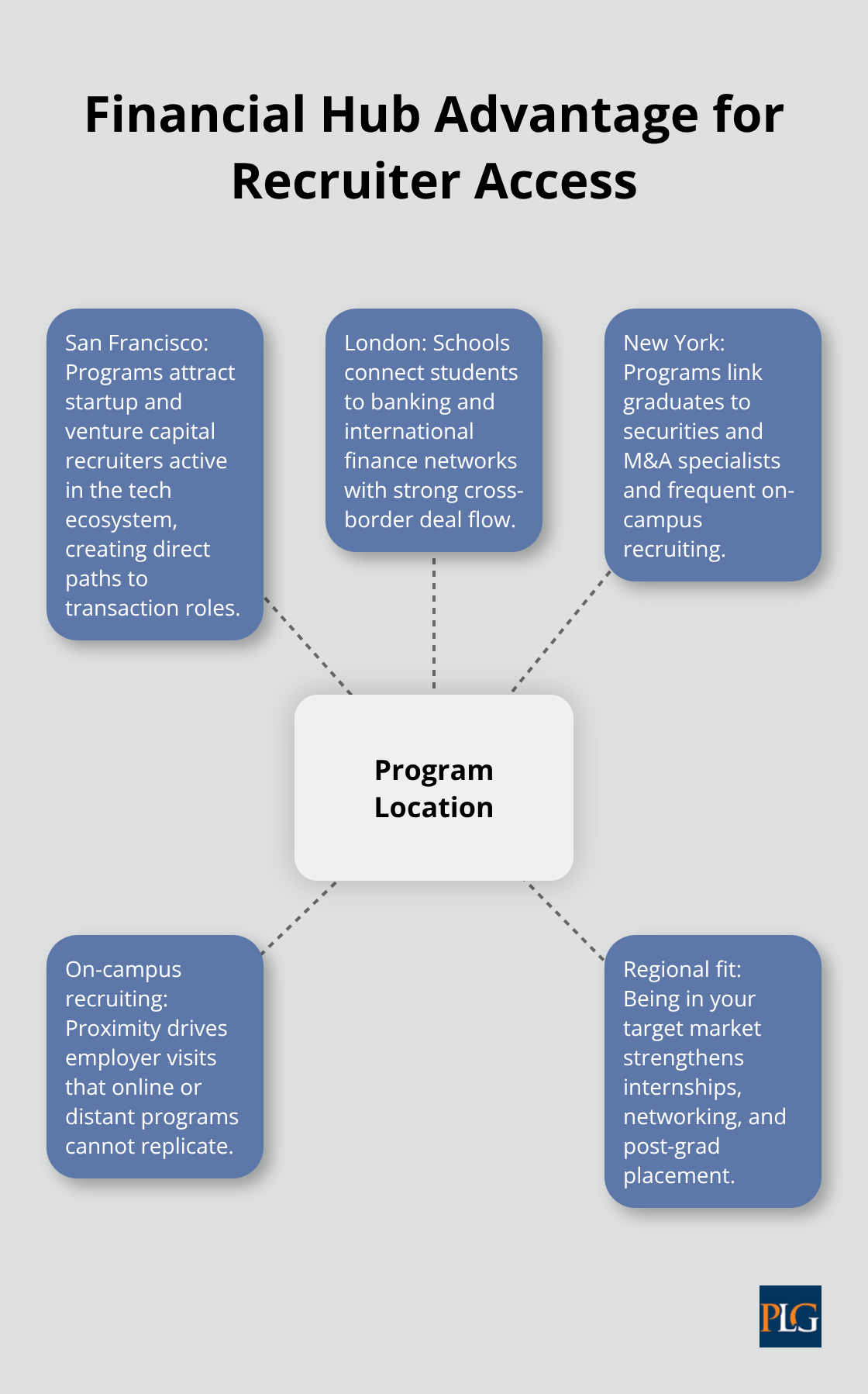
The programs that produce the strongest outcomes sit in major financial centers where recruiters actively hunt for talent. San Francisco-based programs naturally attract venture capital and startup law recruiters. London programs draw banking and international finance recruiters. New York programs connect you to securities and M&A specialists. When you evaluate a program, ask the career services office which law firms and in-house teams conducted on-campus recruiting in the past 12 months. Programs with consistent recruiter visits from your target employers will open more doors than schools with prestigious names but limited recruiter access. This practical reality shapes your post-graduation job search far more than rankings do.
Your next step involves comparing specific programs against these criteria. The evaluation process requires you to contact schools directly, review their curriculum offerings, and assess whether their location and employer relationships align with your career direction.
Program Curriculum and Faculty Matter More Than Rankings
Assess curriculum depth in your target practice area
Curriculum quality separates programs that produce working corporate lawyers from programs that produce graduates with impressive credentials but no practical foundation. When you contact programs, ask for their course catalog and identify which classes directly support your chosen path. If you want to work on cross-border M&A deals, the program must offer courses in international contract drafting, securities regulation, and corporate structuring-not just international law surveys. Duke Law School’s LL.M. program succeeds because it offers semester-long courses in venture capital and private equity alongside traditional securities courses, giving students depth in transaction practice rather than breadth across unrelated topics.

Ask each program for the past three years of course offerings and count how many classes directly relate to your target practice area. Programs that rotate courses annually or offer fewer than four courses in your chosen area lack sufficient curriculum depth. Contact the career services office and request graduate employment data broken down by practice area. This reveals whether the curriculum actually prepares students for the jobs they claim to support.
Prioritize faculty with active practice experience
Faculty backgrounds matter equally. Corporate law programs staffed primarily by academics who’ve never practiced law outside academia produce graduates unprepared for real client work. Seek programs where faculty members have worked at major law firms or in-house at corporations. Ask programs how many faculty members have transaction experience, and request information about their recent practice work.
Programs in financial hubs like San Francisco naturally attract faculty with active practice connections, while programs in secondary locations often struggle to recruit practitioners. Faculty with current client relationships bring real deal experience into the classroom and maintain recruiter connections that benefit students. This practical foundation shapes how effectively instructors teach transaction work and negotiation skills.
Verify employer recruitment patterns and geographic reach
Rankings mean almost nothing without context about employer recognition in your specific target market. A program ranked highly by LLM Guide might have excellent reputation in Europe but minimal recruiter presence in San Francisco’s venture capital market. Contact programs and request their employer recruitment data for the past two years, broken down by geography and practice area. Ask which law firms and in-house teams conducted on-campus recruiting, and request contact information for recent graduates working in your target field. Call those graduates and ask directly whether the program’s reputation translated into job opportunities.
Accreditation status matters only if it affects your credential requirements in your target jurisdiction. Before weighing accreditation heavily, confirm with your target bar association that their specific accreditation matters for your jurisdiction. Many programs maintain accreditation that has no practical impact on where you can practice.
Connect location to recruiter access and deal flow
The programs that produce the strongest outcomes in corporate law sit in major financial centers where real deal work happens. San Francisco-based programs attract startup and venture capital recruiters. London programs connect you to banking and international finance networks. New York programs open doors to securities and M&A specialists. Your program’s location directly determines which recruiters will visit campus and which employers will consider your resume competitive.
When you evaluate a program, ask the career services office which law firms and in-house teams conducted on-campus recruiting in the past 12 months. Programs with consistent recruiter visits from your target employers will open more doors than schools with prestigious names but limited recruiter access. This practical reality shapes your post-graduation job search far more than rankings do. With curriculum and faculty assessed, you now need to evaluate the financial investment against actual job placement outcomes and salary data.
Location, Costs, and Real Deal Experience
Financial investment in an LL.M. program demands honest analysis of what you’ll actually earn and whether the program delivers the connections that create those earnings. Tuition for top-tier programs ranges from $40,000 to $80,000 for full-time study, but this number means nothing without salary data for graduates in your specific practice area.
Request detailed employment and salary data from programs
Contact each program’s career services office and request their graduate employment data for the past three years, broken down by salary, employer type, and geography. Ask specifically about starting salaries for graduates who entered corporate transaction work versus other practice areas. Programs with strong track records in your target field should show graduates earning $150,000 to $200,000 in their first year at major law firms or in-house teams. If a program cannot provide this data, it signals weak employer relationships and weaker post-graduation outcomes. Verify these numbers independently by calling recent graduates and asking about their actual compensation packages.
Evaluate location against salary outcomes and recruiter access
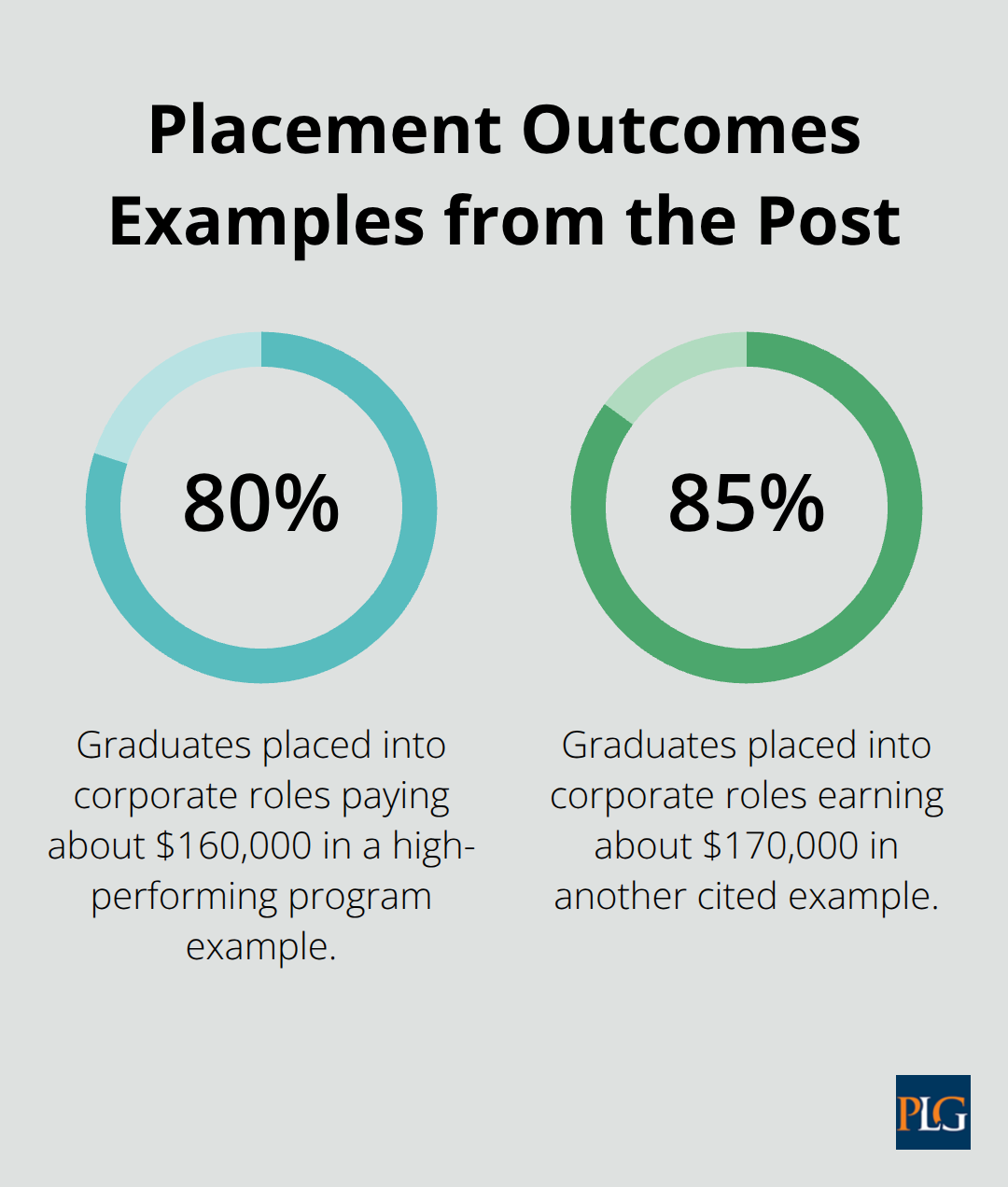
Programs located in major financial centers like San Francisco, London, and New York typically produce higher starting salaries because they sit where the most lucrative deal work actually happens. A program charging $60,000 that places 80 percent of graduates into corporate roles paying $160,000 represents far better value than a program charging $40,000 but placing graduates into positions paying $90,000.
San Francisco-based programs deserve particular attention because the city hosts the largest concentration of venture capital, startup funding, and technology-driven corporate work in the world. Programs in San Francisco naturally attract recruiters from leading firms like Wilson Sonsini, Orrick, and Fenwick & West, which dominate startup and venture capital transactions. These recruiters visit campus regularly and actively recruit LL.M. graduates for transaction work.
Prioritize internship placements and real client work
Internship opportunities in San Francisco connect you directly to real client work on funded startups, venture capital rounds, and equity compensation structures. Ask programs whether they offer clinics or externships where you work on actual client matters rather than hypothetical scenarios. Real deal experience matters far more than classroom theory when you enter the job market.
Programs providing exposure to client work through law firm externships, in-house counsel placements, or corporate clinics give you practical foundation that employers recognize immediately. Try semester-long internship placements at operating law firms over programs offering only occasional guest lectures from practitioners. The difference between watching a partner discuss M&A strategy and actually drafting purchase agreements under supervision determines whether you hit the ground running post-graduation.
Final Thoughts
Your choice of an international corporate & commercial law LLM program shapes the next decade of your legal career. Match program strengths to your specific path rather than general prestige rankings, and evaluate which schools offer genuine curriculum depth in your chosen practice area alongside faculty with active transaction experience. Request employment data from career services and verify those numbers by calling recent graduates directly to confirm they actually work in the roles the program claims to prepare students for.
Calculate financial return honestly by comparing tuition against documented salary outcomes and employer relationships in your target market. A program charging $70,000 that places 85 percent of graduates into corporate roles earning $170,000 represents better value than a cheaper program with weaker recruiter connections and lower starting salaries. San Francisco-based programs attract recruiters from leading firms handling startup funding and venture capital work, creating direct pathways to high-paying transaction roles.
Your final decision should rest on which program delivers the strongest combination of curriculum alignment, faculty credibility, and documented employer relationships in your target market. If you’re building a career in startup and venture capital law, we at Primum Law Group work regularly with lawyers trained at programs offering genuine transaction experience. Contact our team at Primum Law Group to discuss how your LLM choice connects to real-world corporate practice in San Francisco and Silicon Valley.