

Vendor contracts for startups often become afterthoughts until something goes wrong. A poorly written agreement with a supplier can drain your budget, create operational headaches, and derail growth plans.
At Primum Law Group, we’ve seen startups lose thousands because they skipped the negotiation process or missed critical clauses. The good news: fixing this doesn’t require legal training-just the right framework and attention to detail.
Where Vendor Contracts Fall Apart
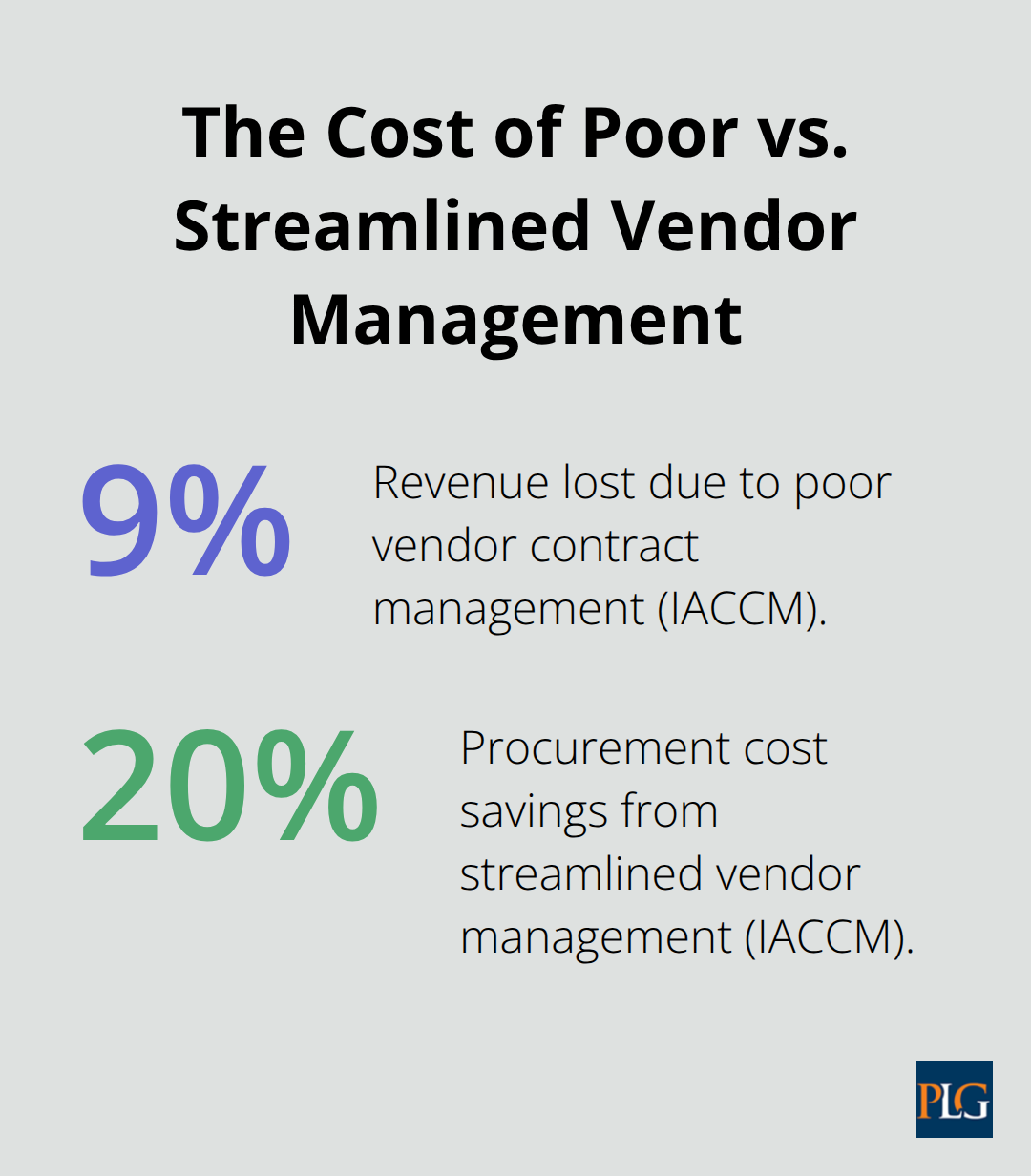
Most startup founders treat vendor contracts as rubber-stamp agreements. They focus on price, skim the fine print, and sign. This approach costs money fast. According to IACCM findings, poor vendor contract management can cost up to 9% of total revenues.
That’s significant enough to sink early-stage growth. We see three critical areas where startups stumble, and they’re entirely preventable with clear thinking and the right language upfront.
Payment terms that create cash-flow disasters
Startups often accept whatever payment terms a vendor proposes without negotiation. Net-30, net-60, net-90-these sound standard until you’re bootstrapped and burning cash. The real damage comes from vague invoicing procedures, undefined late-payment remedies, and missing clarity on when payment actually triggers. One San Francisco startup discovered their vendor’s invoices didn’t specify what work was completed, leading to payment disputes that delayed critical supplies for weeks. Another founder learned too late that the contract said net-60 but the vendor’s system auto-escalated invoices after 45 days without notice.
Set explicit payment terms upfront. Define exactly what triggers an invoice, specify your net terms in days, state what happens if payment is late, and require vendors to use a consistent invoicing format. This alone prevents thousands in dispute costs and keeps your operations moving.
Service level agreements that don’t actually measure anything
A missing or vague service level agreement is like hiring someone without defining the job. Startups often assume vendors understand expectations, then get frustrated when performance slips. The ABA reported that startups without proper contracts face about $47,000 in average dispute costs. Many of these disputes stem from undefined performance standards. Your vendor might think 48-hour response times are acceptable while you need 4 hours. Their definition of delivery might differ from yours.
Write specific, measurable SLAs. Include response times for support, uptime percentages for critical systems, delivery windows, acceptance criteria for deliverables, and consequences if they miss targets. Gartner research shows that modern contract management software improves compliance and reduces contract cycle times through real-time monitoring, but even without software, clear SLAs in writing prevent most conflicts. Include metrics you can actually track and remedies that matter to your business-credits, service refunds, or termination rights if performance falls short consistently.
Termination clauses that trap you in bad deals
Inadequate exit clauses are relationship killers. Startups often accept long contract terms without negotiating termination rights, renewal conditions, or what happens to data and work product when the relationship ends. One Bay Area startup discovered their vendor contract auto-renewed annually with automatic price increases of 5% unless they provided 90-day notice-but they found out only after year two when costs jumped unexpectedly. Another founder couldn’t switch vendors because the contract required 180 days notice and the vendor had become unreliable.
Build termination flexibility into every contract. Specify notice periods that work for your business, include termination-for-cause language if the vendor breaches SLAs, define what happens to your data and IP on exit, and clarify transition obligations like knowledge transfer or vendor cooperation during switchover. For multi-year deals, include price adjustment mechanisms tied to inflation or market rates so you’re not locked into stale pricing. Avoid auto-renewal clauses entirely or make them require explicit written consent.
These provisions take minutes to negotiate but save months of frustration later. The next section covers what terms you should actually push for during negotiations-the ones that shift power back to your startup and protect your bottom line.
What to Actually Negotiate in Vendor Contracts
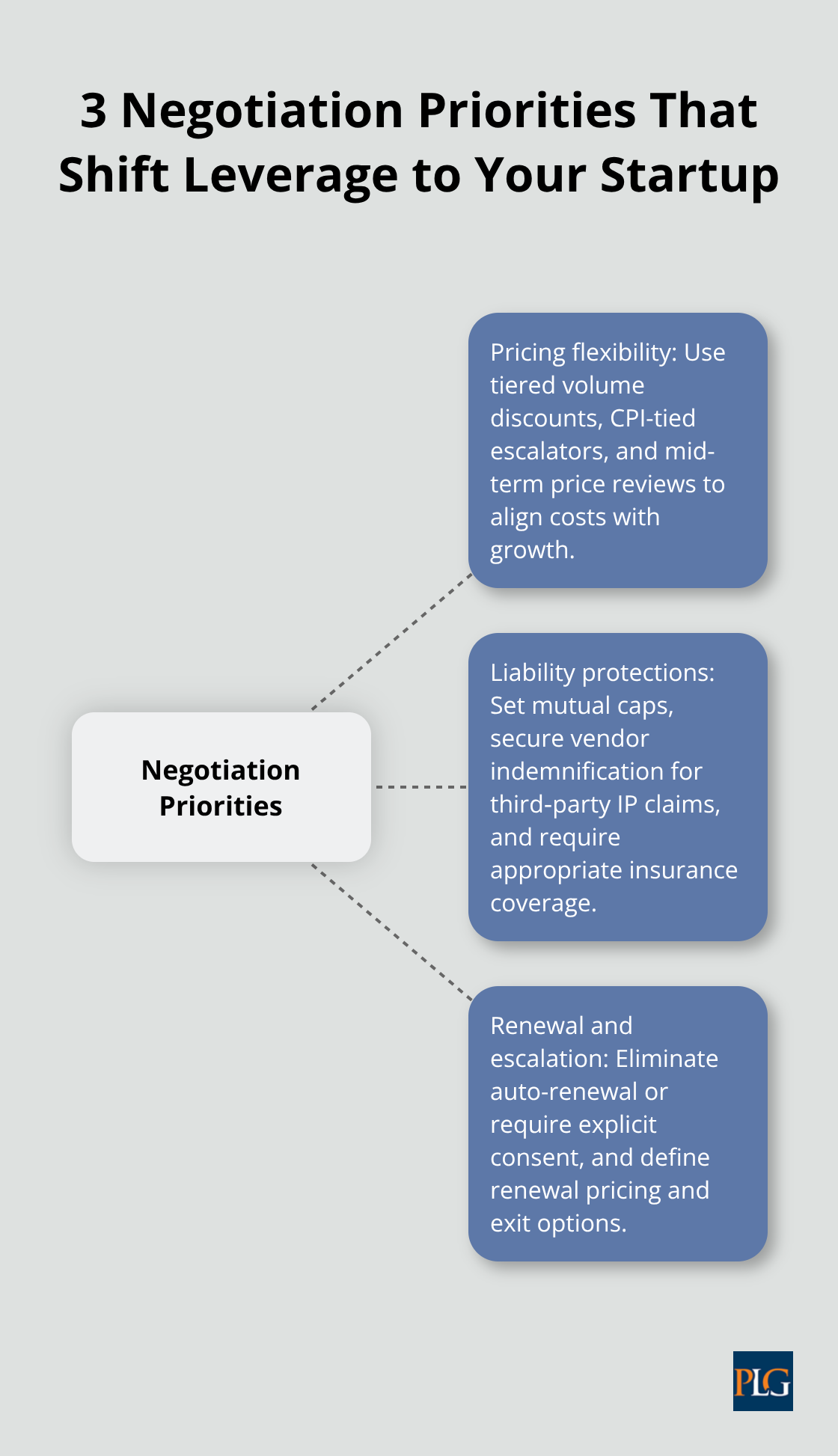
Startups that negotiate vendor contracts strategically gain leverage that compounds over time. Most founders accept vendor-proposed terms without pushback, assuming there’s no room to bargain. This is wrong. Vendors expect negotiation, especially on pricing, liability, and renewal structures. According to IACCM findings, streamlined vendor management can cut procurement costs by up to 20%, and much of that savings comes from negotiating the right terms upfront rather than accepting defaults. The three areas below separate startups that control their vendor relationships from those that get controlled by them.
Pricing flexibility beats fixed rates every time
Volume discounts are the obvious play, but most startups negotiate them poorly. You might ask for a 10% discount on annual volume and accept the first offer. Instead, structure pricing around your actual growth trajectory. If you sign a two-year contract, propose tiered pricing that drops as your volume increases in year two. Tie price reductions to concrete volume thresholds you can actually hit, not aspirational numbers. One San Francisco SaaS startup negotiated a contract where their unit cost dropped 15% once they hit 1,000 monthly transactions, then another 10% at 5,000. They hit the first threshold in month eight and locked in savings across the remaining contract period. The vendor benefited from predictability and higher volume; the startup got real cost reduction aligned with growth.
Beyond volume, negotiate flexibility on pricing adjustments. Avoid contracts with automatic annual escalation clauses unless they cap at inflation rates. If a vendor insists on price increases, tie them explicitly to published indices like the Consumer Price Index rather than leaving increases undefined. One founder accepted a contract with 5% annual increases and later discovered the vendor interpreted this as 5% compounded yearly, doubling costs over five years. Lock in the escalation mechanism in writing. For contracts spanning multiple years, include a price review trigger at the 18-month mark so you can renegotiate if market rates shift. Vendors will resist this, but frame it as mutual protection: if their costs drop, they benefit; if market rates rise, you share the burden fairly.
Liability caps protect both sides
Startups often skip liability discussions because they assume they’re the vulnerable party. Wrong. Well-drafted liability limits actually protect both parties and prevent disputes from spiraling into litigation. Negotiate mutual liability caps that are reasonable for both of you. If a vendor failure costs you $50,000 in lost revenue, cap mutual liability at that number rather than leaving it unlimited. This forces the vendor to price their service appropriately and prevents them from over-exposing themselves.
Indemnification clauses matter more than liability caps for startups. Push for the vendor to indemnify you against third-party IP infringement claims if their product or service violates someone else’s patent or copyright. This is standard in the industry, and vendors who resist are hiding something. Conversely, agree to indemnify them only for your specific misuse of their service, not for their general negligence. One Bay Area startup accepted broad indemnification language and later faced a lawsuit when the vendor’s system failed; the startup’s contract required them to cover the vendor’s legal fees even though the vendor caused the problem. Read indemnification language carefully and push back on overreach.
Require the vendor to carry insurance that covers the risk they’re taking on. Ask for proof of general liability, professional liability if they’re providing services, and cyber insurance if they’re handling your data. Request certificates of insurance listing your company as an additional insured. This costs vendors almost nothing if they’re already insured, and it gives you recourse beyond the contract if something goes wrong.
Renewal and escalation language determines long-term costs
Auto-renewal clauses are vendor-friendly traps. Startups sign multi-year contracts and forget about them, then wake up to a surprise renewal at higher rates. Eliminate auto-renewal entirely or require explicit written consent 60 days before expiration. Make the vendor send notice, not the other way around. If they forget, the contract expires and you’re free to shop around.
Some vendors will resist and insist on auto-renewal for their cash-flow certainty. Respond by offering them a longer initial term in exchange for eliminating auto-renewal. A three-year contract with no auto-renewal is more valuable to a vendor than a two-year contract with auto-renewal, because you’ve committed longer upfront. For contracts that do renew, define renewal pricing explicitly. State whether renewal rates stay flat, increase by a capped percentage, or reset to market rates determined by competitive bids. If you leave renewal pricing undefined, the vendor controls it. One startup’s vendor proposed a 25% increase at renewal, claiming market rates had risen. The contract didn’t specify how renewal pricing would be set, so the startup had no leverage. Never accept undefined renewal pricing.
Include a termination-for-convenience clause that lets you exit at renewal without cause, even if you pay a small penalty. This gives you an exit ramp if the vendor becomes expensive or underperforms. The penalty should be reasonable-perhaps 30 days of service costs-not prohibitive. Startups that build pricing flexibility and clear renewal terms into contracts avoid the ratcheting cost problem that derails budgets as you scale. The next section covers how to manage these relationships after you’ve signed, because a well-negotiated contract only works if both parties actually follow it.
How to Monitor Vendor Performance Without Constant Friction
A signed contract is just the beginning. Most startups treat vendor agreements as static documents filed away, then wonder why performance degrades or costs creep up over time. The reality is that vendor relationships require active management from day one. You need systems to track whether vendors actually deliver what they promised, communication channels that catch problems early, and a documented process for handling changes.
Without these, your carefully negotiated terms become meaningless. Startups that implement structured performance management see fewer disputes, better vendor behavior, and stronger negotiating positions when renewal time arrives.
Track performance against every SLA metric
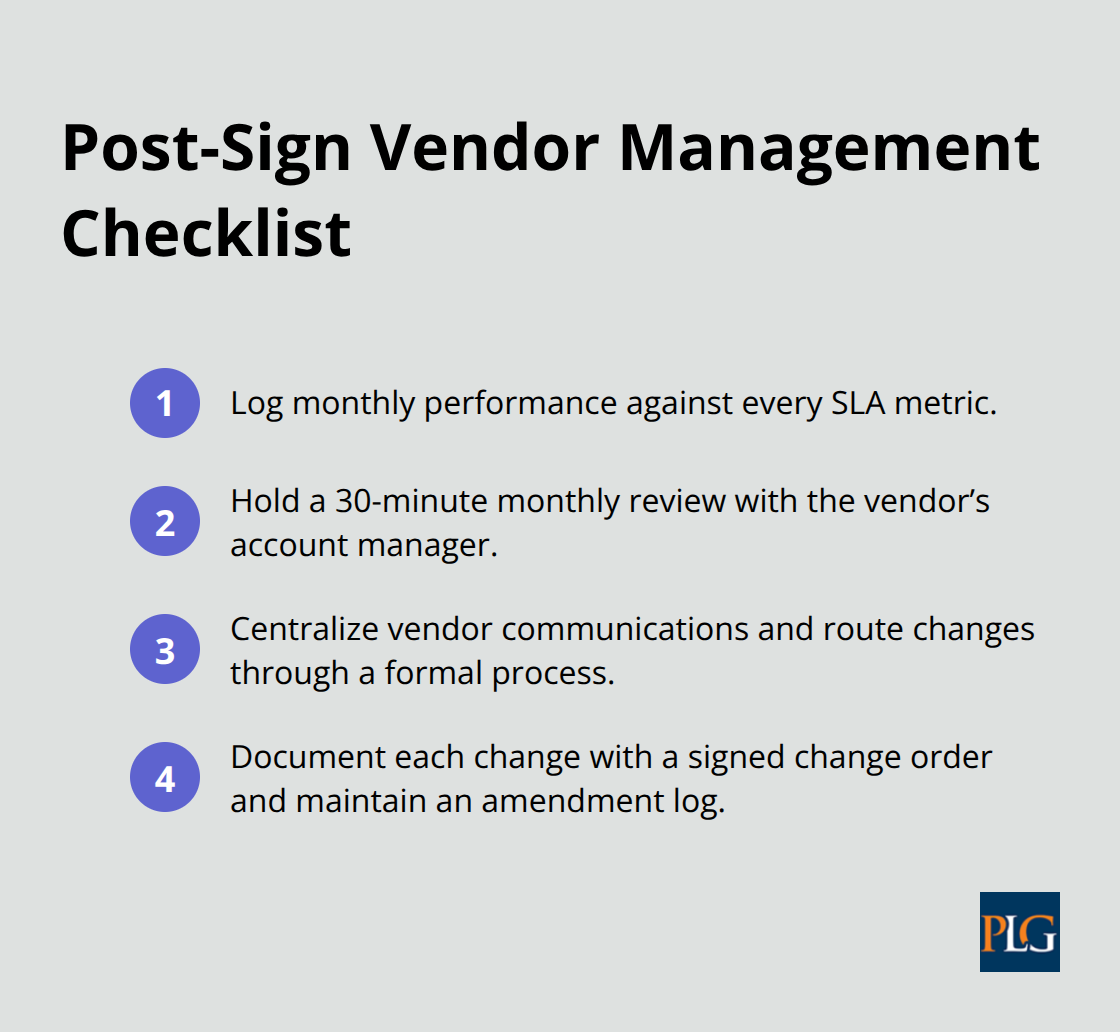
The SLAs you negotiated are only useful if you actually measure them. Many startups set response-time targets or uptime guarantees, then never measure whether vendors hit them. This wastes the negotiation work you did upfront. Create a simple spreadsheet or use contract management software to log vendor performance against each SLA metric every month. If your vendor committed to 99.5% uptime, record their actual uptime. If they promised 24-hour response times for support tickets, track how many tickets they answered within that window and how many missed. Document everything. When renewal discussions happen and the vendor proposes a 15% price increase, you’ll have six months of data showing whether they’ve earned it. One San Francisco fintech startup discovered their payment processor hit only 98.8% uptime against a 99.5% commitment. Armed with six months of performance logs, they negotiated a 12% price reduction and stricter penalty clauses before renewal.
Schedule monthly performance reviews with your vendor contacts. Spend 30 minutes with the vendor’s account manager to review the metrics from the previous month, discuss any SLA misses, and address operational issues before they become problems. Come prepared with specific data points. Don’t say the vendor’s service seems slow; say response times averaged 34 hours when the contract specifies 24 hours. Frame these reviews as collaborative problem-solving, not criticism. Ask what obstacles the vendor faces in hitting targets and whether your usage patterns strain their capacity. Many vendors will proactively offer solutions or concessions if you approach the conversation as a partnership. This monthly touchpoint also gives you early warning if a vendor is heading toward failure, letting you plan an exit before the relationship breaks down completely.
Establish communication protocols that prevent scope creep
Unclear communication channels cause most vendor disputes. When someone on your team emails the vendor asking for a small change, and the vendor implements it without documenting the change order, costs drift and contract terms become meaningless. Establish a single point of contact on your side for each vendor relationship. This person owns communication, approves any requests for changes or additional services, and ensures everything flows through the formal change process. Tell your entire team: no direct vendor communication for requests or modifications. All requests go through the designated contact. This sounds rigid, but it prevents the chaos that happens when five different people email the vendor asking for slightly different things.
On the vendor side, identify their account manager and escalation contact. Get their direct phone number and email. Agree on communication response times for different issue types: critical outages get a response within one hour, standard support requests within 24 hours, billing questions within three business days. Put this in writing as part of your SLA or in a separate communication addendum. When issues arise, you know exactly who to contact and what timeline to expect. One Bay Area startup’s vendor sent an invoice for services that weren’t ordered because someone in engineering mentioned needing extra capacity in a casual email. The vendor’s sales team treated this as a purchase order. With a formal change-request process in place, this never happens.
Document every change in writing
Verbal agreements with vendors are worthless. If your vendor agrees to reduce prices, extend a deadline, or add a service, get it in writing. Create a simple change-order template that captures the change, who approved it, when it takes effect, and how it affects pricing or timeline. Email it to the vendor for signature. This takes five minutes and prevents disputes months later when the vendor claims they never agreed to something. Many startups skip this because it feels bureaucratic, but it’s the difference between having leverage and having nothing. When a vendor claims they never agreed to a discount or service addition, you’ll have signed documentation proving otherwise. One founder accepted a vendor’s verbal promise to waive setup fees, then received an invoice including the setup charges. Without written confirmation of the waiver, he had no recourse.
Keep a master amendment log for each vendor contract. Record the original contract date, the amendment date, what changed, and the impact on pricing or terms. This log becomes invaluable during renewal negotiations because you can see the full history of modifications and pricing adjustments. If you’ve made three amendments over two years, all adding cost or reducing flexibility, you have data to push back against further unfavorable changes. When disputes arise, this documentation is your strongest defense. Modern contract management improves compliance through real-time monitoring, but even a basic spreadsheet tracking amendments and changes prevents most conflicts. The goal is simple: no handshake agreements, no assumptions about what was agreed to, and a clear written record of every change to the original contract.
Final Thoughts
Vendor contracts for startups determine whether you control costs or costs control you. A poorly managed vendor relationship drains up to 9% of your revenue according to IACCM research, while streamlined vendor management cuts procurement costs by up to 20%. The difference rests on three foundations: clarity around payment and performance expectations, negotiated terms that reflect your actual business needs, and active management after you sign.
Strong vendor contracts startups implement include explicit payment terms that specify when invoices trigger and what happens if payment arrives late, measurable SLAs tied to real consequences rather than vague promises, and termination clauses that give you flexibility to exit if the relationship deteriorates. Pricing should reward your growth through volume discounts and tiered structures instead of locking you into fixed rates that become expensive as you scale. Liability caps and indemnification language protect both parties and prevent disputes from spiraling into litigation. Renewal terms should require your explicit consent, never auto-renew without your signature, and include defined pricing mechanisms so you avoid surprises at contract anniversary.
Once you sign, treat these agreements as living documents by tracking vendor performance monthly against every SLA metric you negotiated, scheduling regular reviews with your vendor contacts to catch problems early, and establishing formal change-request processes so modifications stay documented. We at Primum Law Group help startups in San Francisco and the Bay Area draft, review, and negotiate vendor agreements that protect your interests and support growth. Reach out to discuss your current agreements or get support on upcoming vendor negotiations.