

Corporate venture capital companies deployed $73.6 billion globally in 2023, marking a significant shift in how large corporations approach innovation and growth.
These strategic investments go far beyond traditional funding – they create pathways for technology acquisition, market expansion, and competitive positioning. At Primum Law Group, we see firsthand how these deals reshape entire industries through carefully structured partnerships.
Which San Francisco Corporate VCs Lead the Market?
San Francisco’s corporate venture capital landscape reveals clear leadership patterns through three dominant players. Intel Capital manages the largest technology-focused CVC portfolio with over 1,700 investments since 1991, and deploys approximately $1.5 billion annually across semiconductors, AI, and autonomous driving sectors. Their strategic approach prioritizes companies that complement Intel’s hardware ecosystem, with notable successes that include investments in Cloudera and McAfee before their respective exits.
Intel Capital’s Deep Tech Investment Focus
Intel Capital targets startups that advance semiconductor innovation and edge computing capabilities. The fund invests $50-100 million per deal in later-stage companies, with portfolio companies like Mobileye (acquired for $15.3 billion) and Altera demonstrating their ability to identify transformative hardware technologies. Their investment committee includes Intel executives who provide technical due diligence and market validation that traditional VCs cannot match.
Salesforce Ventures Enterprise Software Dominance
Salesforce Ventures has backed over 600 startups with a laser focus on enterprise SaaS solutions that integrate with their platform ecosystem. Their $500 million Trailblazer Fund targets companies that build on Salesforce infrastructure, which creates direct revenue synergies. Recent investments in companies like Snowflake and Zoom generated substantial returns while they strengthened Salesforce’s market position. The fund’s average deal size of $3-5 million for early-stage rounds makes it accessible for new enterprise software companies.
Google Ventures Multi-Stage Investment Strategy
GV operates with $7 billion in assets under management and invests across all stages from seed to growth. Their portfolio spans 500+ companies that include Uber, Nest, and Stripe, with an average annual deployment of $300 million. Unlike other corporate VCs, GV maintains investment independence from Google’s strategic priorities and focuses purely on financial returns. This approach has generated top-quartile returns while it provides startups access to Google’s technical talent and infrastructure without strategic constraints.
These three firms demonstrate how corporate venture capital has evolved beyond simple financial returns to create strategic value through sector focus, platform integration, and operational support that traditional venture firms struggle to replicate.
Where Do Corporate VCs Invest Most?
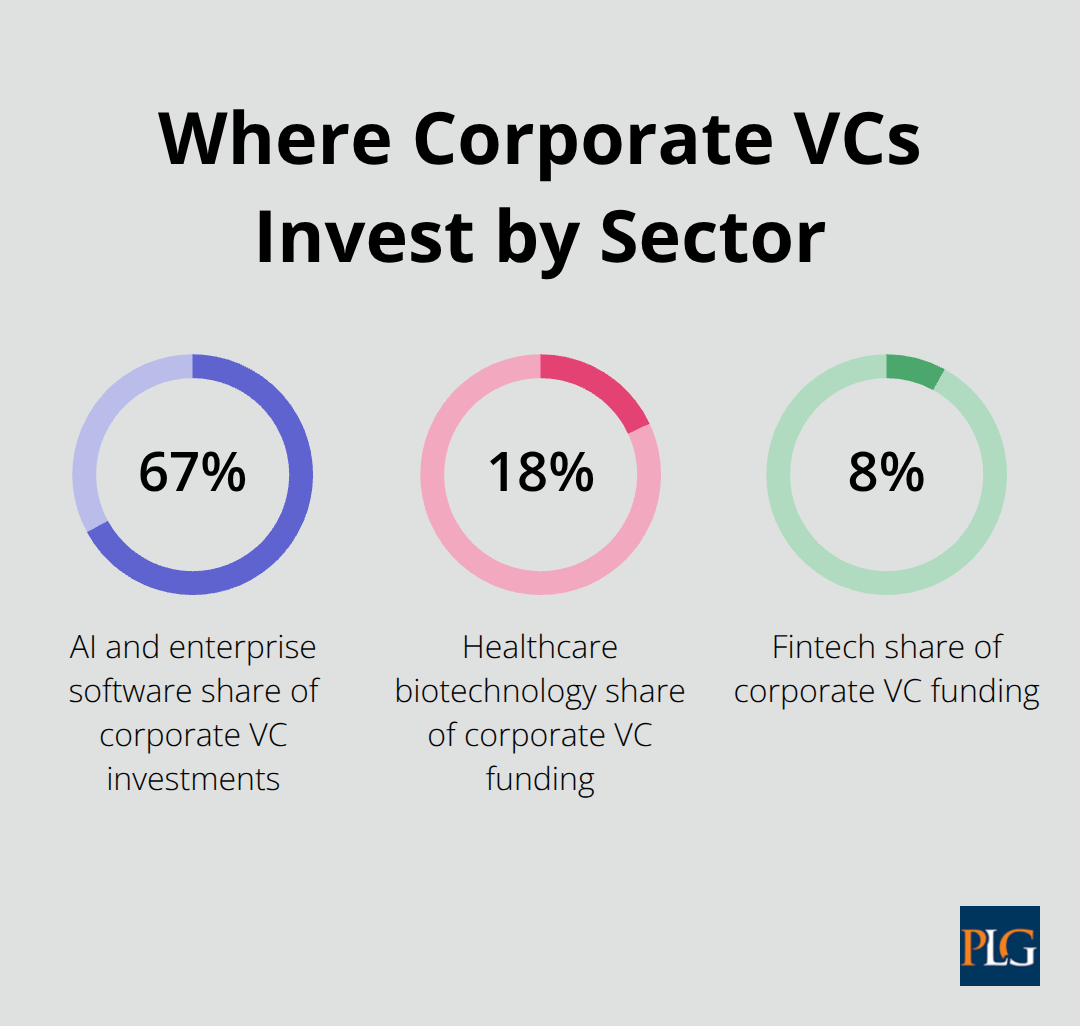
Corporate venture capital firms direct 67% of their investments toward artificial intelligence and enterprise software, with AI companies receiving an average of $15.2 million per deal in 2024 according to PitchBook data. Healthcare biotechnology captures 18% of corporate VC funding, while fintech and mobility sectors each attract approximately 8% of total investments. These sector preferences reflect corporate parents’ strategic priorities rather than pure financial returns, with companies like Intel Capital investing heavily in semiconductor-adjacent technologies and Salesforce Ventures backing SaaS platforms that integrate with their ecosystem.
Geographic Concentration Drives Deal Flow
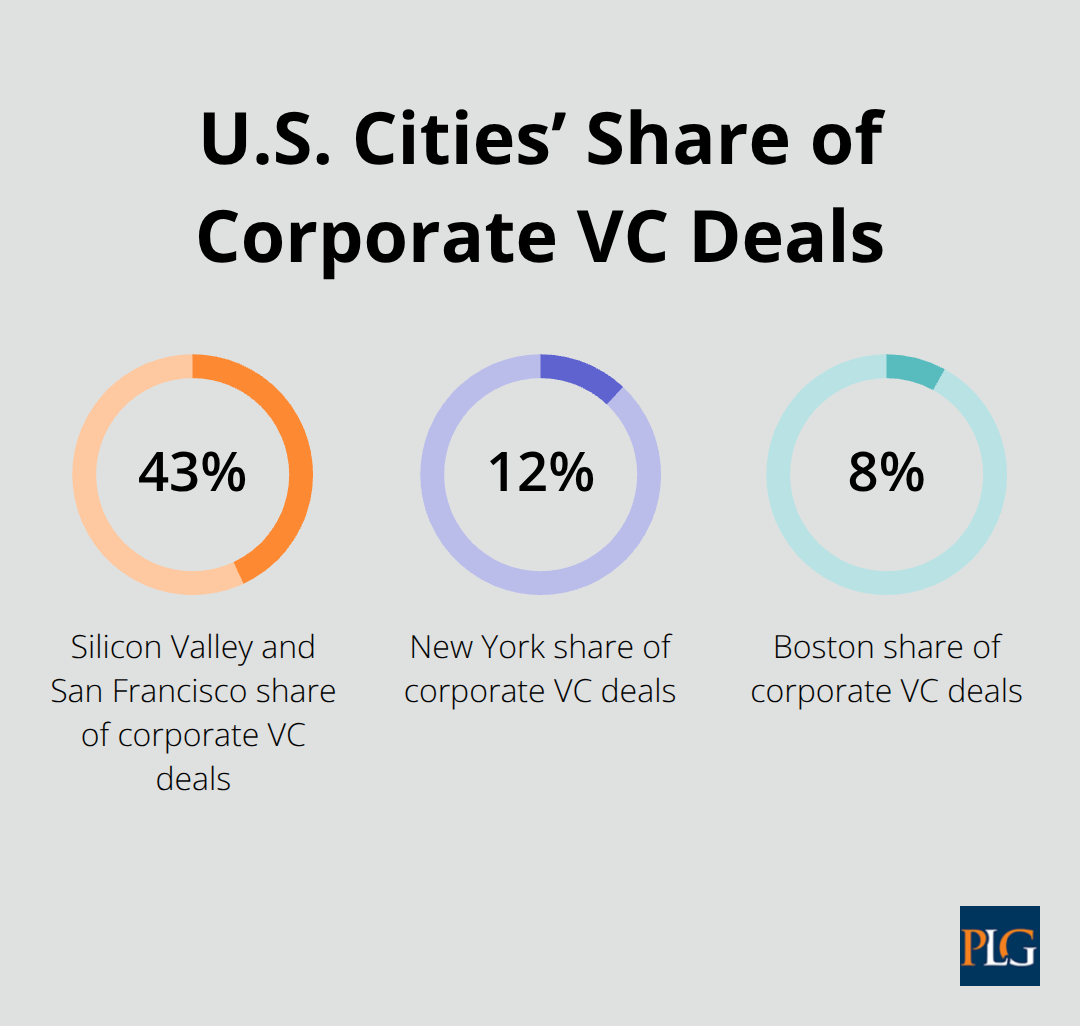
Silicon Valley and San Francisco capture 43% of all corporate venture capital deals, with New York accounting for 12% and Boston securing 8% of total investment volume. European corporate VCs deployed $23.4 billion in 2024, primarily in London, Berlin, and Stockholm, while Asian markets saw $31.7 billion in corporate investments led by Singapore and Beijing.
Stage preferences show corporate VCs favor Series A and B rounds, which represent 58% of their deal activity with average investments of $8.3 million for Series A and $18.7 million for Series B. Seed-stage investments account for only 23% of corporate VC deals, as these firms typically enter after startups demonstrate product-market fit and strategic alignment with corporate objectives.
Strategic Investment Timing Patterns
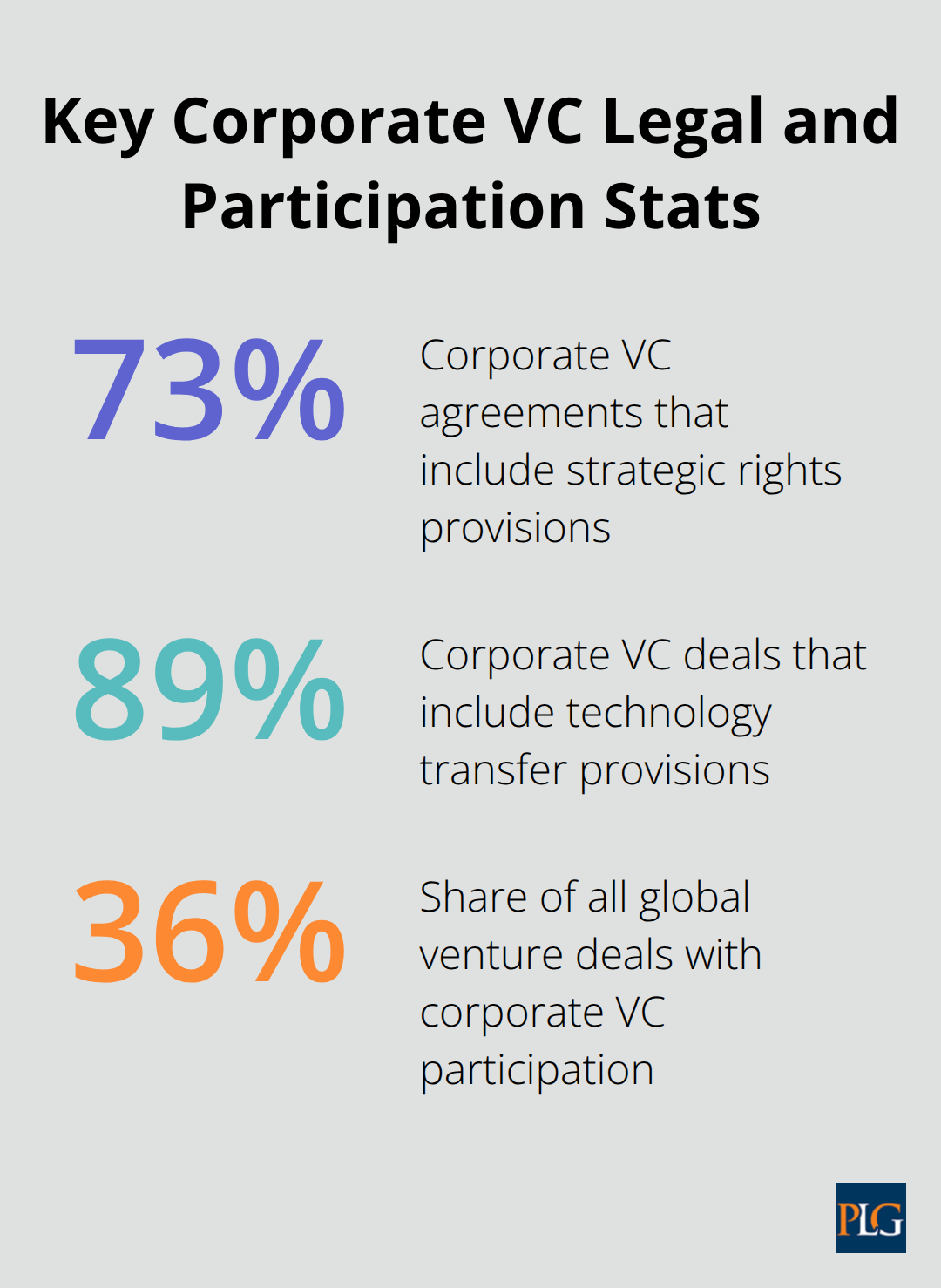
Late-stage corporate investments above $50 million increased 34% in 2024, driven by companies seeking strategic partnerships before IPOs or acquisitions. Corporate VCs now participate in 36% of all venture deals globally (up from 28% in 2020), indicating their growing influence in startup funding ecosystems. The average time from initial investment to strategic partnership or acquisition has shortened to 2.8 years, demonstrating how corporate VCs accelerate business development cycles through direct access to enterprise customers and distribution channels.
These investment patterns create complex legal frameworks that require careful structuring to balance corporate strategic interests with startup independence and growth objectives.
How Do Corporate VC Deals Navigate Complex Legal Structures?
Corporate venture capital deals require fundamentally different legal frameworks than traditional VC investments, with 73% of corporate VC agreements including strategic rights provisions that standard venture terms lack according to Fenwick & West data. These deals demand careful balance between corporate strategic objectives and startup autonomy through term sheets that address technology licensing, board composition, and future acquisition pathways. Attorneys structure these agreements with protective provisions that prevent conflicts of interest while they maintain startup flexibility, including anti-dilution protections and information rights that serve both parties’ long-term interests.
Strategic Partnership Integration Within Investment Terms
Corporate VC agreements must address intellectual property ownership and licensing from day one, with 89% of deals including technology transfer provisions that create mutual benefits without compromising startup independence. Smart structuring involves separate commercial agreements that run parallel to equity investments, preventing strategic partnerships from becoming acquisition prerequisites.
Legal teams establish clear governance frameworks that separate investment decisions from strategic partnership negotiations. This approach protects both corporate investors and startups from regulatory scrutiny while it maximizes collaborative value creation opportunities.
Due Diligence and Regulatory Compliance Requirements
Due diligence extends beyond financial metrics to include competitive analysis, technology overlap assessment, and regulatory compliance verification that traditional VCs often overlook. Securities regulations require enhanced disclosure when corporate investors hold strategic influence, with SEC reporting obligations that increase for investments exceeding 5% ownership stakes.
Corporate VCs face additional compliance burdens when their investments create potential conflicts with existing business lines. Antitrust considerations become particularly complex when large corporations invest in companies that compete with their core operations (or their customers’ operations), requiring careful legal analysis to avoid regulatory challenges.
Intellectual Property Protection and Technology Transfer
Technology transfer provisions in corporate VC deals create bidirectional benefits while they protect each party’s core intellectual property. These agreements typically include cross-licensing opportunities, joint development rights, and technology sharing protocols that traditional venture deals rarely address.
Patent portfolios require separate analysis to prevent inadvertent technology transfers that could compromise competitive advantages. Legal framework requirements must account for future scenarios where corporate investors might acquire portfolio companies, ensuring that intellectual property rights remain clear throughout the investment lifecycle.
Final Thoughts
Corporate venture capital companies have fundamentally transformed startup funding through strategic investments that create value beyond traditional financial returns. The $73.6 billion deployed globally in 2023 demonstrates how these firms bridge innovation gaps between large corporations and emerging technologies. The dominance of San Francisco-based players like Intel Capital, Salesforce Ventures, and Google Ventures reflects the region’s continued leadership in technology investment.
Their sector focus on AI and enterprise software, combined with geographic concentration in key innovation hubs, creates predictable investment patterns that startups can leverage for strategic partnerships. Legal complexity remains the defining challenge for corporate VC deals, which require sophisticated frameworks that balance corporate strategic interests with startup independence. The 73% of agreements that include strategic rights provisions highlight how these investments differ from traditional venture capital structures.
Corporate venture capital activity will likely accelerate as companies seek competitive advantages through external innovation. The shortened 2.8-year timeline from investment to strategic partnership indicates faster value realization for both parties. For startups that consider corporate VC funding, understanding these legal and strategic dynamics becomes essential for successful partnerships, and Primum Law Group provides the venture capital transaction guidance necessary to navigate these complex deal structures while protecting long-term growth objectives.