

Tech startup agreements are often written hastily, leaving founders exposed to serious legal and financial risks down the road. We at Primum Law Group have seen countless startups struggle because their contracts lacked clarity on ownership, equity, or confidentiality.
The good news is that getting these agreements right from the start prevents costly disputes and protects your company’s future. This post walks through the essential components, common mistakes, and practical strategies for negotiating startup contracts that actually work.
Key Components of Technology Startup Agreements
Intellectual Property Ownership Requires Explicit Written Language
Intellectual property ownership is the first place most startups get it wrong. Many founders assume their work automatically belongs to the company, but without explicit assignment language in writing, courts have ruled that employees retain ownership of inventions created outside work hours using personal resources. Include IP assignment clauses that specify what work product belongs to the company, what remains personal, and how side projects are handled. The clause should cover patents, copyrights, trademarks, and trade secrets. One critical detail: state that IP created as part of job duties belongs to the company from the moment of creation, not after signing. This prevents months of legal battles later.
Equity and Compensation Structures Demand Precision
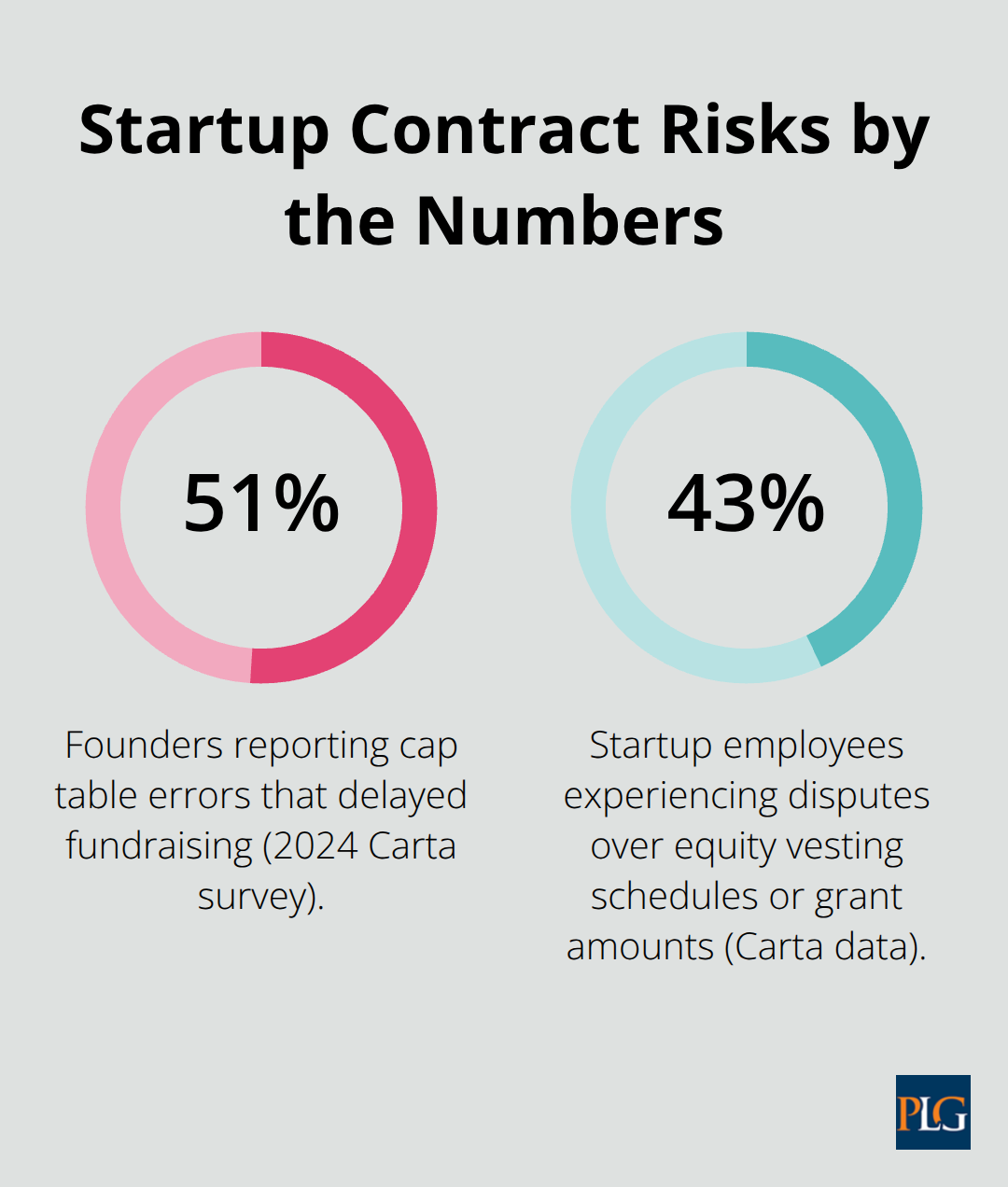
Equity and compensation structures demand precision because vague terms cost founders money and create resentment among team members. According to data from Carta, 43% of startup employees experience disputes over equity vesting schedules or grant amounts. Your agreement should specify the vesting period, cliff period, acceleration triggers, and what happens if someone leaves before vesting completes. A standard four-year vesting schedule with a one-year cliff means employees earn nothing for the first year, then 25% after year one, then monthly increments thereafter. The agreement must also define how equity dilution works in future funding rounds and whether employees have anti-dilution protections.
Confidentiality and Non-Compete Clauses Need Narrow Tailoring
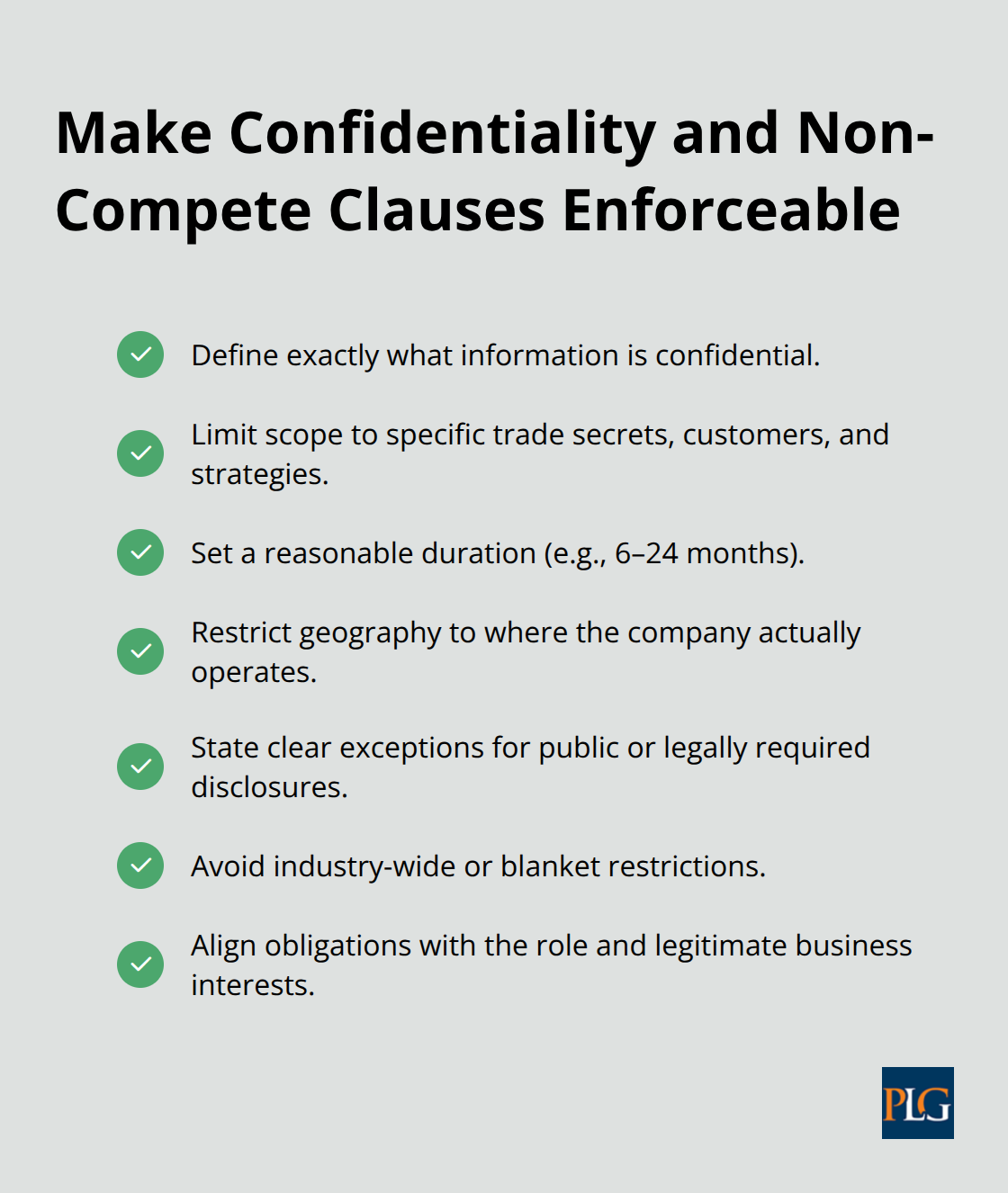
Confidentiality and non-compete clauses protect your competitive advantage, but they must be narrowly tailored to survive legal scrutiny. Courts reject overly broad non-competes that restrict someone from working in an entire industry or geographic region. Draft clauses that protect specific trade secrets, customer lists, and business strategies for a defined period (typically 6 to 24 months) and limit geographic scope to where your company actually operates. Make the confidentiality obligations clear: which information qualifies as confidential, how long the obligation lasts, and what exceptions apply for public information or legally required disclosures.
These three components form the backbone of any startup agreement, but drafting them correctly requires attention to detail and an understanding of how courts interpret contractual language.
Common Pitfalls in Startup Contracts
Founder Equity Disputes Destroy Companies When Documentation Fails
Founder equity disputes represent the most destructive pitfall we see, and they almost always stem from handshake deals or vague cap table documentation. One founder thinks they own 40% while another believes it’s 30%, and when a funding round arrives, the company cannot close because the cap table is contested. A 2024 Carta survey found that 51% of startup founders experienced cap table errors that delayed fundraising, and most of those errors originated from missing or conflicting equity documentation.
The fix is straightforward: document equity grants in writing before any work begins. Specify the exact percentage owned, include the vesting schedule with cliff period, and have all founders sign the same agreement. The agreement must also address what happens to unvested equity if a founder leaves, whether buyback provisions exist, and how future dilution will be handled. Without this clarity, disputes consume months and tens of thousands in legal fees.
IP Assignment Language Gaps Create Hidden Ownership Problems
Inadequate IP assignment language creates a second critical failure point that catches founders off guard during due diligence. Many startups use generic templates that say all work created by employees belongs to the company, but courts interpret this narrowly if the language lacks specificity. You need language that explicitly assigns patents, copyrights, source code, designs, and trade secrets created during employment to the company, and the assignment must take effect at the moment of creation.
Additionally, agreements with service providers and vendors often contain buried IP ownership clauses that inadvertently give those third parties rights to your technology. A developer hired to build a feature might own the code under their standard contract terms unless you explicitly assign it to your company. A designer, marketing agency, or contractor might retain rights to work they produced for you (even when you paid for it). Review every vendor and service provider agreement line by line, and include clear IP assignment language that transfers all work product to your company. This protects your ability to raise capital and prevents disputes when investors conduct due diligence on your intellectual property ownership.
Vague Service Provider Terms Leave Your Company Vulnerable
Service provider and vendor agreements often lack the specificity that protects your interests. Many founders treat these contracts as afterthoughts, accepting whatever terms the vendor proposes without negotiation. Standard vendor contracts frequently contain indemnification clauses that shift liability to you, limitation of liability provisions that cap their responsibility, and confidentiality terms that work against your company. You might also discover that vendors claim ownership of methodologies, processes, or improvements they develop while working on your project. Negotiate these agreements with the same rigor you apply to employment contracts. Define what work the vendor performs, specify that all deliverables belong to your company, clarify liability and indemnification terms, and establish data security and confidentiality obligations. These oversights compound as your startup grows and you engage more vendors, making early attention to service provider agreements a practical necessity.
How to Structure Agreements That Survive Funding and Growth
Embed Milestones and Triggering Events Into Your Agreements
Startup agreements fail not because founders lack intelligence, but because they build contracts without anticipating what comes next. The moment you raise capital, bring on new team members, or pivot your business model, poorly structured agreements become anchors that slow everything down.
The most effective approach is to embed milestones and triggering events directly into your agreements from the beginning. Instead of writing static equity vesting schedules, include acceleration triggers tied to specific outcomes: product launch, revenue targets, or Series A funding. This forces you to think through what matters to each party and creates natural checkpoints where everyone reassesses their commitment. For instance, an agreement might specify that a founder’s one-year cliff accelerates by six months if the company reaches $100,000 in monthly recurring revenue before that cliff date.
Define what constitutes a triggering event with mathematical precision, not vague language. A product launch means code deployed to production with at least 100 active users, not just an internal demo. Revenue target means actual customer payments received, not projected bookings. The specificity prevents disputes and forces early conversations about what success looks like.
Build Flexibility for Future Fundraising Rounds Now
Flexibility for future fundraising rounds must be written into your agreements now, not negotiated frantically when investors arrive at your door. Your cap table, equity structure, and investor rights all depend on how you drafted founder and employee agreements. If your employment agreements don’t address dilution, anti-dilution provisions, or how equity adjusts in down rounds, you cannot close a Series A without renegotiating every single grant.
Include language that allows for future option pool creation without requiring founder approval on every new hire. Specify how future rounds will handle equity conversion and what happens to vesting schedules when new investors arrive. Address whether employees have single-trigger acceleration (they receive their equity immediately if acquired) or double-trigger acceleration (they only receive equity if acquired and then terminated). Most investors prefer double-trigger because it keeps employees engaged post-acquisition, but this must be decided upfront, not during due diligence. A standard approach used by most venture-backed startups is to reserve 15 to 20 percent of fully diluted equity for an option pool before Series A funding, with language in your agreements that allows the board to expand this pool for future hires without renegotiating founder terms.
Document Everything in Writing With Legal Review
All agreements must exist in writing with legal review before anyone begins work or receives equity. Handshake deals and email confirmations create the disputes that consume months and thousands in legal fees. A written agreement costs a fraction of what you spend fighting over ownership later.
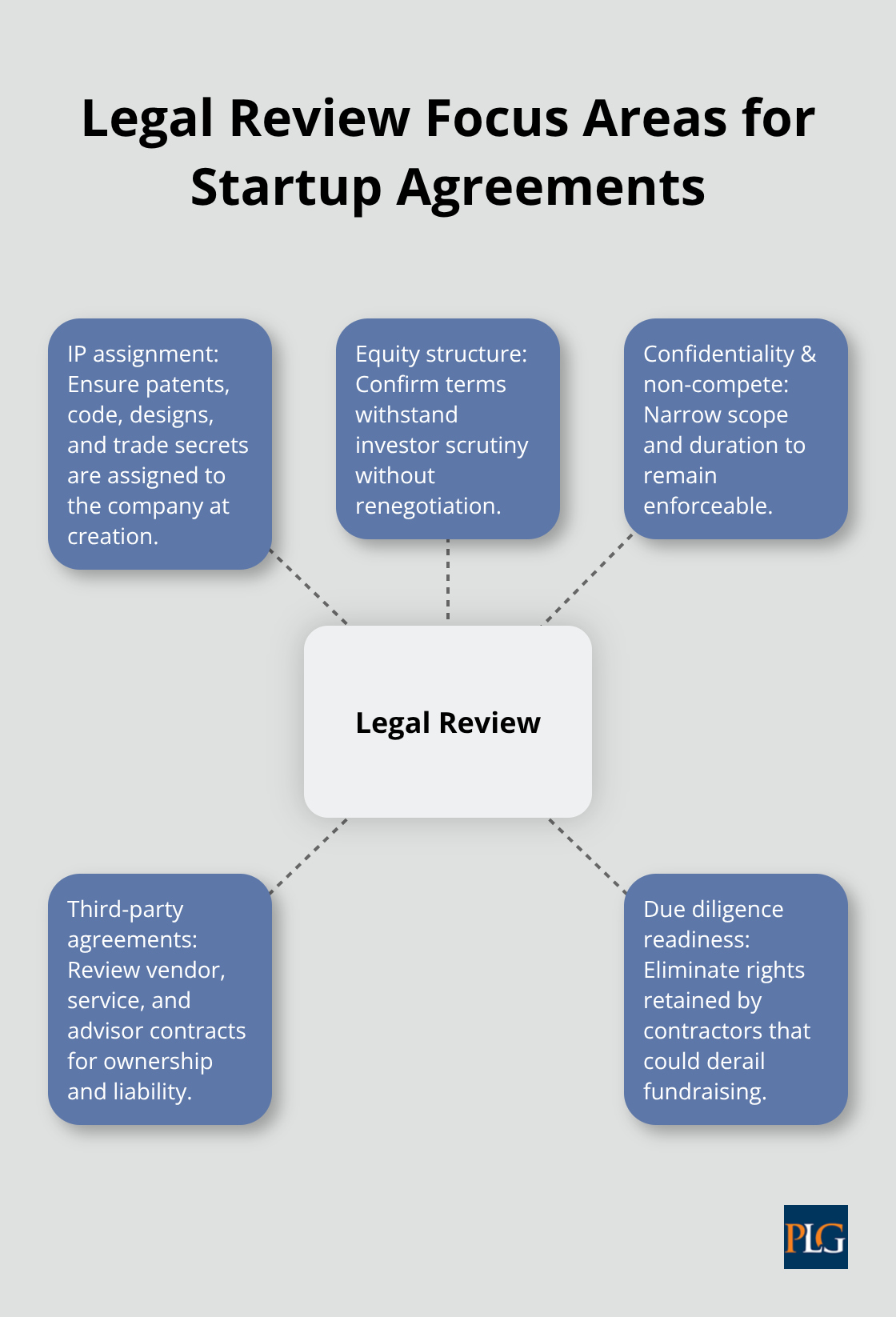
When reviewing agreements, focus on three critical areas: does the language clearly assign intellectual property to the company, does the equity structure survive investor scrutiny without requiring renegotiation, and do confidentiality and non-compete terms narrow enough to be enforceable. Have an attorney review not just employment agreements but also vendor contracts, service agreements, and advisor arrangements. Many founders skip legal review on smaller contracts and then discover during due diligence that a contractor retained rights to technology or a vendor owns improvements they made to your product (which can derail fundraising entirely).
Final Thoughts
Tech startup agreements form the foundation of every successful company, yet most founders treat them as legal formalities rather than strategic tools. The three elements covered in this post-intellectual property ownership, equity structures, and confidentiality clauses-appear in nearly every startup dispute we encounter. Getting these right from day one prevents the cap table errors, ownership conflicts, and vendor disputes that derail fundraising and drain resources.
The practical reality is that tech startup agreements must accomplish two things simultaneously: they protect your company today while remaining flexible enough to survive tomorrow’s growth. A contract that works for a three-person team often breaks when you raise capital or bring on investors, which is why embedding milestones, triggering events, and flexibility into your agreements now saves months of renegotiation later. The founders who succeed treat contracting as an ongoing process, not a one-time event.
If your startup needs guidance on contracting strategy or review of existing agreements, contact Primum Law Group to discuss your situation. We work with startups at every stage, from pre-seed through Series C and beyond, handling the specific challenges that tech companies face. The right legal foundation makes everything else possible.