

Intercompany contracts negotiation often fails when teams across different regions operate without alignment. Mismatched objectives, unclear payment terms, and poor risk allocation create friction that slows deals and increases costs.
At Primum Law Group, we’ve seen how the right governance structures and tools transform these negotiations. This post covers the pitfalls to avoid and the practical strategies that get global teams on the same page.
Where Intercompany Negotiations Break Down
Division leaders across your organization negotiate from different playbooks. Sales teams want favorable payment terms to boost cash flow. Finance pushes for strict currency hedging. Operations demands risk protections that legal views as unenforceable. When these groups operate independently, intercompany contracts become a patchwork of competing interests rather than coherent agreements.
The result is slower cycles, weaker terms, and exposure to tax authorities who scrutinize misalignment between contract language and actual operations. IRS Section 482 gives regulators explicit authority to reallocate income if intercompany pricing fails to reflect economic substance, and they use this power regularly. The Coca-Cola case resulted in a $3.3 billion IRS adjustment partly because intercompany licensing terms did not align with how the business actually functioned. Your divisions need a shared framework before negotiating with counterparties, not after.
Payment Terms Create Immediate Friction
Currency mismatches and payment timelines collide fastest across divisions. One subsidiary wants payment in its home currency to avoid exchange risk. Another insists on net-60 terms for working capital. A third demands monthly settlements tied to usage metrics that no one can measure consistently. These disagreements paralyze negotiations and leave agreements unsigned or retroactively modified.
Retroactive changes trigger audit red flags because tax authorities view them as evidence that the original terms were not genuine. Unsigned agreements or agreements signed after the tax year begins create compliance gaps that regulators exploit. Establish your payment terms and document them before the fiscal year starts. Define currency exposure clearly, specify settlement frequency, and tie payment triggers to measurable operational events. If multiple currencies are involved, decide upfront whether you will hedge, pass through volatility, or fix exchange rates. This removes negotiation friction and produces audit-ready documentation.
Risk Allocation Without Teeth
Intercompany contracts often assign risks on paper without matching them to actual responsibilities. A service agreement might state that one entity bears operational risk, but the contract lacks enforcement mechanisms or consequences for failure. An IP licensing agreement allocates royalty risk without defining how royalty adjustments occur if market conditions shift. A cost-sharing agreement outlines allocation formulas but fails to specify what happens if one party stops participating.
These gaps invite disputes and create openings for tax authorities to rewrite terms based on real-world conduct. The arm’s length principle requires that risk allocation reflect what independent parties would negotiate. If your contract assigns risk to an entity that lacks the resources or control to manage it, regulators will view the allocation as artificial. Ensure each party has the functional capacity and authority to bear the risks assigned to it. Document why the risk allocation makes economic sense. Include dispute resolution clauses with clear escalation paths and remedies so disagreements do not fester into compliance failures.
Alignment Starts Before External Talks Begin
Your internal teams must reach consensus on pricing, risk, and payment terms before you sit down with counterparties. When sales, finance, legal, and operations each push their own minimums, little room remains for creative trade-offs at the negotiation table. This internal deadlock slows deal cycles and weakens your position with the other party. Surface options internally and build consensus around those options before external talks begin. This shift-treating internal alignment as part of the negotiation itself-removes friction and accelerates outcomes.
How to Build Decision-Making Authority That Sticks
Internal misalignment happens because no single person owns the decision. Sales pushes for lenient payment terms. Finance demands currency hedging. Legal wants airtight IP protections. Operations needs operational risk caps. Without a clear decision-maker and a structured approval process, these groups negotiate separately with external counterparties, producing inconsistent terms and audit exposure.
Assign One Owner to Set Internal Guardrails
Establish a single decision authority for intercompany contracts-ideally someone in finance or legal who understands both commercial and tax implications. This person does not negotiate externally; instead, they set internal guardrails and approve all material terms before your team talks with counterparties. Define what counts as material: changes to payment frequency, currency exposure, risk allocation, and pricing methodology always require approval. Routine adjustments tied to volume or usage may not.
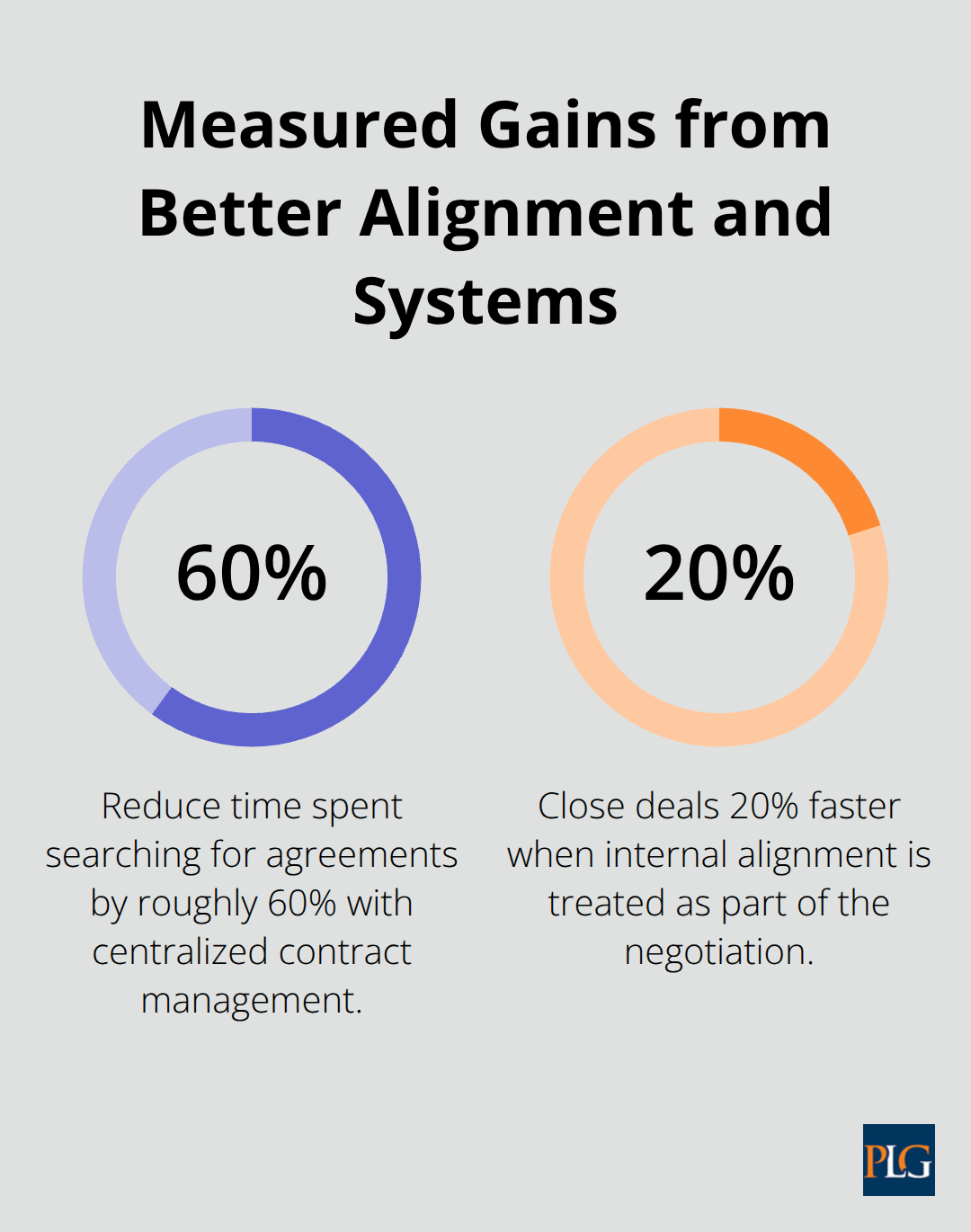
Document this authority structure in writing and share it with all divisions. When sales knows that finance approval is non-negotiable, they adjust expectations upfront rather than pushing back mid-negotiation. Harvard Business School research on enterprise negotiation found that organizations treating internal alignment as part of the negotiation itself close deals 20 percent faster and achieve stronger terms than teams that lock in rigid instructions beforehand. The shift works because negotiators return with options and recommendations rather than fixed concessions, giving decision-makers credible leverage with counterparties.
Use Standard Terms as Your Starting Point
Do not start each negotiation from scratch. Develop three to five standard contract templates covering your most common transactions: service agreements, IP licensing, cost-sharing, and financing. Each template should embed arm’s length pricing methodology, clear payment triggers tied to measurable events, and dispute resolution language that reflects your risk tolerance.
Templates reduce negotiation scope dramatically. When both internal teams and external counterparties know that certain terms are non-negotiable-such as payment currency, settlement frequency, and force majeure definitions-conversation focuses on the few items that actually move risk or value. Mature markets like Eurobond term-setting operate almost entirely on standardized terms with only a handful of negotiated points. Your intercompany contracts should follow the same model. Customize templates for geographic or functional variations, but preserve core protections across all agreements.
This consistency also strengthens your position during tax audits because regulators see uniform policies applied across entities rather than ad hoc arrangements that invite scrutiny. Cross-functional teams should review templates annually and update them when tax rules change or new transaction types emerge. Assign ownership of template maintenance to your legal and finance leads so updates roll out consistently rather than sitting in email threads.
Involve Finance and Operations Early
The biggest negotiation failures occur when legal and sales design contracts without input from those who execute them. A service agreement might specify monthly billing based on headcount, but operations cannot measure headcount consistently across systems. An IP licensing agreement ties royalties to revenue, but finance uses three different revenue definitions depending on the subsidiary. A financing agreement assumes quarterly interest payments, but treasury processes payments monthly.
These misalignments between contract language and operational reality create compliance gaps that tax authorities exploit. Involve finance and operations at the template design stage, not after drafting. Finance should confirm that the pricing methodology and payment terms map to actual billing systems and cash flow processes. Operations should validate that any measurement metrics in the contract (headcount, usage, transaction volume) can be tracked reliably. Legal should then document how the contract language reflects these operational realities.
This upstream coordination compresses negotiation timelines and produces agreements that both parties can actually execute. When counterparties see that your terms reflect real operational capacity rather than theoretical constructs, they negotiate faster and with greater confidence because they know implementation will not stall. The next chapter covers how to structure these agreements so they withstand regulatory scrutiny and support your transfer pricing documentation.
Building a Contract System That Actually Works
Intercompany contracts live or die based on execution, and execution depends on whether your team can find the agreement, track changes, coordinate feedback, and produce audit-ready documentation without drowning in email threads and outdated versions. Most organizations store contracts across SharePoint folders, email inboxes, and local drives, which means negotiators waste hours searching for the current version while losing track of who approved what. This fragmentation compounds during tax audits when regulators demand proof that agreements existed before the fiscal year started and reflected actual operations.
Consolidate Agreements in One Searchable Repository
A centralized contract management system eliminates this chaos by consolidating all agreements in one searchable repository with automated version control, audit trails, and metadata that maps each agreement to your transfer pricing documentation. When you upload an intercompany service agreement, the system automatically captures the parties involved, pricing methodology, payment terms, effective date, and expiration date so you can instantly identify which agreements apply to which fiscal years and transactions. Role-based access controls restrict upload and validation rights to designated users in legal and finance, preventing unauthorized changes while enabling operations and business units to view terms they need to execute.
Enable Real-Time Collaboration Across Teams
Real-time collaboration platforms allow multiple teams to comment on draft terms simultaneously without creating separate versions, compressing negotiation cycles that traditionally stretch across weeks. Platforms like Ramp include custom coding fields that let you tag agreements by transfer pricing category, entity, transaction type, and regulatory framework, making it trivial to pull all IP licensing agreements or service agreements tied to specific tax jurisdictions during audit preparation. Automated expiration and renewal notifications flag agreements approaching their end dates so you can initiate renegotiations months in advance rather than scrambling when terms lapse.
Close Compliance Gaps Before Auditors Find Them
The system detects missing or outdated agreements by comparing your master file inventory against actual agreements in the repository, closing compliance gaps before regulators discover them. Usage tracking shows how often each agreement was linked to financial reports and in which fiscal years, providing regulators with concrete evidence that terms were genuinely applied rather than retroactively invented. A dashboard displaying the status of all active agreements across regions and entities gives finance and legal visibility into bottlenecks and renewal risk, enabling proactive management instead of reactive firefighting.
Accelerate Audits and Strengthen Your Position
Teams that implement centralized contract management reduce time spent searching for agreements by roughly 60 percent, accelerate negotiations by eliminating version confusion, and produce audit-ready documentation that regulators expect. When your finance team needs to prove that an IP licensing agreement existed before the tax year began and accurately reflected royalty rates, pulling the agreement from the system with a complete audit trail showing signatures and approval dates takes minutes instead of days.
This speed and transparency matter during audits because regulators view organized, consistent documentation as a signal that your transfer pricing policies were genuine and not engineered to minimize tax. Establish your system before you need it during an audit, and train all divisions on how to upload, search, and retrieve agreements so the repository becomes the single source of truth rather than another tool that sits unused.
Final Thoughts
Successful intercompany contracts negotiation hinges on three fundamentals: internal alignment before external talks, standardized terms that reflect operational reality, and centralized systems that keep agreements audit-ready. When your divisions operate from a shared playbook instead of competing agendas, negotiation cycles compress and contract terms strengthen. The Coca-Cola case showed what happens when intercompany agreements drift from actual business operations-a $3.3 billion IRS adjustment that could have been prevented with proper governance and documentation.
Tax authorities now use data analytics and AI to detect inconsistencies between contract terms and real-world conduct, and IRS Section 482 gives regulators explicit authority to reallocate income if intercompany pricing fails to reflect economic substance. EU transfer pricing rules penalize agreements that do not reflect economic reality, while Asia-Pacific jurisdictions require disclosure of risk allocation and benchmarking data. Your intercompany contracts are the first documents regulators examine during audits, and weak agreements invite adjustments and penalties that compound across years.
Organizations that move fastest treat internal alignment as part of the negotiation itself, establish one decision authority who sets guardrails before external talks begin, use three to five standard templates that embed arm’s length pricing and clear payment triggers, and consolidate agreements in searchable repositories with version control and audit trails. If your organization is scaling internationally or restructuring entities across regions, contact Primum Law Group to review your current intercompany agreements and strengthen your transfer pricing documentation before auditors arrive.