

Corporate law education requirements in San Francisco and beyond aren’t optional-they’re the foundation of a legitimate practice. State licensing boards, continuing education mandates, and compliance standards create a complex landscape that demands your attention.
At Primum Law Group, we’ve guided countless attorneys through these requirements without wasting time or money on irrelevant courses. This guide cuts through the confusion and shows you exactly what you need to know and do.
What California Actually Requires for Corporate Law Practice
Five Pathways to California Bar Admission
California’s corporate law education system operates on two distinct tracks, and choosing the wrong path costs you years and thousands of dollars. The State Bar of California recognizes five legitimate routes to becoming a lawyer: ABA-accredited law school (three to four years), state-bar-registered fixed-facility law school (four years), unaccredited distance learning or correspondence programs (four years with a minimum 864 hours), study under a state judge or attorney (four years), or a combination of these pathways. This flexibility matters because each route carries different credit implications and timeline variations.
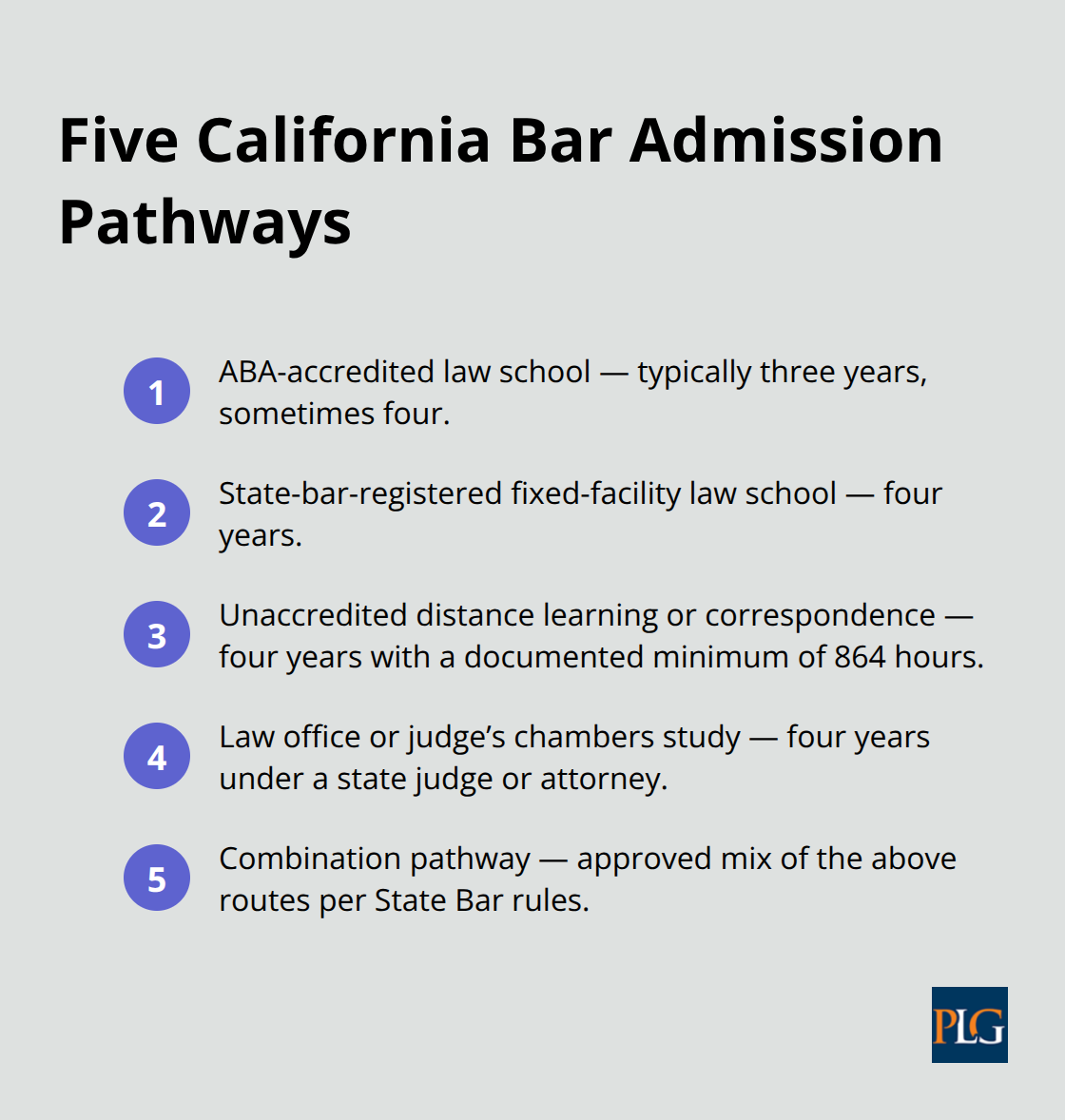
ABA-accredited programs typically compress into three years, while other routes stretch to four. If you’re considering an unaccredited distance-learning program, understand that you must document and complete exactly 864 hours of preparation over your four-year period-anything less disqualifies you from bar eligibility. The State Bar’s dual accreditation structure (both ABA and State Bar accreditation) means you have genuine options, but that also means you need clarity on which option aligns with your timeline and learning style. Don’t assume all law schools are created equal in California; they aren’t, and the path you select determines how quickly you can sit for the bar exam.
The Three-Year MCLE Compliance Cycle
Once you’re practicing corporate law in California, the education requirements don’t stop-they intensify. Active attorneys must complete a minimum of 25 hours of Continuing Legal Education every three years according to California State Bar standards. This isn’t busywork; it’s a compliance mandate with real consequences for noncompliance. The State Bar operates on a three-year compliance cycle, and your specific reporting window depends on your assigned MCLE compliance group within the State Bar system. Track your credits through your My State Bar Profile account, and maintain detailed records of every course you take because the State Bar conducts audits without warning. Different activities qualify for different credit types, so verify that each course you select actually counts toward your 25-hour requirement before enrolling.
Deadlines and Financial Penalties
Missing an MCLE deadline triggers penalties that compound quickly. The State Bar waived late fees for renewals submitted by January 30, 2026, but that grace period is temporary, and future deadlines carry financial consequences. Law corporations in California face additional scrutiny-they must renew annually through the Agency Billing system with a $103 annual renewal fee plus a $257 application fee. Guarantees increased effective February 21, 2025, to $51,350 per claim and $102,700 per attorney, reflecting rising compliance costs. Plan your education schedule around these deadlines, not the other way around. The next section examines which specific corporate law topics you must master to meet these requirements and build a defensible practice.
Key Corporate Law Knowledge for San Francisco Practitioners
Business Formation and Entity Structure
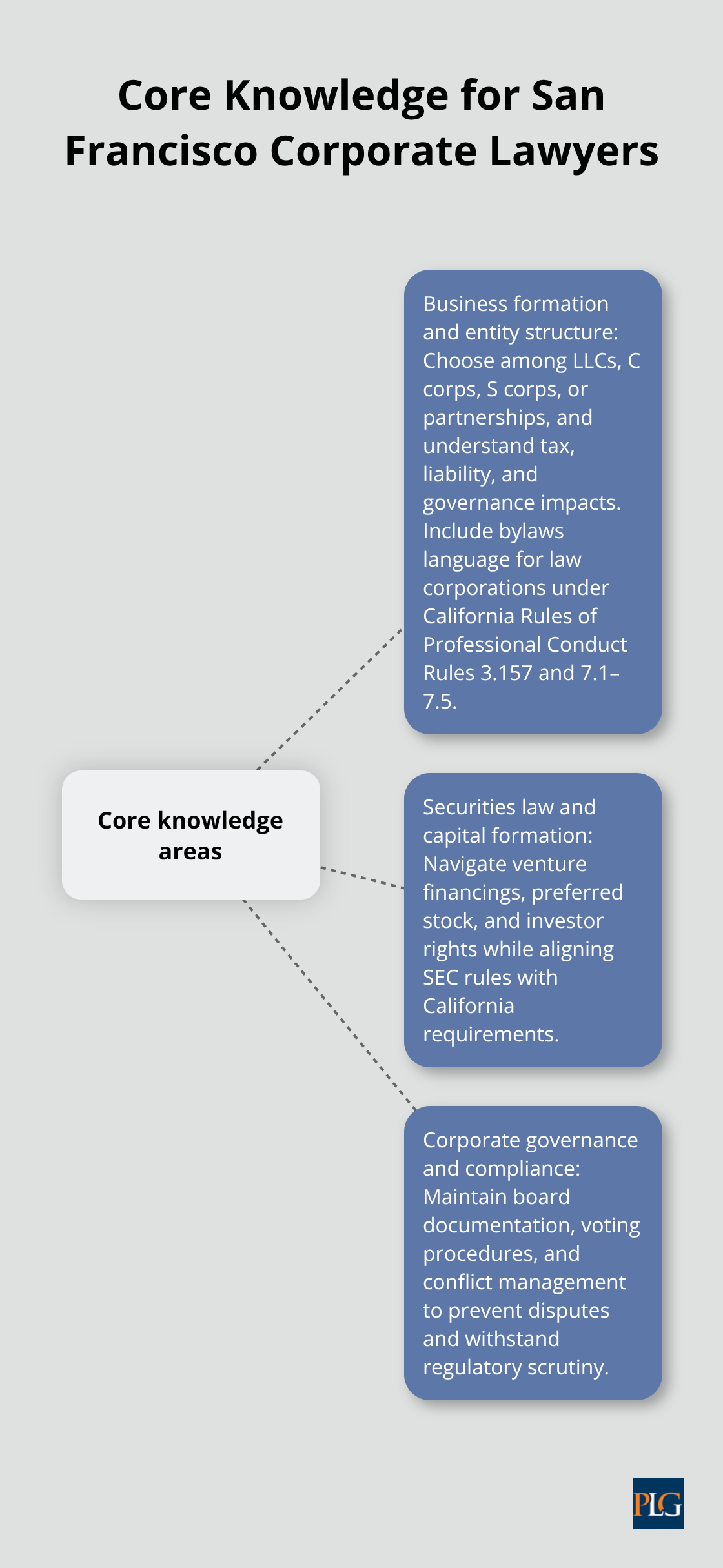
Corporate law education in San Francisco demands mastery of three interconnected domains that directly impact your ability to advise clients and maintain compliance. Business formation and entity structure determine how your clients organize themselves, what tax implications follow, and which governance rules apply. When clients approach you, they need answers about whether to form an LLC, C corporation, S corporation, or partnership structure. Each entity type carries different tax consequences, liability protections, and administrative burdens. California corporate lawyers handle formation documents constantly, so understand the bylaws language required for law corporations under California Rules of Professional Conduct Rules 3.157 and 7.1–7.5. This foundational knowledge separates attorneys who can actually serve clients from those who merely process paperwork.
Securities Law and Capital Formation
Securities law governs how companies raise capital and manage investor relationships, a critical skill since the average venture-backed startup raises capital multiple times during its lifecycle. You’ll encounter venture capital transactions, preferred stock issuances, and investor rights agreements regularly in San Francisco’s startup ecosystem. The SEC maintains detailed guidance on securities regulations that apply across state lines, and California’s proximity to Silicon Valley means your clients will routinely navigate federal securities requirements alongside state rules. Capital formation is how startups and growth companies survive, so this knowledge directly translates to client value.
Corporate Governance and Compliance Obligations
Corporate governance obligations extend beyond formation into ongoing compliance, board meeting documentation, shareholder voting procedures, and conflict-of-interest management. Many attorneys underestimate governance complexity until they face a shareholder dispute or SEC inquiry. These three areas form the backbone of corporate law practice, and your education strategy must target them specifically rather than wasting time on tangential topics that rarely appear in your actual client work.
Selecting Courses That Match Your Practice
When selecting continuing education, prioritize courses in Business Associations, Securities Regulation, Corporate Governance, and Transactional Skills rather than general business law overviews. The University of San Francisco Law School offers specialized courses in these exact domains, including Corporate Governance, Securities Regulation, and Business Associations, which provide the depth you need. Choose providers who teach practical application rather than theory. Your clients don’t care about abstract corporate law concepts; they care whether you can draft a shareholder agreement, structure an equity issuance, or identify governance gaps in their current operations (and whether you can do it efficiently). This practical focus separates competent corporate lawyers from those who merely pass compliance requirements.
Building Practical Skills Over Theoretical Knowledge
Your MCLE courses should target these three areas directly. Try selecting education that emphasizes real-world application, not abstract principles. The attorneys who thrive in corporate practice master these domains through hands-on experience combined with targeted continuing education. As you build this knowledge foundation, the next section shows you how to structure your education timeline and track credits to avoid penalties while staying current with California’s compliance demands.
How to Structure Your Education Timeline Without Wasting Time
Front-Load Your Compliance Hours Early
Most San Francisco corporate lawyers treat MCLE as a checkbox exercise rather than a strategic investment in their practice. You have 25 hours to complete every three years, which sounds manageable until you realize you’re juggling client work, business development, and actual learning. The solution requires brutal honesty about your schedule. If you wait until month 34 of your three-year cycle to search for courses, you’ll enroll in whatever’s available rather than what actually matters for your practice.
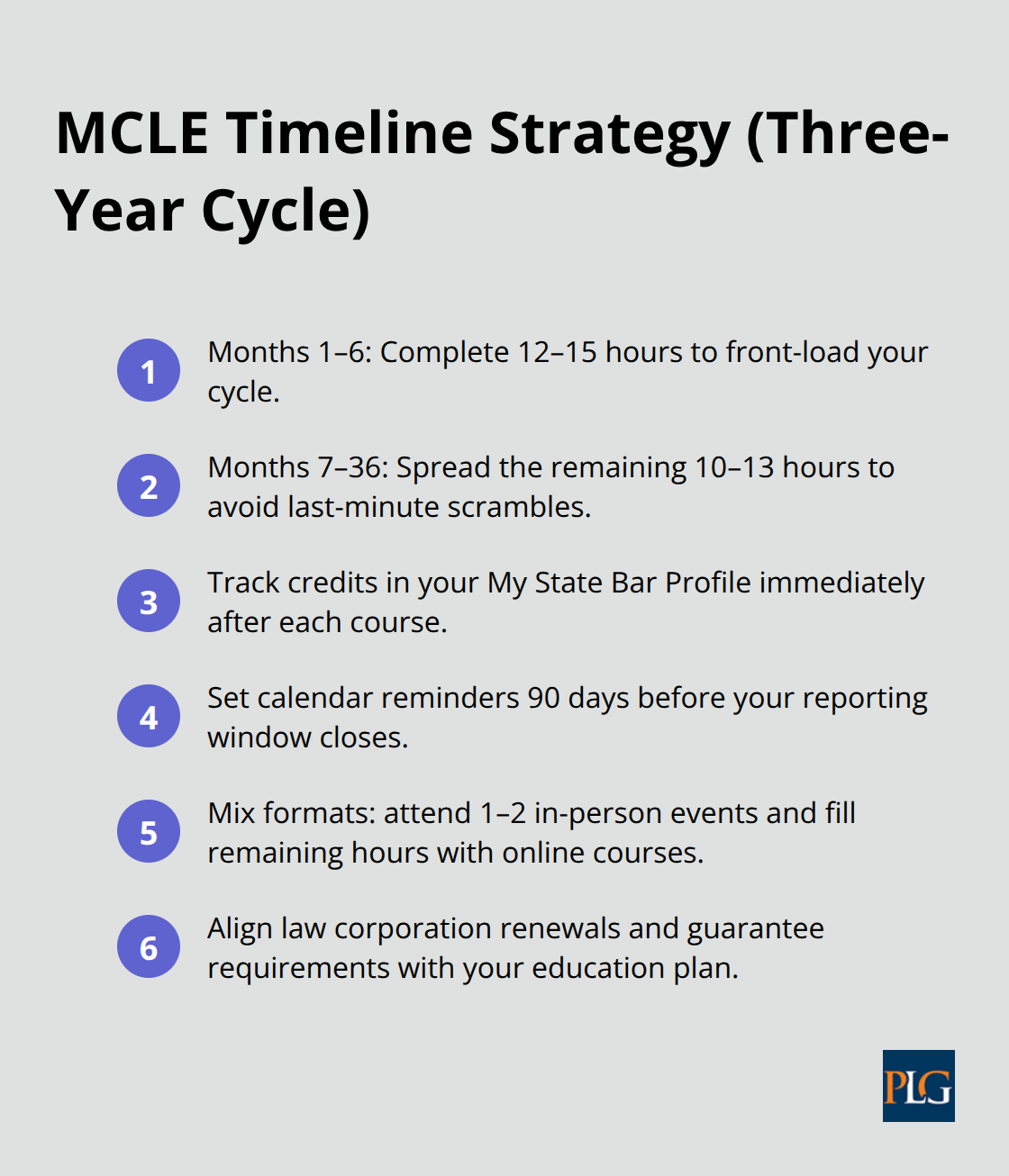
Front-load your education in year one of your compliance cycle instead. Take 12 to 15 hours in months one through six, then spread the remaining 10 to 13 hours across the next two and a half years. This approach eliminates the panic-driven course selection that wastes money on irrelevant content.
When you select courses early, you can evaluate whether they cover Business Associations, Securities Regulation, Transactional Skills, or Corporate Governance rather than settling for generic business law topics that won’t improve your client work.
Use Your State Bar Profile to Track Deadlines
The State Bar’s Agency Billing system tracks your renewal deadlines automatically once you log into your My State Bar Profile. Set calendar reminders for 90 days before your reporting window closes. This gives you cushion time to complete final hours without incurring late fees that previously reached $113 before the State Bar waived them through January 30, 2026.
Combine Online and In-Person Learning
Hybrid learning works better than pure online or in-person for corporate law education. Online courses let you control timing around client emergencies, but in-person seminars at legal conferences create networking opportunities that lead to referrals and knowledge exchanges with peers facing identical challenges. The Clio Cloud Conference, for example, combines continuing education with practical insights about legal technology and practice management that directly reduce your operational costs. Attend one or two in-person events per year and fill remaining hours with online courses from providers like the State Bar’s own MCLE resources or law school continuing education programs.
Document Credits Immediately After Completion
Track every credit immediately after completing a course rather than waiting until your reporting deadline. Create a spreadsheet listing course name, provider, completion date, credit hours, and credit type, then upload that documentation to your My State Bar Profile before your deadline arrives. This prevents the common audit scenario where the State Bar requests verification and you scramble to retrieve certificates from providers who’ve moved or changed their systems.
Align Law Corporation Renewals With Your Education Calendar
Law corporations face additional complexity because they must annually renew through Agency Billing with the $103 renewal fee plus documentation requirements. Guarantee amounts increased to $51,350 per claim effective February 21, 2025. Verify your law corporation’s bylaws contain exact language from California Rules of Professional Conduct Rule 3.157 before renewal deadlines arrive, and submit original documents rather than photocopies since the State Bar rejects copies without exception. Your education timeline should integrate with your law corporation’s renewal calendar so you’re not juggling separate compliance deadlines simultaneously.
Final Thoughts
Corporate law education requirements in California demand ongoing commitment, not a one-time investment. The five pathways to bar admission, the 25-hour MCLE cycle every three years, and the specialized knowledge in business formation, securities law, and corporate governance create a framework that separates competent practitioners from those who cut corners. Your education strategy determines whether you serve clients effectively or fumble through transactions that should feel routine.
Staying current with corporate law education directly strengthens your practice and client relationships. When you master Business Associations, Securities Regulation, and Transactional Skills through targeted continuing education, you handle venture capital transactions, equity issuances, and governance disputes with confidence rather than uncertainty. Your clients notice the difference immediately-they receive faster turnarounds, more sophisticated advice, and fewer costly mistakes because you invested in genuine knowledge rather than checkbox compliance.
Front-load your MCLE hours in year one of your compliance cycle, track credits through your My State Bar Profile immediately after completion, and select courses that directly address your client work rather than generic business law topics. If you operate a law corporation, align your education timeline with your annual renewal deadlines and guarantee requirements that increased effective February 21, 2025. We at Primum Law Group handle the complex transactions, governance structures, and capital formation challenges that demand current knowledge and practical skills.