

Founder equity structure determines who owns what, who makes decisions, and what happens when things change. Getting this wrong costs founders millions in disputes, dilution problems, and tax headaches.
We at Primum Law Group have seen countless startups struggle because their equity agreements were either too loose or too restrictive. This guide walks you through the real decisions you need to make.
How Founder Equity Actually Gets Divided in San Francisco Startups
The 50-50 split between co-founders sounds fair in theory, but it rarely works in practice. A 2023 Carta analysis of over 30,000 cap tables found that only 28% of co-founder teams used a strict equal division. The remaining 72% weighted equity based on who brought what to the table-specific skills, initial capital, customer relationships, or sweat equity timing.
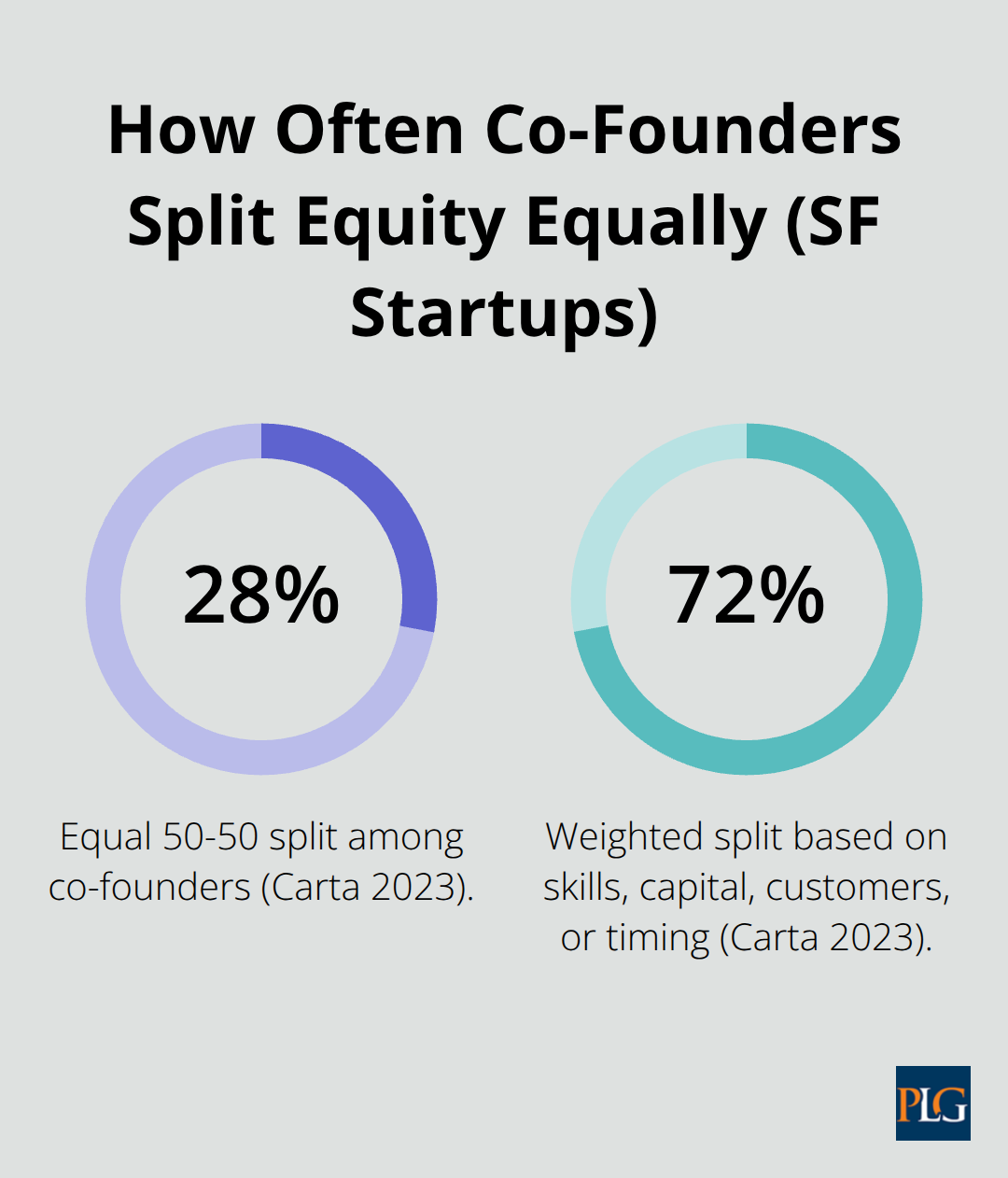
The problem with equal splits emerges when one founder joins three months after incorporation while another spent a year building the product alone. Without addressing this timing gap upfront, you reward someone for showing up late with the same ownership as someone who took the early risk.
Unequal Splits Reflect What Founders Actually Contribute
Unequal equity structures work because they reflect reality. One founder might contribute 40% of initial capital while another brings a customer list worth $500,000 in ARR. A third handles operations and hiring. The mistake founders make is leaving these contributions vague. Instead of saying someone gets 5% more equity for being CTO, calculate what that role was worth-did they prevent hiring an external CTO at $200,000 per year? Did their technical network save six months of development time? Assign a value and stick to it.
The most defensible approach uses a founder equity calculator that weighs multiple factors: capital invested, time before incorporation, technical contributions, business development work, and industry connections. Once you establish this framework, document it in your shareholder agreement before funding. Investors want to see that equity was allocated thoughtfully, not split arbitrarily.
Vesting Schedules Protect Everyone Involved
Vesting schedules solve the timing problem by spreading equity grants over four years with a one-year cliff. This means if a founder leaves after 11 months, they keep nothing. After two years, they’ve earned 50% of their grant. The cliff period protects remaining founders from someone taking a large equity stake after minimal contribution.
Most San Francisco startups use four-year vesting because venture investors expect it, and it aligns with how long it typically takes to build something meaningful. A shorter vesting period leaves you vulnerable to an investor saying your equity structure suggests low confidence in founder commitment. The cliff should match your industry reality-tech startups use one year, but some deep-tech companies negotiate 18-month cliffs because the first year involves only hiring and infrastructure setup.
What Happens When Founders Leave Early
Equity clawback provisions protect your cap table when a founder departs before their equity fully vests. These provisions reclaim unvested shares and sometimes claw back vested shares if the founder leaves within the first few years. The specifics matter: some agreements reclaim only unvested equity, while others include a sliding scale that returns vested shares on a pro-rata basis during the cliff period. Your shareholder agreement should specify exactly what triggers a clawback and whether it applies to all departures or only terminations for cause. This clarity prevents disputes later and shows investors you’ve thought through founder transitions. The next section covers how voting rights and decision-making authority interact with your equity structure-because ownership percentages mean nothing if you can’t actually control what happens to your company.
Balancing Control and Incentives in San Francisco Startups
Voting Rights Determine Who Actually Controls Decisions
Ownership percentages mean nothing without clear voting rights. A founder with 30% equity but no board seat and no protective provisions watches their company get sold, pivoted, or restructured while powerless to stop it. San Francisco startups frequently skip this conversation until Series A arrives, then discover their equity structure gives them zero say in major decisions.
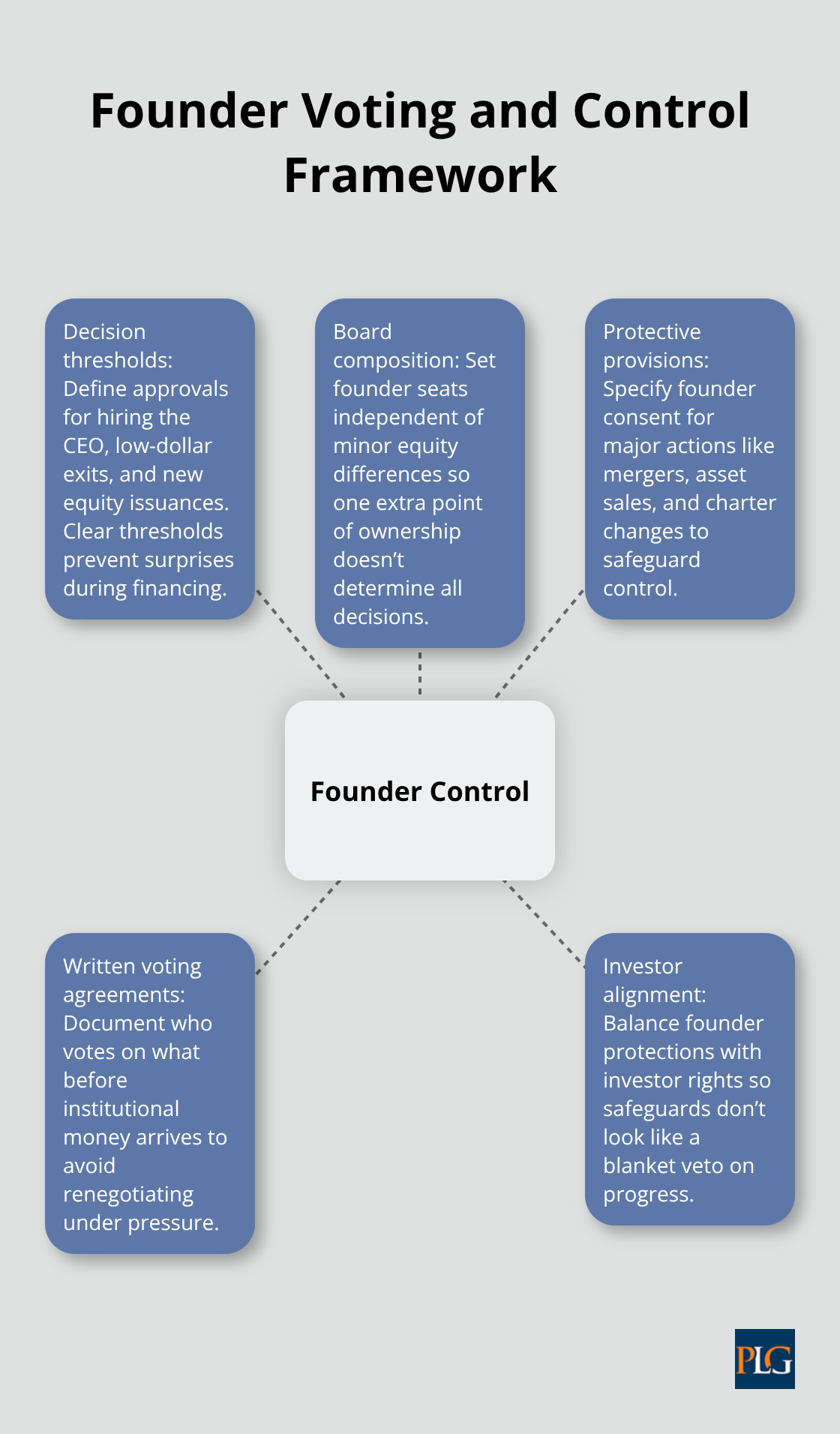
The fix starts with written voting agreements that specify who votes on what. Series A investors will demand board seats and protective provisions anyway, so establish your founder voting framework now rather than fight about it later. Most venture-backed startups give founders board seats proportional to their equity stake, but this fails when one founder owns 40% and the other owns 35%-a one-seat difference shouldn’t determine decision-making power.
Instead, structure voting rights around specific decisions: hiring the CEO requires founder approval, any sale under $10 million requires founder approval, and equity issuance beyond a certain threshold requires founder consent. Document these thresholds in your shareholder agreement before institutional money arrives. This protects your control without looking like you’re blocking investor influence.
Anti-Dilution Clauses Protect Your Ownership Through Funding Rounds
Anti-dilution provisions directly impact how much equity you retain through future funding rounds. Two types exist: broad-based weighted average and narrow-based weighted average. Broad-based weighted average includes all outstanding shares when calculating your dilution, which is fairer to founders but harder to negotiate with investors. Narrow-based only includes preferred shares, heavily favoring existing investors.
If your seed round valued the company at $5 million and your Series A values it at $20 million, broad-based anti-dilution softens the impact on your stake. Narrow-based makes the dilution worse. Founders should push for broad-based anti-dilution clauses in seed agreements because Series A investors will demand narrow-based protections anyway, and negotiating this early gives you leverage.
Salary Versus Equity: The Trade-Off Every Founder Faces
Most San Francisco startups underpay founders in salary to preserve cash and align incentives through equity. The median founder salary at pre-seed stage is $60,000 according to Carta’s 2024 founder compensation report, while Series A founders averaged $120,000. This gap reflects both company stability and runway availability.
Your equity allocation should compensate for below-market salary. If you’re paying yourself $80,000 when market rate is $150,000, your equity package needs to make up that $70,000 annual gap over your four-year vesting schedule. Calculate this explicitly rather than guessing. One founder takes 8% equity to match their salary sacrifice, another takes 6% because they negotiated higher cash compensation.
Document these trade-offs in writing so future disputes don’t arise from vague assumptions about who earned what. This clarity becomes critical when you approach Series A funding, as investors scrutinize founder compensation structures to assess whether equity allocations reflect actual contributions or political compromises. Your next step involves understanding the legal agreements that lock these decisions in place-shareholder agreements, buy-sell provisions, and founder departure clauses all determine what happens when circumstances change.
Protecting Your Equity Through Legal Agreements in San Francisco Startups
Shareholder Agreements Lock In Your Equity Structure
Your shareholder agreement is the document that actually locks in everything discussed so far. Without one, your equity structure exists only as a handshake, and when disputes arise-which they will-you have no protection. A 2022 survey by the American Bar Association found that 34% of startup founders never formalized their equity arrangements in writing, creating massive liability when co-founders disagree on ownership percentages, vesting schedules, or what happens if someone leaves.
The shareholder agreement specifies vesting terms, clawback triggers, buy-sell provisions, and voting rights in legally binding language that holds up in court. San Francisco startups should treat this document as non-negotiable, not optional. Your agreement needs to address what happens when a founder departs voluntarily, gets fired, or becomes unable to work.
Buy-Sell Provisions Prevent Hostile Ownership Situations
If Founder A owns 35% and walks away after 18 months, does Founder B have the right to purchase their remaining vested equity at fair market value, or can Founder A sell to an outside investor? Without a buy-sell provision, you could end up with a hostile minority shareholder who opposes every major decision.
Most agreements include a right of first refusal, giving remaining founders the chance to purchase departing founder shares before they go to outsiders. Price these shares using a predetermined formula-typically a multiple of revenue or a valuation from your last funding round-rather than negotiating price during an emotional departure. The equity clawback mechanism you established earlier needs legal teeth. Specify exactly which shares get reclaimed if someone leaves during the cliff period, whether clawbacks apply to vested equity after early departure, and how the company exercises this right. Some agreements include acceleration clauses that vest all remaining equity if the company is sold or if a founder is terminated without cause, protecting founders from losing equity during a liquidity event.
83(b) Elections Determine Your Tax Burden
Section 83(b) elections, filed with the IRS within 30 days of receiving equity, determine when you pay taxes on your shares. Without an 83(b) election, you pay taxes only when your equity vests, meaning you owe taxes in years two through five as shares vest. With an 83(b) election, you pay taxes upfront on the full value of your equity grant at the time you receive it, usually when the company is worthless or nearly worthless.
This creates massive tax savings because the difference between what you paid and what your equity is worth when you eventually sell gets taxed as capital gains rather than ordinary income. Founders who skip this step often regret it-if your equity is worth $500,000 when it vests and you haven’t filed an 83(b) election, you owe ordinary income tax on that $500,000 in the year it vests, potentially triggering a six-figure tax bill with no liquidity to pay it.
Filing Your 83(b) Election Correctly
File your 83(b) election immediately after receiving your equity grant and keep a copy for your records. State tax treatment varies, but most states follow federal treatment. Restricted stock units (RSUs), increasingly common in later-stage startups, have different tax treatment than restricted stock-RSUs are typically taxed when they vest rather than when granted, so 83(b) elections don’t apply. Understand which structure your agreement uses before assuming you need to file.
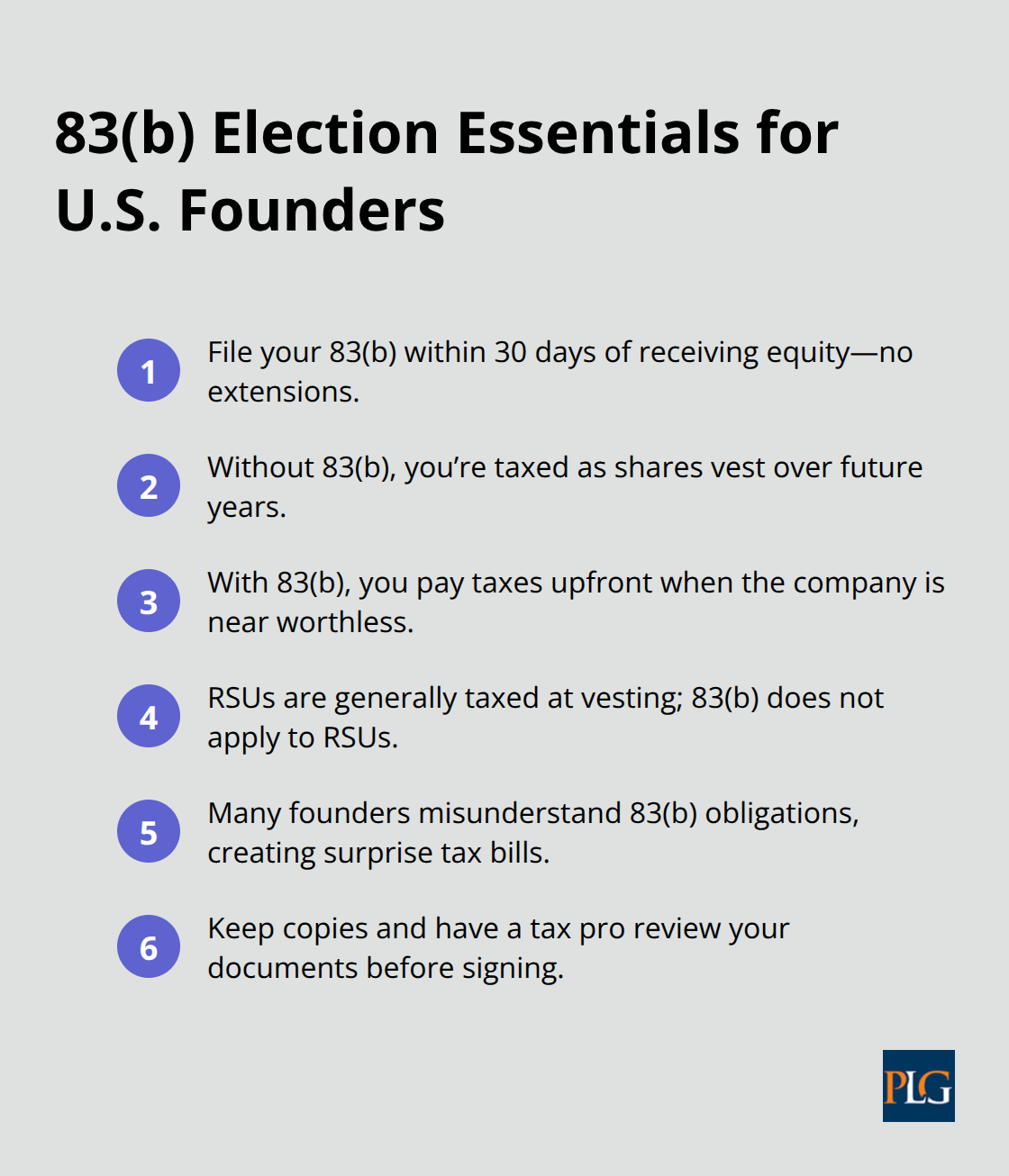
Carta’s 2024 founder tax guide noted that approximately 41% of founders misunderstood their 83(b) obligations, leading to unexpected tax liability later. The IRS doesn’t care about your intentions or whether your advisor told you something different-if you miss the 30-day window, you cannot file the election retroactively, and you’ll pay ordinary income tax on vested equity for years. Have a tax professional review your equity documents before you sign anything, as the structure of your agreement directly impacts your long-term tax burden.
Final Thoughts
Your founder equity structure determines whether your startup survives co-founder disputes or collapses under them. The decisions you make now-about vesting schedules, voting rights, anti-dilution protections, and tax filings-shape your company’s future far more than most founders realize. Document everything in writing before money arrives, align equity with actual contributions rather than good intentions, and structure your agreements to survive founder departures, funding rounds, and potential sales without triggering disputes that drain your runway.
The mistakes we see repeatedly follow a predictable pattern: founders skip the 83(b) election and face six-figure tax bills years later, use equal splits despite unequal contributions and then resent each other, ignore anti-dilution clauses and watch their ownership percentage collapse in Series A, fail to specify what happens when someone leaves, and confuse ownership percentages with actual control. Getting your founder equity structure right requires more than a template agreement downloaded from the internet-you need someone who understands both the legal mechanics and the practical realities of startup growth. We at Primum Law Group work with founders to structure equity that protects your interests, satisfies investors, and survives the chaos of building a company, handling everything from shareholder agreements and 83(b) filings to anti-dilution negotiations and founder departure provisions.