

Data privacy compliance for startups has become non-negotiable. Regulations like GDPR and CCPA now shape how companies collect, store, and use customer information, and the rules keep changing.
At Primum Law Group, we’ve seen startups struggle with compliance because they treat privacy as an afterthought. This guide walks you through building a privacy program that actually works, avoiding costly mistakes along the way.
What Privacy Laws Actually Apply to Your Startup
Europe’s GDPR Sets the Enforcement Standard
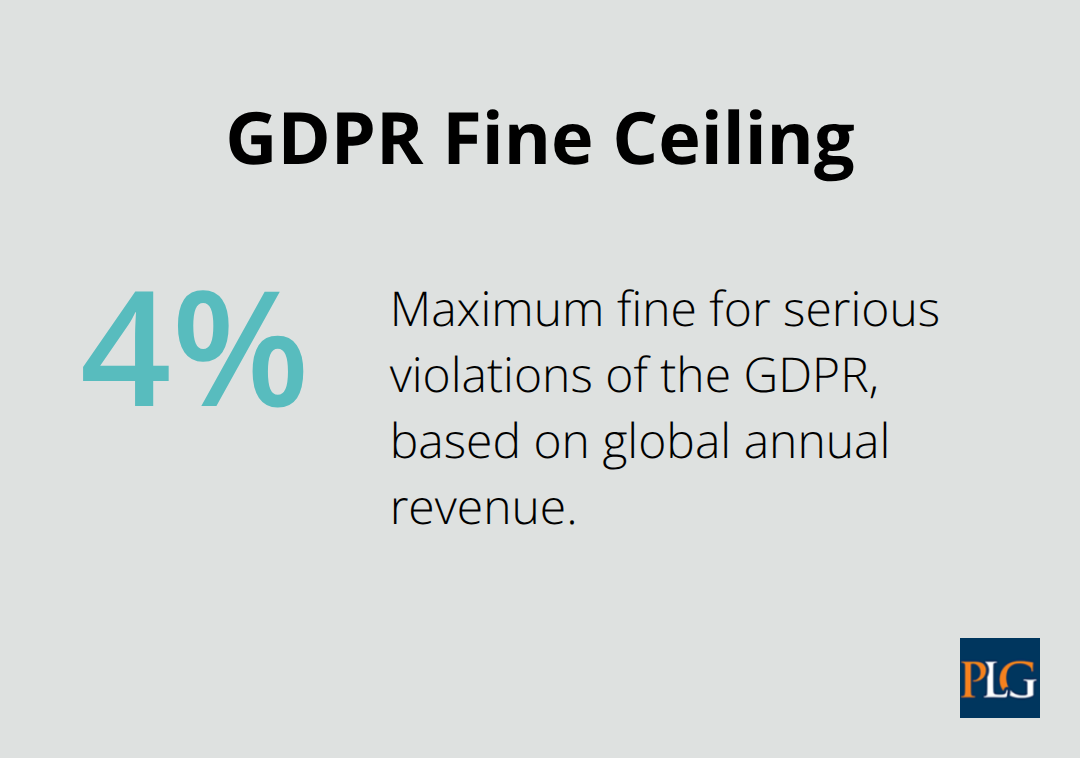
Europe’s GDPR remains the gold standard that startups reference, but treating it as your only compliance target is a mistake. GDPR fines reach up to 4% of global annual revenue for serious breaches, which sounds alarming until you realize that most enforcement actions target companies with sloppy documentation and inadequate consent mechanisms. The real lesson: GDPR’s enforcement structure forces you to map where personal data lives across your infrastructure, implement access controls, and respond to data subject requests within 30 days. If you operate anywhere in Europe or serve European customers, you cannot ignore this.
GDPR compliance actually makes compliance with other regimes easier because its standards are stricter. Once you meet GDPR’s requirements, adapting to weaker frameworks becomes straightforward. This is why many startups treat GDPR as their baseline rather than a regional afterthought.
The United States Fragmentation Problem
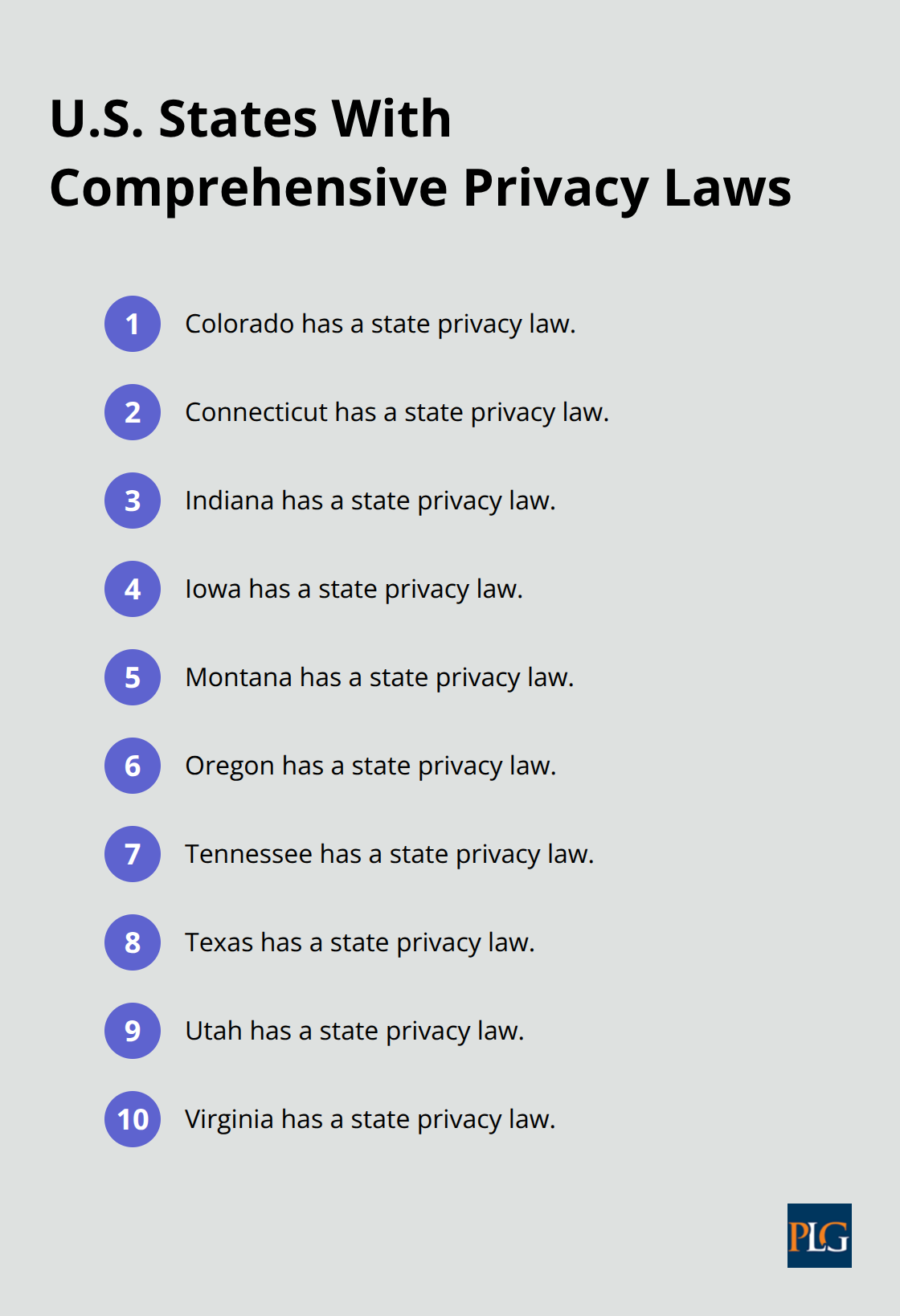
The United States presents the opposite problem. There is no federal baseline, which means 10 states now have their own privacy laws: Colorado, Connecticut, Indiana, Iowa, Montana, Oregon, Tennessee, Texas, Utah, and Virginia. Each has different definitions of personal information, different deletion requirements, and different opt-out mechanics. Texas’s SCOPE Act and California’s Age-Appropriate Design Code create specific obligations for products targeting or used by minors, which matters if your startup touches youth data at all.
The fragmentation is intentional by design-state legislatures rejected a unified approach-so you must audit which states your users live in and build compliance workflows that handle state-specific rights. This is not theoretical. A startup serving customers across five states needs five different privacy notice templates and five different deletion workflows. The American Data Privacy and Protection Act (ADPPA) sits in Congress and would theoretically preempt state laws, but its passage remains uncertain, so planning around it is premature.
Asia’s Data Localization Requirements
Asia’s privacy landscape differs fundamentally. India’s DPDP Act 2023, China’s PIPL, and Canada’s PIPEDA create their own data localization and consent requirements. India requires explicit consent for processing and mandates a Data Protection Officer for certain organizations. China’s PIPL restricts cross-border data transfers unless you meet specific conditions.
If your startup has ambitions beyond North America, you cannot bolt on compliance later. Data residency requirements mean your infrastructure choices matter immediately. Meeting localization requirements demands architectural decisions made upfront, not retrofitted afterward. The convergence myth deserves skepticism-regulators are moving toward GDPR-like standards globally, but the differences in scope and enforcement create genuine compliance complexity.
Building Your Compliance Audit Strategy
A startup claiming to be compliant everywhere is either lying or hasn’t scaled yet. Your next step involves mapping which jurisdictions your users actually occupy and which regulations apply to your data flows. This audit determines whether you need separate infrastructure, different consent mechanisms, or modified deletion workflows. The complexity is real, but it is manageable if you address it before scaling across borders.
Building a Compliant Data Privacy Program From the Ground Up
Start With a Complete Data Inventory
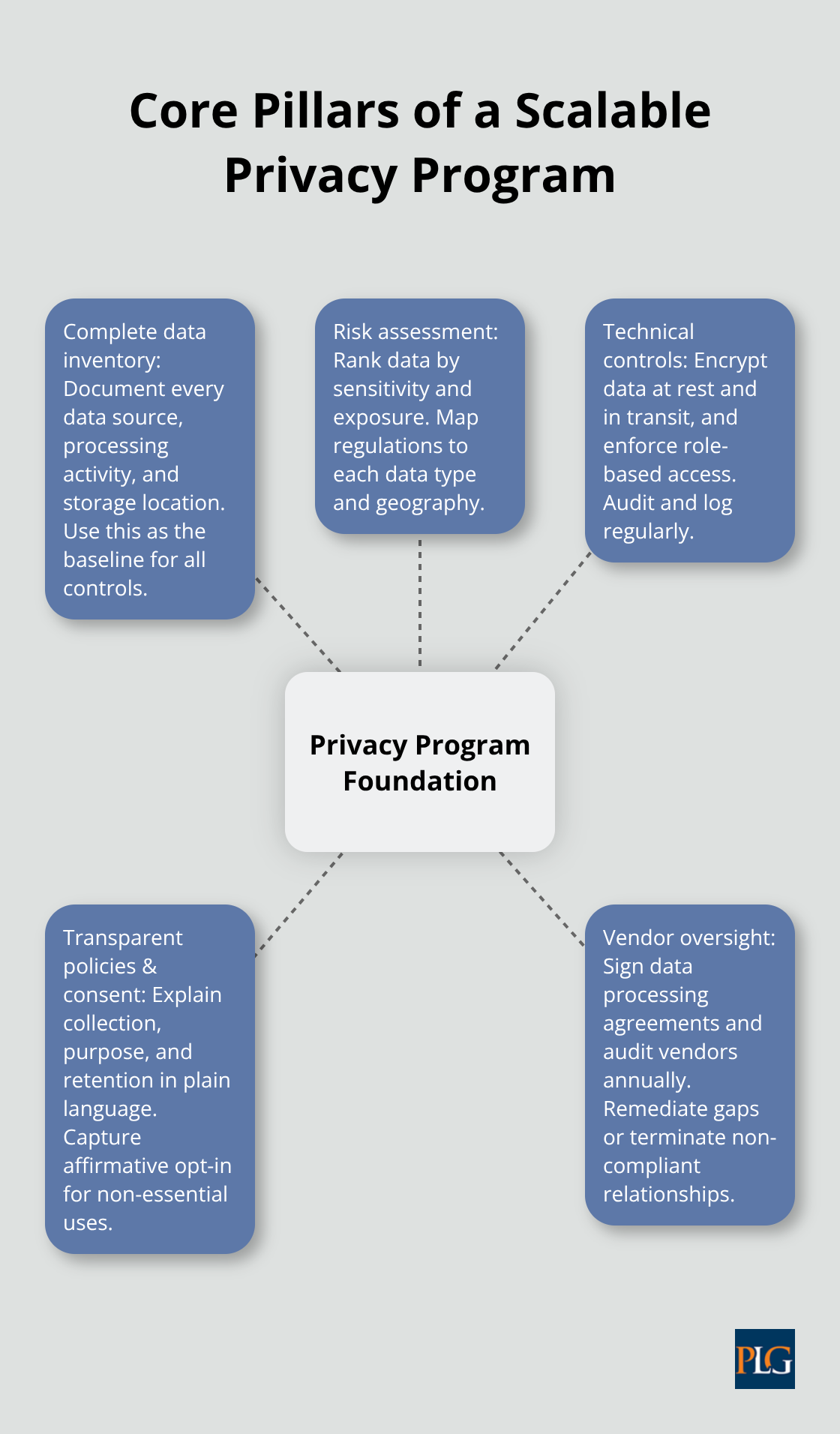
Compliance begins with a complete inventory of what data you actually hold. Most startups fail here because they assume their engineering team knows where customer information lives across databases, backup systems, cloud storage, and third-party integrations. They do not. You need a formal data audit that documents every data source, every processing activity, and every storage location. This audit becomes your foundation for everything that follows.
List all systems that touch customer data: your production database, analytics platforms, email marketing tools, customer support software, payment processors, and backup infrastructure. For each system, identify what personal information flows through it, who has access, how long it stays, and whether it leaves your infrastructure.
Assess Risk and Map Regulatory Requirements
Ponemon Institute research shows small business data breaches cost between $120,000 and over $1 million, and most occur because companies cannot account for where sensitive information actually sits. Once you complete your inventory, conduct a risk assessment that ranks your data by sensitivity and exposure.
Health data, financial information, and minors’ data carry higher regulatory risk than general contact information. Map which regulations apply to each data type based on your user geography. A startup serving European and Californian customers simultaneously must apply GDPR standards to European data and CCPA standards to California data, even if you operate from a single codebase. This is where many startups get trapped: they build one consent mechanism and one deletion workflow, then discover these cannot satisfy both regimes.
Implement Technical Controls and Encryption
Implement technical controls aligned with NIST SP 800-53 Rev. 5 standards, which provide concrete baselines for encryption, access controls, and security monitoring. Encrypt personal data at rest using AES-256 or equivalent; encrypt data in transit using TLS 1.2 or higher. Enforce role-based access controls so employees can only view data necessary for their function.
Conduct security audits at least quarterly and maintain audit logs for a minimum of 12 months. Establish a data retention schedule that deletes information when no longer needed for its original purpose. Test your deletion workflows quarterly to verify they actually remove data across all systems; many startups discover their deletion processes fail to reach backup systems or third-party integrations.
Create Transparent Policies and Consent Mechanisms
Create transparent privacy policies that explain what data you collect, why you collect it, and how long you keep it. Update these policies within 30 days of regulatory changes, not annually. Implement a consent management system that captures explicit opt-in for non-essential processing, particularly for marketing and analytics. Consent must be affirmative, not pre-checked boxes.
Document everything. GDPR requires records of processing activities; CCPA requires documentation of consumer requests and your response timelines. Maintain a vendor risk register that tracks which third parties process personal data and verify they meet your privacy standards through data processing agreements. These are not optional formalities but operational necessities that reduce breach risk and demonstrate compliance to regulators.
Manage Third-Party Risk and Vendor Agreements
Your compliance program extends beyond your own infrastructure. Third-party vendors who access customer data create compliance exposure if they lack adequate safeguards. Require all vendors to sign data processing agreements that specify how they handle personal information, what security measures they maintain, and how they respond to data subject requests. Audit vendor compliance annually and document these reviews. When a vendor fails to meet your standards, you must either remediate the gap or terminate the relationship. This vendor management layer prevents breaches that originate outside your direct control and demonstrates to regulators that you take third-party risk seriously.
The foundation you build now-complete data inventory, risk assessment, technical controls, transparent policies, and vendor oversight-determines whether your startup can scale compliance across new jurisdictions and regulations without rebuilding your entire program. With these systems in place, you can now address the mistakes that derail most startups during their growth phase.
Common Compliance Mistakes Startups Make and How to Avoid Them
Incomplete Data Mapping Creates Liability
Most startups discover their data mapping is incomplete only when facing a data subject access request they cannot fulfill. You document your production database, your analytics platform, maybe your email system. Then a customer requests their data, and you realize information also lives in backup snapshots from six months ago, in a third-party customer support tool with its own database, in Slack conversations, in spreadsheets on employee laptops, and in cloud storage you forgot about. This is not a minor inconvenience. GDPR requires you to respond to access requests within 30 days. If you cannot locate all instances of a person’s data within that window, you fail compliance.
The penalty for inadequate data mapping is not a warning. Regulators view incomplete data inventories as negligence. Treat your mapping as an infrastructure audit, not a compliance checkbox. Assign one person ownership of this process and give them access to your entire technical stack. They must document every system that touches personal information, including development environments, testing databases, and disaster recovery backups.
Many startups maintain multiple database copies for redundancy, yet their mapping only covers the primary system. Your mapping must include these copies explicitly. List the retention period for each system. If you keep backups for seven years but delete production data after two years, your deletion workflows must account for this gap. Test your deletion process quarterly by requesting your own data, then verify it actually disappears from every documented location. Most startups fail this test on the first attempt. When you discover gaps, document them and prioritize remediation. If you cannot delete data from a backup system within your stated retention period, you have a compliance violation. Fix this before scaling further.
Regulatory Changes Outpace Your Updates
Regulatory changes happen constantly, yet most startups update their privacy policies once yearly or when a lawyer reminds them. This approach leaves you non-compliant for months after new rules take effect. Texas enacted the SCOPE Act in 2023, and Indiana, Iowa, Montana, Oregon, Tennessee, and Utah all passed new privacy laws between 2024 and 2026. If your startup serves users in any of these states, your privacy policy and consent mechanisms must reflect these laws.
The mistake is treating privacy updates as administrative work rather than engineering work. When a regulation changes, you often need to modify your consent system, your data retention schedules, or your deletion workflows. These are not policy document changes. They are code changes. Establish a monitoring system that alerts you to regulatory developments. MLex provides real-time coverage of privacy and AI regulatory changes, helping you catch new rules before they take effect. When you identify a change affecting your startup, create a cross-functional task that includes legal review, engineering implementation, and documentation updates. Set a 30-day deadline for implementation, not a 90-day timeline. Regulators expect you to adapt quickly, and delays create liability.
Vendor Agreements Expose Your Blind Spots
Third-party vendors represent your largest compliance blind spot. You sign a contract with a payment processor, analytics platform, or customer support tool, then assume they handle compliance. This assumption is wrong. You remain liable for how vendors process personal data. If a vendor suffers a breach, regulators hold you accountable for failing to vet them adequately.
Conduct a vendor audit immediately. List every service with access to customer data. For each vendor, verify they have a data processing agreement in place that specifies what data they access, how long they retain it, and what security measures they maintain. Many vendors lack these agreements. When you request one, they either provide it or you must stop using them. This is not negotiable. Audit your vendors annually and document these reviews. When a vendor fails to meet your standards, escalate to their account manager and set a remediation deadline. If they cannot meet your requirements within 90 days, terminate the relationship. Neglecting this oversight creates a direct path to breach liability.
Final Thoughts
Building a privacy-first startup culture requires commitment beyond compliance checkboxes. Your team needs to understand that data privacy compliance startups reshape market expectations, and customers now demand transparency about how their information gets handled. Conduct privacy training quarterly, not annually, and communicate regulatory changes to your team immediately so they understand why workflows shift. Privacy becomes cultural when everyone recognizes their role in protecting customer information.
Invest in tools that automate compliance work. Data discovery platforms like BigID help you locate personal information across your infrastructure without manual spreadsheet tracking, while DSAR automation tools reduce the time required to fulfill access and deletion requests. Cloud providers offer built-in encryption and access controls that cost far less than building these capabilities yourself, and open-source tools from OWASP provide encryption and anonymization capabilities without licensing fees. The goal is reducing manual compliance work so your team focuses on building products rather than managing spreadsheets.
Monitor regulatory developments continuously because state privacy laws will continue expanding and the ADPPA remains uncertain. Minnesota’s MCDPA takes effect in 2025, and more states will follow, so plan your infrastructure and policies to adapt quickly when new rules arrive. We at Primum Law Group work with startups navigating these exact challenges, and our team helps you build compliance programs that scale with your business rather than constrain it.