

Cross-border tax startups face a complex web of regulations that most founders don’t anticipate until it’s too late. The difference between a tax-efficient structure and a costly mistake often comes down to planning before you expand internationally.
At Primum Law Group, we’ve seen startups lose hundreds of thousands in unnecessary taxes simply because they didn’t understand transfer pricing rules or permanent establishment requirements. This guide walks you through the real compliance obligations, structural decisions, and common pitfalls that determine whether your global expansion strengthens or weakens your bottom line.
What Tax Obligations Actually Apply to Your Startup
Presence, Revenue, and Payments Trigger Multi-Jurisdiction Obligations
When you hire your first remote employee in the UK or sell your product to customers across the EU, you’ve crossed into multi-jurisdiction tax territory whether you realized it or not. Most founders assume they only need to file taxes where they’re incorporated, but that’s where costly mistakes begin. Presence, revenue, and payments across jurisdictions activate obligations in corporate income tax, indirect taxes like VAT and sales tax, withholding requirements, and transfer pricing rules.
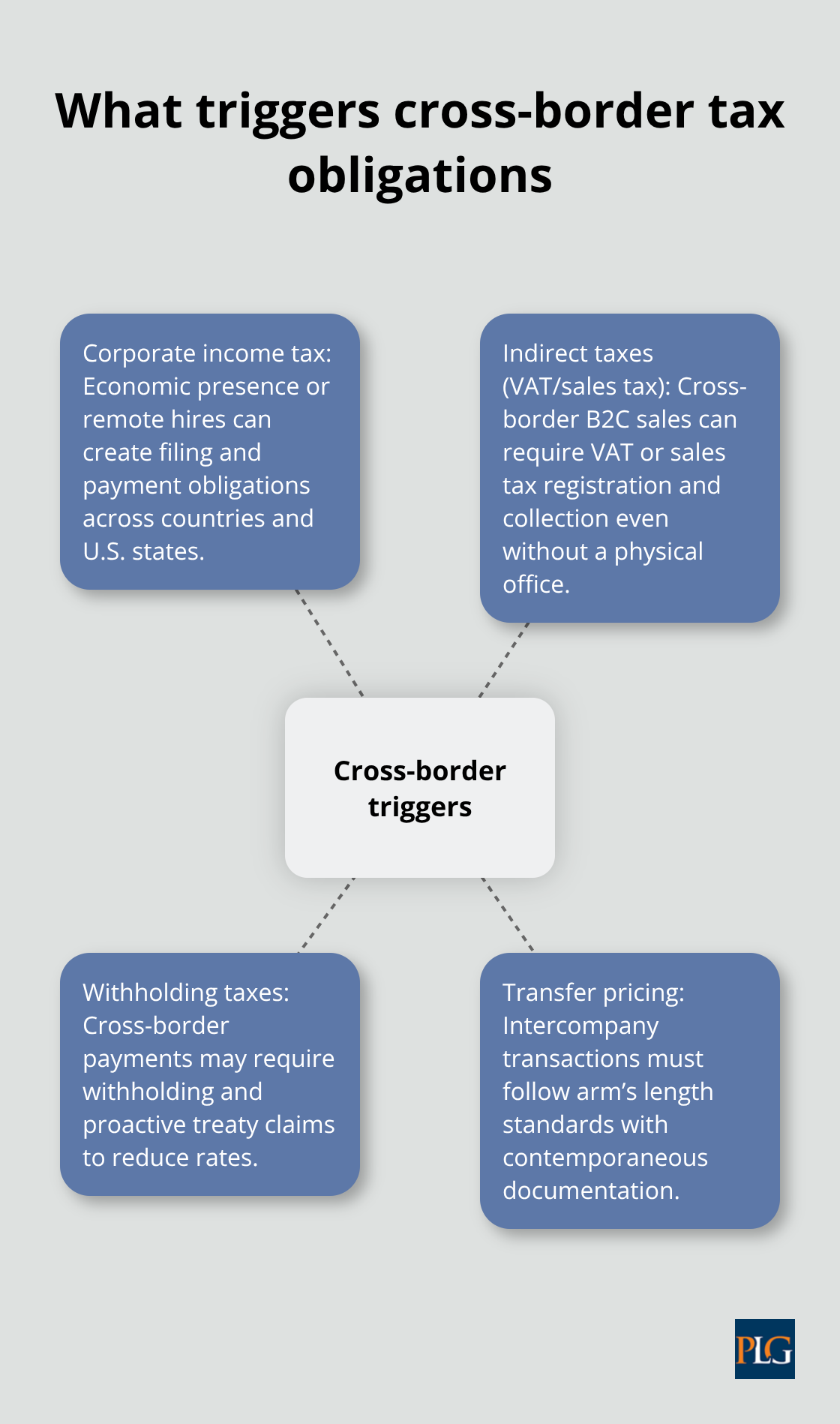
The US Supreme Court’s Wayfair decision in 2018 made this concrete: states can now require sales tax collection based on economic nexus alone. California’s threshold sits roughly at $500,000 in annual sales or 200 transactions, meaning many growing startups already owe registration and collection duties without knowing it. That threshold applies whether you maintain a physical office or operate entirely remotely.
Transfer Pricing Rules Demand Arm’s Length Documentation
If you operate through a subsidiary abroad or have intercompany transactions, transfer pricing rules demand that you price those transactions at arm’s length rates as if the parties were unrelated. The IRS reported $4.7 billion in transfer pricing adjustments in 2023, with technology companies representing about 60% of major cases. That concentration signals enforcement focus on your sector.
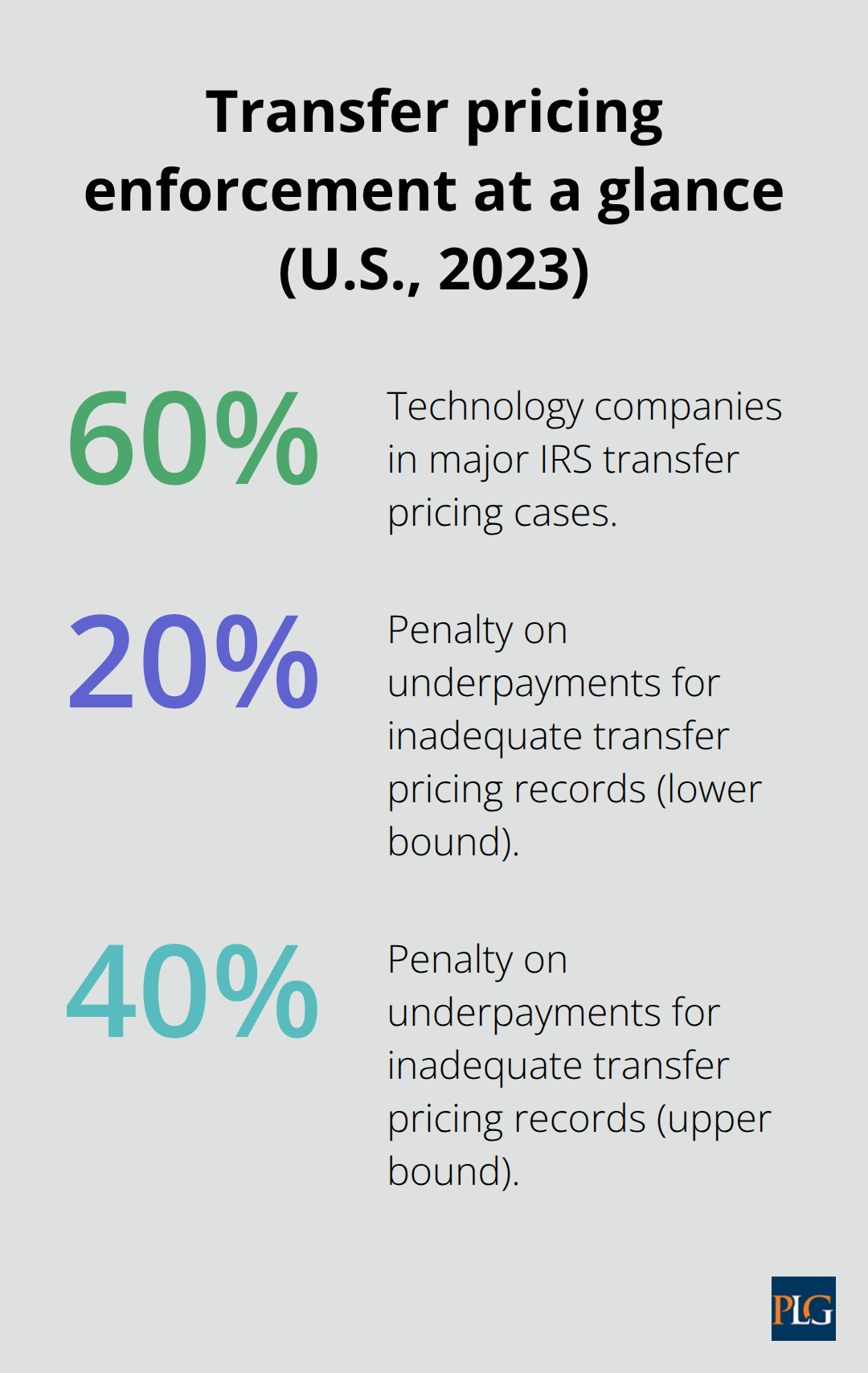
Documentation must be contemporaneous with your tax filings, and penalties for inadequate records range from 20% to 40% of underpayments. Transfer pricing documentation isn’t optional complexity; it’s a requirement that protects you during audits. If you license technology between your US parent and an Irish subsidiary, or if a UK affiliate handles customer support for your US operations, those intercompany transactions must reflect what unrelated parties would charge. The arm’s length principle isn’t theoretical-audits and adjustments can result in double taxation if your positions aren’t solid. For startups with under $50 million in intercompany transactions, documentation standards are less intense than for larger multinationals, but that doesn’t mean you can ignore them. Document your pricing rationale, maintain records of comparable transactions, and prepare to explain your methodology.
Tax Treaties Reduce Withholding-But Only If You Claim Relief
Tax treaties between countries reduce withholding rates and clarify which jurisdiction gets to tax certain income, but they don’t apply automatically and don’t override domestic rules for indirect taxes. Many founders treat treaties as a safety net, but they’re only useful if you actively claim relief using proper documentation like a W-8BEN form or residency certificate. Without that documentation, you pay the default withholding rate and miss the treaty benefit entirely.
Permanent Establishment and VAT Create Immediate Registration Duties
Permanent establishment risk is another threshold issue: hiring a remote employee abroad can trigger payroll registrations, social contributions, and in some cases permanent establishment status that exposes your entire profit to tax in that country. The complexity compounds when you add VAT. EU B2C sales require VAT registration once you exceed certain thresholds, and the One Stop Shop scheme lets you file a single return covering all EU member states. For goods imported into the EU valued under €150, the IOSS handles VAT collection. These aren’t suggestions-they’re mandatory once you cross the threshold.
Build a Filing Calendar Before You Expand
The practical reality is that you need a filing calendar mapping registration deadlines, return due dates, and payment schedules across every jurisdiction where you have nexus. Without that calendar, you’ll miss deadlines and face penalties that erode margins far more than tax planning saves. Structuring your startup to manage these obligations upfront prevents expensive restructuring later. The next section walks you through how to choose the right corporate entity and intercompany agreements that align with these obligations and reduce your overall tax exposure.
How to Structure Your Startup for Tax Efficiency Across Borders
Choose the Right Entity in Each Jurisdiction
The entity you select in each jurisdiction determines whether you pay 21% federal tax, 8.84% California tax, plus San Francisco’s layered taxes, or whether you structure through a lower-tax jurisdiction that still complies with US rules. Most founders default to a single C corporation and operate subsidiaries without thinking through the tax consequences. That approach leaves money on the table.
S corporation elections can reduce self-employment taxes in early-stage companies, but they require careful planning around foreign ownership rules and timing. If you operate in California, you face an 8.84% corporate tax plus a mandatory $800 franchise tax annually, regardless of profit. San Francisco adds another layer: a Gross Receipts Tax ranging from 0.075% to 0.65% depending on your business type, with technology companies over $25 million in receipts taxed at up to 0.56%. A startup generating $5 million in San Francisco revenue could owe an additional $28,000 in Gross Receipts Tax alone.
Coordinating federal, state, and local planning can achieve a 15–20% reduction in your effective tax rate if you structure correctly from the start. Electing S corp status in low-profit years, timing income recognition to match your growth phase, and accelerating deductions where possible all require deliberate structuring.
Leverage International Structuring and Tax Credits
For startups with international operations, the decision grows more complex: holding intellectual property in a lower-tax jurisdiction like Ireland or Singapore while licensing it back to your US operations can defer US taxation on foreign profits, but only if you follow transfer pricing rules and document the arm’s length pricing. Doing this wrong triggers the IRS’s GILTI regime, which taxes foreign profits at roughly 10.5% anyway, negating the benefit.
The California R&D tax credit provides a 15% credit on qualified research expenses and can be claimed alongside the federal credit; in 2023, California approved about $1.2 billion in credits, with software claiming roughly 40% of the total. If your startup qualifies, that credit directly reduces your state tax liability and carries forward indefinitely if unused. The New Employment Credit offers $3,000 to $5,000 per qualified employee in designated census tracts, but you must maintain employment levels for at least three years to retain the benefit. Startups often miss these credits because they don’t track qualifying expenses or don’t understand which census tracts qualify.
Document Intercompany Agreements Before Transactions Begin
Intercompany agreements sit at the center of tax-efficient structures. If your UK subsidiary performs services for your US parent, or if a German entity manufactures products for your US sales operation, those transactions must be priced at what unrelated parties would charge. You should document your intercompany agreements before you execute the first transaction, not after an audit notice arrives. This documentation protects you during audits and demonstrates that you applied arm’s length principles from day one.
Manage Foreign Subsidiary Income and PFIC Rules
For US shareholders of foreign subsidiaries, Subpart F rules require you to include certain foreign income in your US tax return immediately, even if you don’t distribute it. If your Irish subsidiary earns passive income, you cannot defer US tax by leaving profits abroad. A Qualified Electing Fund election lets you include your pro rata share of PFIC earnings in ordinary income, but the election timing and Form 8621 filing deadlines are strict and easily missed. These rules apply whether your subsidiary operates as a manufacturing hub, a service center, or a holding company for intellectual property.
The mistakes startups make when expanding internationally often stem from overlooking these structural decisions until operations are already underway. The next section examines the most common pitfalls that trigger audits, penalties, and costly restructuring.
Common Tax Mistakes Startups Make When Expanding Internationally
VAT and GST Registration Delays Cost Thousands in Back Taxes
The most expensive mistake we at Primum Law Group see startups make isn’t a single oversight-it’s the combination of three avoidable errors that compound during the first two years of international expansion. Founders focus on product-market fit and hiring, then wake up to registration deadlines they’ve already missed, VAT obligations they didn’t know existed, and transfer pricing documentation the IRS now demands retroactively. About 80% of tax penalties for San Francisco corporations stem from nexus errors, inadequate transfer pricing documentation, and poor audit preparation according to enforcement data from the California Franchise Tax Board.
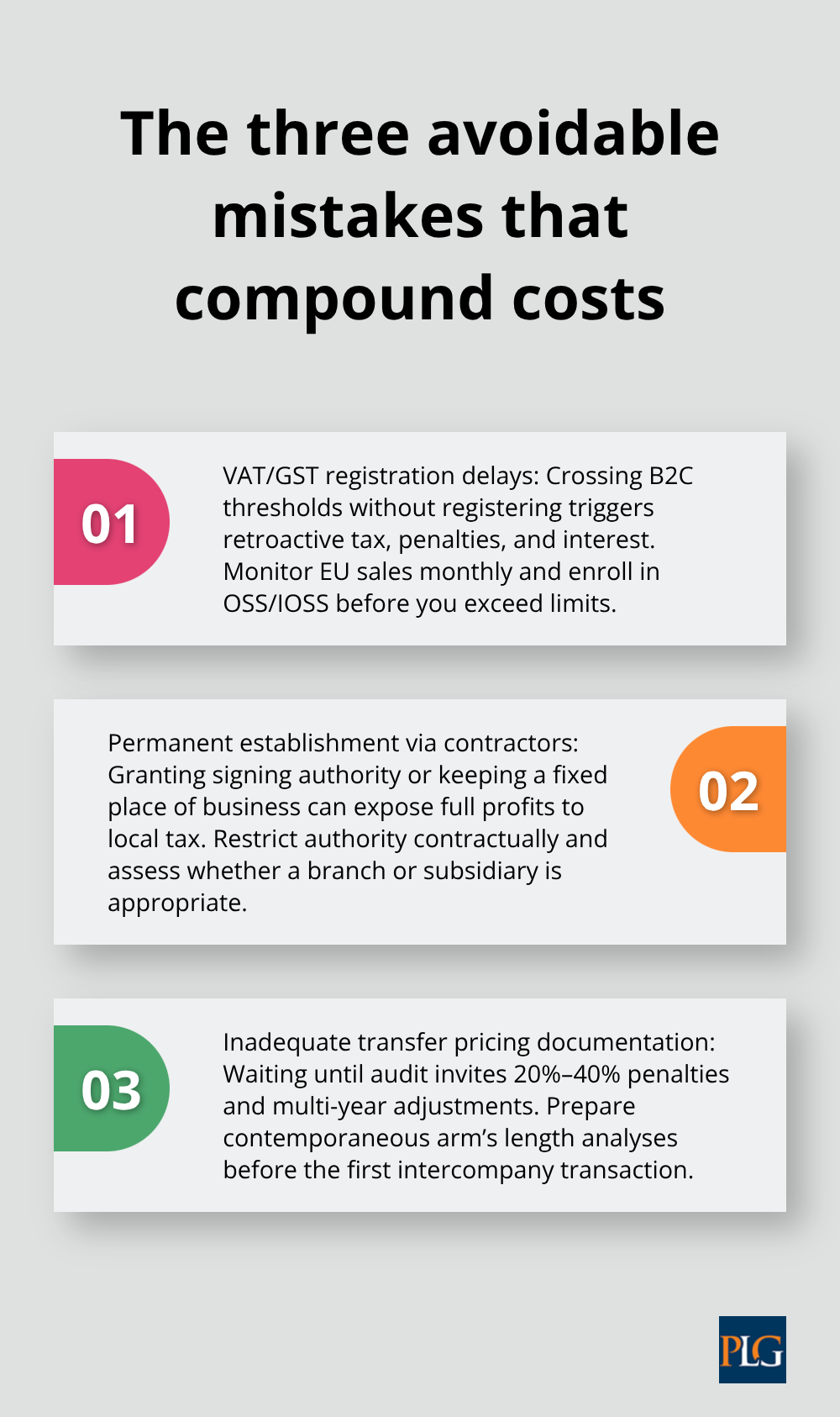
VAT and GST thresholds are where most startups trip first. You cross into VAT registration territory the moment your EU B2C revenue hits the threshold, typically around €10,000 in annual sales depending on the member state. The One Stop Shop scheme lets you file a single EU-wide return instead of registering separately in each country, but only if you register proactively before your sales exceed the threshold. Once you’re past that point, you owe VAT retroactively on all previous sales, plus penalties and interest. Many founders assume EU VAT does not apply to their business, particularly when selling software or services internationally, but this misconception creates substantial liability.
A startup selling physical products to customers across Germany, France, and Spain without understanding these schemes can owe €50,000 to €150,000 in back VAT within months of hitting scale. The practical fix is to monitor your cross-border sales monthly and register the moment you approach threshold, not after you’ve already exceeded it.
Permanent Establishment Through Contractor Structures
Permanent establishment is the second trap, and it’s more insidious because you can trigger it without realizing you’ve created a taxable presence. Hiring a single remote employee in the UK, Canada, or Australia doesn’t just create payroll obligations-it can establish permanent establishment status that exposes your entire profit to taxation in that country, not just the employee’s salary. A dependent agent (which includes contractors with signing authority or authority to conclude contracts on your behalf) also creates permanent establishment.
Many founders structure their first overseas hire as a contractor to avoid payroll complexity, then discover that contractor has authority to bind the company and created permanent establishment liability. The safeguard is clear contractual language restricting contractor authority and explicit documentation that no fixed place of business exists. If you maintain an office, even a shared desk at a co-working space, permanent establishment risk increases substantially. Understanding whether to use a branch office or subsidiary structure for your expansion affects liability exposure and tax complexity significantly.
Transfer Pricing Documentation Triggers Audit Exposure
Transfer pricing documentation is where the audit exposure becomes concrete. The IRS reported $4.7 billion in transfer pricing adjustments in 2023, with technology companies representing about 60% of major cases. Your sector faces heightened scrutiny, and the documentation standards are non-negotiable. If you license intellectual property from your US parent to an Irish subsidiary, price intercompany services between offices, or have inventory transfers between jurisdictions, you must document the arm’s length methodology before you file your first return.
Waiting until an audit notice arrives to create this documentation triggers penalties of 20% to 40% of underpayments, and the IRS will adjust your pricing retroactively across multiple years. The practical approach is to complete transfer pricing documentation before your first intercompany transaction closes, not after. Document comparable company analysis, explain your pricing rationale in writing, and maintain records that would withstand IRS scrutiny. These three mistakes-VAT registration delays, permanent establishment through unclear contractor structures, and inadequate transfer pricing documentation-are preventable with deliberate planning executed before expansion accelerates.
Final Thoughts
Cross-border tax startups succeed when founders treat tax planning as a core business function rather than an afterthought. The three mistakes covered in this guide-VAT registration delays, permanent establishment through unclear contractor structures, and inadequate transfer pricing documentation-are entirely preventable with deliberate action before expansion accelerates. California penalties totaled about $347 million in 2023, with nexus violations contributing significantly, yet your startup can avoid that outcome through proactive planning.
Tax law changes constantly and enforcement priorities shift across jurisdictions. The OECD’s global minimum tax of 15% for large multinationals, state-level economic nexus rules, and EU VAT schemes create moving targets that require ongoing attention. Professional guidance helps you flag risks before they materialize and identify credits like California’s R&D tax credit (which saved qualifying startups thousands in 2023) that you’d otherwise miss.
Your next step is concrete: conduct a comprehensive tax position review across every jurisdiction where you have nexus or plan to expand. We at Primum Law Group help startups navigate this complexity through international corporate structuring and tax law services tailored to your growth stage, and the difference between a tax-efficient structure and a costly mistake often comes down to planning executed before expansion accelerates.