

Cross-border contracting requires navigating complex legal systems, payment regulations, and dispute resolution frameworks that vary dramatically by country. At Primum Law Group, we’ve seen countless partnerships falter because teams overlooked tax implications or failed to align expectations upfront.
The difference between a thriving international agreement and a costly dispute often comes down to preparation. This guide walks you through the legal differences you’ll encounter, the essential clauses that protect your interests, and the pitfalls that derail most global partnerships.
How Contract Enforcement and Payment Rules Shift Across Borders
Contract Enforcement Varies by Legal System
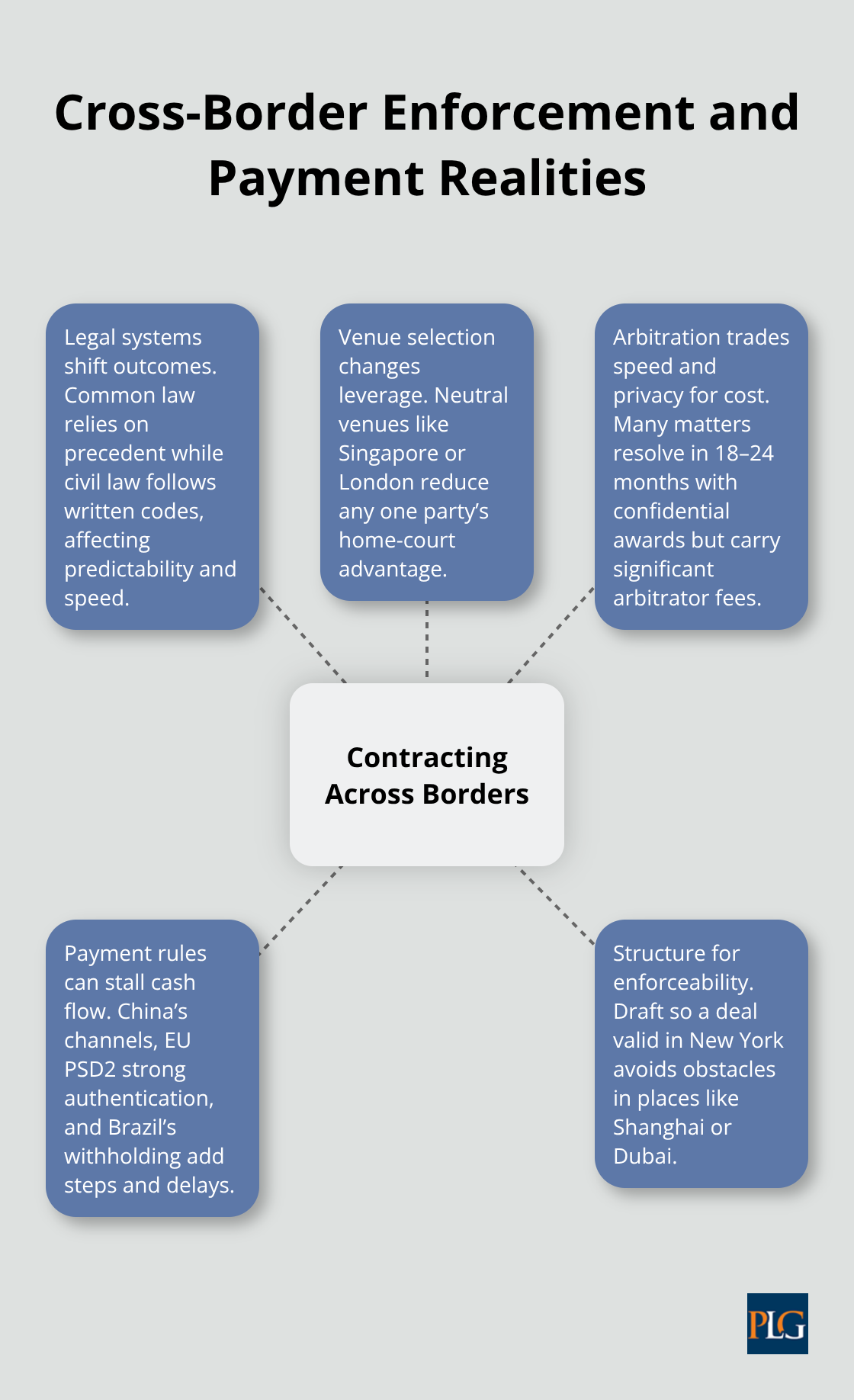
Contract enforcement differs dramatically depending on where your agreement lives legally. The United States enforces contracts through state and federal courts, which typically take two to four years to resolve disputes and cost between $100,000 and $500,000 in litigation expenses according to the American Bar Association. European jurisdictions like Germany and France operate under civil law systems where judges interpret written codes rather than relying on precedent, often resulting in faster resolution but less predictability for common law practitioners. Singapore and Hong Kong use English common law frameworks, making them attractive for parties familiar with US or UK contract interpretation. A contract that’s enforceable in New York might face serious obstacles in Shanghai or Dubai if you haven’t structured it properly.
Selecting the Right Governing Law and Venue
Your governing law clause should match your operational reality, not just your home country. If you operate across multiple jurisdictions, choosing a neutral venue like Singapore or London for dispute resolution prevents any single party from holding an enforcement advantage. Arbitration under the International Chamber of Commerce rules offers faster resolution than courts, typically completing within 18 to 24 months, though arbitrator fees run $5,000 to $15,000 per day. Arbitration also produces confidential awards, protecting your business terms from public disclosure unlike court proceedings.
Payment Regulations Create Compliance Obstacles
Payment regulations create their own minefield across borders. China requires all cross-border payments to pass through state-approved channels and involves documentation proving the transaction’s legitimacy, which can delay payments by 30 to 60 days. The European Union’s Payment Services Directive 2 mandates strong customer authentication for electronic payments, adding compliance steps that many US companies overlook. Brazil imposes a 25% withholding tax on dividend payments to foreign investors unless your contract specifically addresses tax treaty benefits.
Managing Currency Risk in International Deals
Currency fluctuations matter significantly: a contract denominated in euros exposes you to exchange rate swings of 10 to 15% annually, which can erase margins on thin deals. Price contracts in the currency where your costs occur, specify payment timelines that account for banking delays in each jurisdiction, and include currency adjustment clauses for deals exceeding 12 months. These structural choices protect your bottom line and prevent payment surprises that derail partnerships.
These enforcement and payment realities shape how you’ll structure your actual contract language. The next section covers the essential clauses that protect your interests across these varying legal landscapes.
Essential Clauses for International Contracts
Force Majeure Clauses Protect Against Unpredictable Disruptions
Force majeure clauses separate companies that survive disruptions from those that collapse under unexpected events. The 2020 pandemic exposed how vague force majeure language created litigation nightmares: companies in Europe claimed COVID-19 triggered their force majeure protections while US counterparts faced judges who interpreted the same event differently. Your force majeure clause must specifically name events that qualify (pandemics, wars, government actions, natural disasters) and define exactly when obligations suspend versus terminate entirely.
If a supplier in Vietnam experiences a factory flood, your contract should specify whether it automatically cancels or allows 30 days to find alternatives.
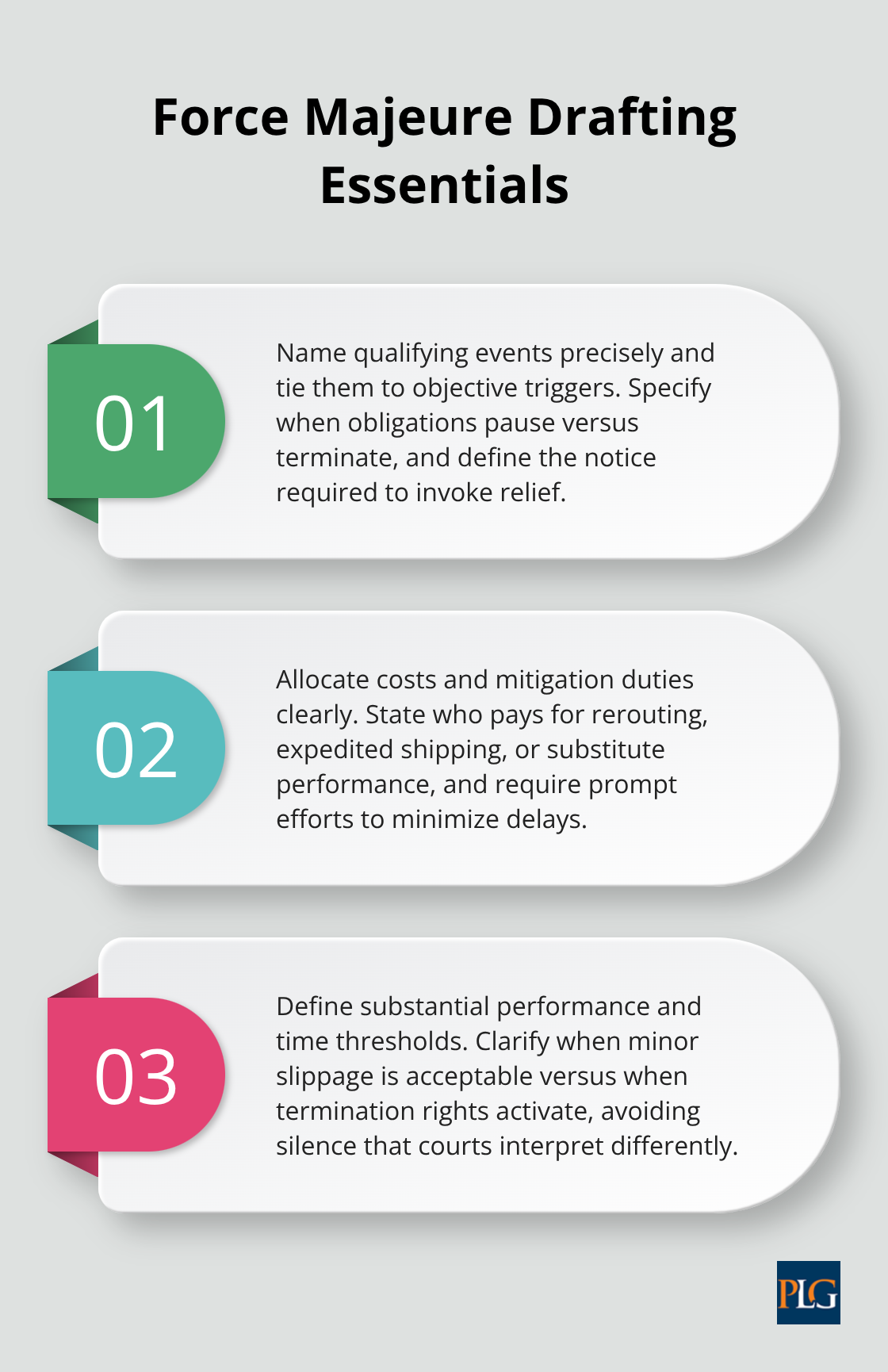
The World Bank reports that supply chain disruptions occur every 3.7 years on average, making explicit risk allocation language non-negotiable. Allocate the cost of delays clearly: if your Indian manufacturer faces a port closure, your contract should state who bears the cost of rerouting shipments through alternative ports. Also define what constitutes substantial performance-if force majeure delays delivery by 10%, does that trigger contract termination, or only delays exceeding 60 days? Courts across jurisdictions interpret silence differently, so write it down.
Intellectual Property Protection Requires Registration in Every Market
Intellectual property protection across borders demands registration in every jurisdiction where you operate, not just your home country. The World Intellectual Property Organization confirms that 60% of cross-border IP disputes stem from inadequate registration in secondary markets. Register your patents, trademarks, and copyrights in each country where competitors might launch copycat products-China alone sees 1.4 million trademark applications annually, and unregistered marks receive zero protection there.
Your contract should specify which party owns improvements to IP developed during the partnership and whether either party can license the IP to third parties. Many partnerships collapse because one party assumes they can continue using licensed IP after exit, then faces infringement claims. Include explicit post-termination provisions: does the licensee have 90 days to wind down use, or does access terminate immediately? For data and trade secrets, specify which party controls access, who can access what information, and what happens to copies after the contract ends.
Exit Strategies Prevent Disputes When Partnerships End
Termination and exit strategies often get overlooked until relationships deteriorate, but clear exit language prevents disputes. Define termination triggers precisely-does missing a single deadline trigger immediate termination, or only after written notice and 30 days to cure? Include termination for convenience clauses that let either party exit after a defined period (typically 12 to 24 months) with 90 days written notice.
Specify what happens to ongoing obligations: if you terminate a distribution agreement, must the distributor return all inventory within 30 days, or do they have 90 days to sell through existing stock? Address payment obligations that survive termination-does the vendor still invoice for work completed before the termination date? These details prevent costly disputes when partnerships end and position you to address the compliance and documentation gaps that commonly derail international agreements.
Common Pitfalls in Cross-Border Contracting
Tax Obligations Destroy Deal Economics When Overlooked
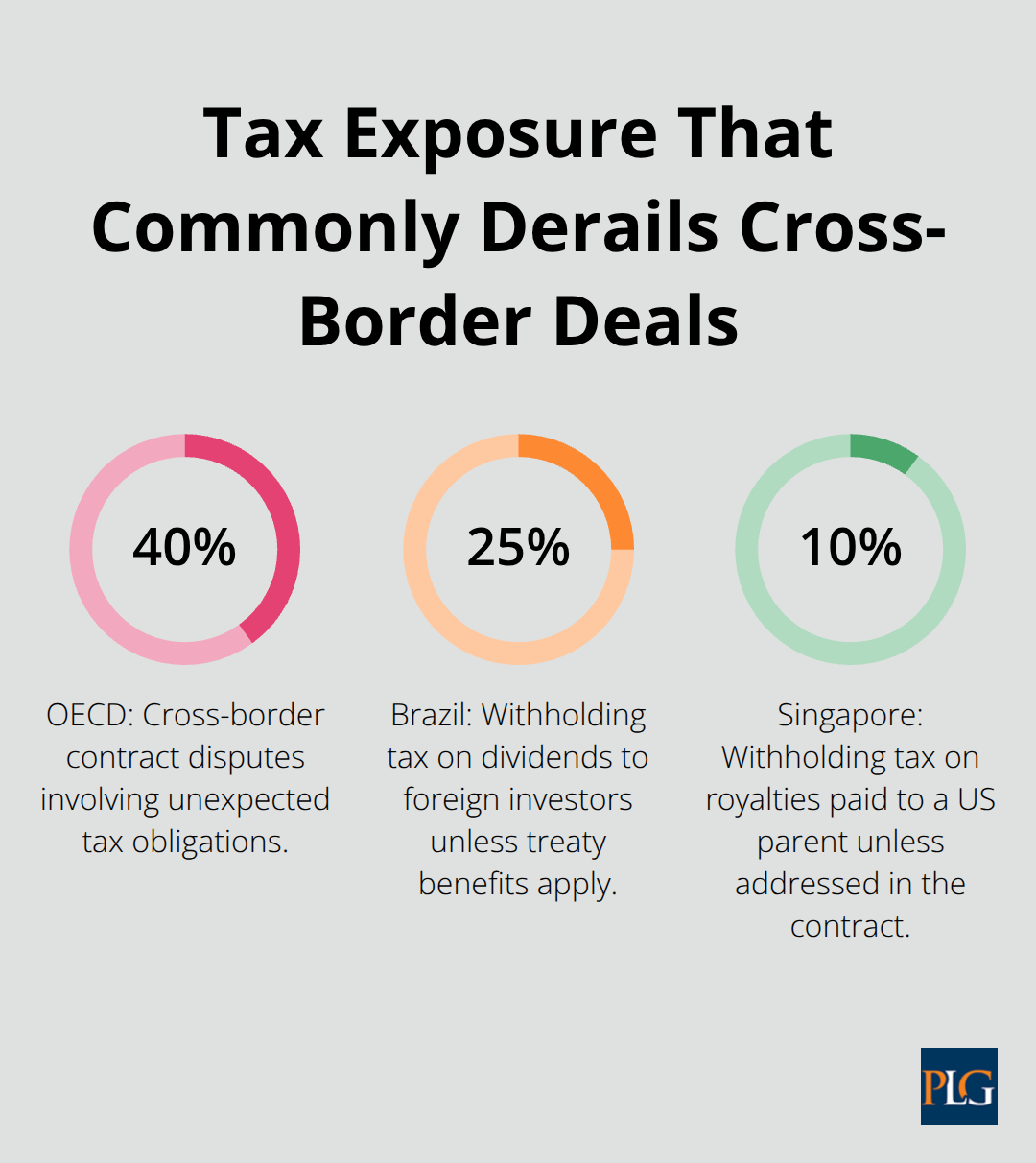
Tax compliance failures represent the fastest path to partnership collapse in international agreements. Companies sign contracts without understanding their tax exposure across jurisdictions, then face withholding taxes, double taxation, or penalties that consume profits entirely. Brazil imposes a 25% withholding tax on dividend payments to foreign investors unless your contract specifically references applicable tax treaty benefits. China requires documentation proving transaction legitimacy for cross-border payments, which delays funding by 30 to 60 days and creates cash flow crises for unprepared businesses.
The OECD reports that 40% of cross-border contract disputes involve unexpected tax obligations that weren’t addressed in the original agreement. Your contract must specify which party bears tax liability, how withholding taxes apply, and whether either party can claim treaty benefits. If your Singapore subsidiary pays royalties to your US parent company, the contract should state whether the payment includes or excludes the 10% withholding tax imposed by Singapore law.
Without this clarity, one party absorbs costs the other party anticipated passing through, destroying deal economics.
Misaligned Expectations Between Partners Trigger Disputes
Expectation misalignment between parties creates disputes that tax issues alone cannot explain. When a German manufacturer commits to delivery dates, they interpret timelines differently than a US distributor who expects just-in-time inventory management. The contract must define what constitutes acceptable performance: does on-time delivery mean within 24 hours, 7 days, or 30 days of the agreed date?
Quality standards present another common friction point. Your Chinese supplier might assume basic compliance suffices while you require ISO 9001 certification. Specify these standards explicitly in writing rather than relying on verbal assurances or industry assumptions. Different legal systems train parties to interpret vague language in opposite ways, so written precision prevents costly misunderstandings.
Documentation Gaps Leave You Defenseless in Disputes
Documentation gaps compound expectation problems exponentially. Courts across jurisdictions require written evidence of what parties actually agreed to, yet many partnerships operate on email chains and WhatsApp messages that disappear or get misinterpreted under pressure. Create a master contract document that supersedes all prior communications and specifies amendment procedures requiring written signatures from authorized representatives.
Require both parties to confirm understanding of critical terms in writing before work begins. This single step prevents the most common cross-border dispute: one party claims they never agreed to terms the other party insists were settled. Written confirmation forces clarity upfront and provides the documentation courts demand when disputes arise.
Final Thoughts
Cross-border contracting succeeds when you treat legal differences as operational realities rather than obstacles to address later. The companies that thrive internationally structure governing law and dispute resolution before signing anything, write down every material term instead of relying on verbal assurances, and address tax obligations explicitly in contract language. These steps eliminate the surprises that derail most global partnerships.
Your contract must account for how enforcement works in each jurisdiction, how payment regulations affect cash flow timing, and what happens when force majeure events disrupt operations. Intellectual property protection requires registration in every market where you operate, not just your home country. Exit strategies prevent disputes when partnerships end by defining termination triggers, wind-down periods, and surviving obligations with precision.
We at Primum Law Group help startups and growing companies structure international corporate arrangements that actually work across borders. Our team handles the cross-border contracting details that most businesses overlook until problems emerge, and we work with companies establishing operations in new markets or entering partnerships with international counterparts. Contact Primum Law Group to get your contract right upfront and protect your bottom line.