

Startup tax planning isn’t an afterthought-it’s a foundational decision that shapes your company’s profitability for years to come. The structure you choose, how you compensate employees, and where you operate all directly impact your bottom line.
At Primum Law Group, we’ve seen founders leave hundreds of thousands of dollars on the table by making tax decisions reactively instead of strategically. This guide walks you through the concrete moves that protect your growth.
Choosing Your Entity Structure in San Francisco
Your entity structure choice is the single most impactful tax decision you make as a founder. This isn’t a detail to delegate or postpone. The IRS doesn’t offer mulligan options here, and changing structure later costs thousands in legal and accounting fees while creating compliance headaches. C Corporations, S Corporations, and LLCs each carry fundamentally different tax consequences, and the right choice depends on your specific funding path and exit timeline.
Why Venture-Backed Startups Choose C Corporations
Most venture-backed startups in San Francisco operate as C Corporations because investors demand this structure, period. Venture capitalists won’t touch S Corporations or LLCs because of pass-through taxation complications and lack of preferred stock classes. If you’re raising Series A funding, your investors will require conversion to a C Corporation anyway, so starting there saves friction. The C Corporation structure means corporate-level taxation on profits, but it also means you can retain earnings, reinvest in growth, and defer personal income taxes.
The S Corporation Advantage for Bootstrapped Founders
For bootstrapped founders without outside capital, the analysis shifts entirely. An LLC taxed as an S Corporation often delivers better results. You pay self-employment taxes only on W-2 wages you actually take, not on all business profit. A founder earning $200,000 in profit might pay themselves a $100,000 salary and take $100,000 as a distribution, saving roughly 15% on self-employment taxes according to accounting data. That’s real money.
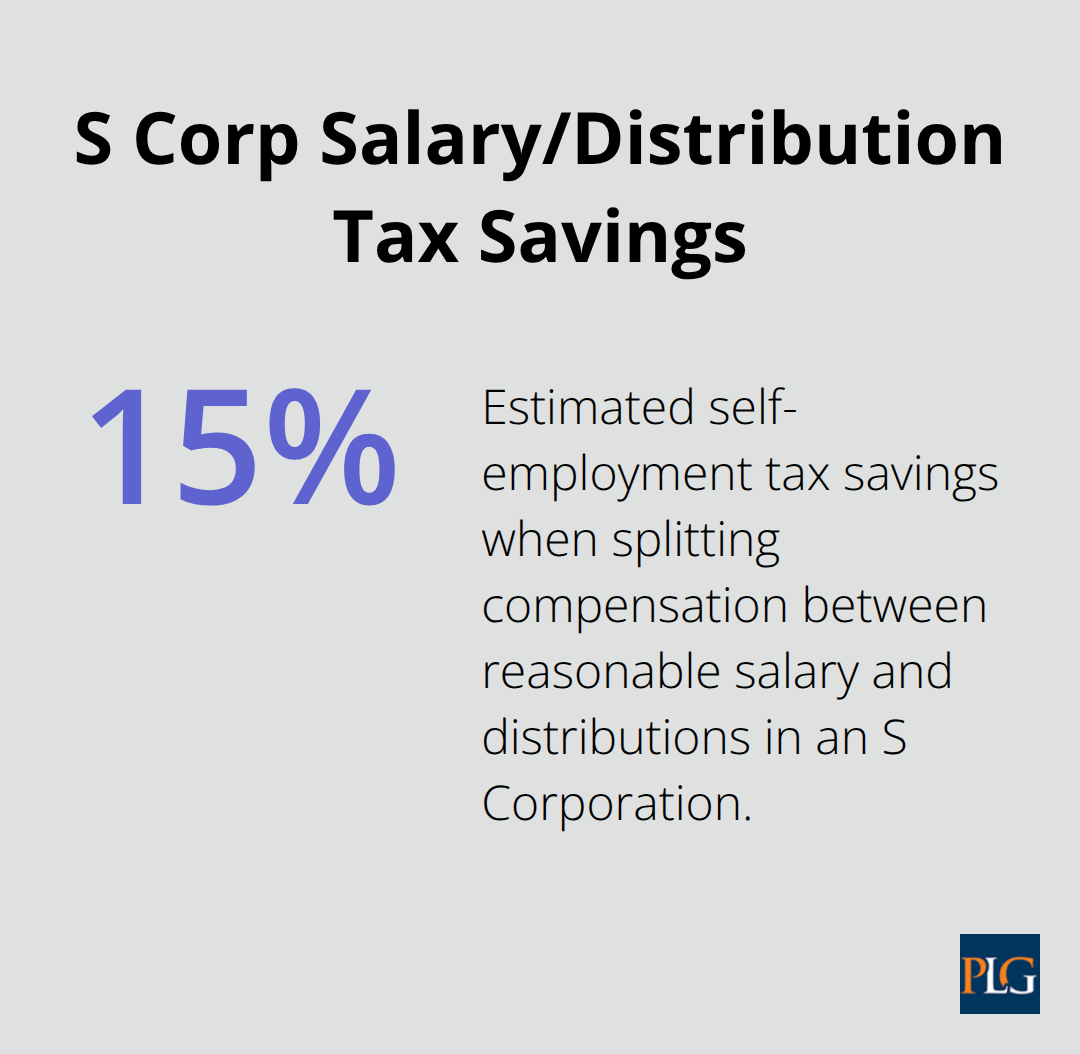
An S Corporation requires more paperwork and accounting costs typically run $2,000 to $5,000 annually, but the tax savings often exceed this cost for profitable businesses. A plain LLC taxed as a sole proprietorship or partnership triggers self-employment tax on the entire net profit. Skip this structure if you’re profitable.
How Exit Strategy Drives Your Entity Choice
Your exit strategy should drive your entity choice backward. If acquisition is likely within five years, a C Corporation minimizes complications because buyers understand this structure and prefer it. The corporate-level tax applies at sale, but this is predictable. S Corporations create tax complications in M&A transactions because the built-in gains tax hits differently. If you plan a long hold or build toward an IPO, C Corporation taxation compounds favorably over decades because retained earnings compound without annual personal tax drag.
Aligning Structure With Your Business Model
Founders pursuing lifestyle businesses or slow-growth models should seriously consider the S Corporation or LLC route because the entity structure aligns with cash flow needs rather than institutional investor requirements. The structural choice locks in tax consequences for years. Your next decision-how you compensate employees and founders-depends entirely on the entity you select, which makes equity compensation strategy inseparable from your structural foundation.
How Founders and Employees Should Time Equity Grants
The moment you grant equity determines tax outcomes for the next decade. Stock options and restricted stock units carry completely different tax mechanics, and the timing of when you issue them directly controls how much tax your team pays. Most founders treat equity grants as a one-time HR event rather than a strategic tax decision tied to your company valuation and funding timeline. Founders who grant options after Series A closes lock in higher exercise prices and create tax inefficiency for employees who never benefit from the original low-cost equity.
Why Valuation Timing Controls Your Tax Bill
The IRS scrutinizes option pricing carefully, and the strike price must reflect fair market value on the grant date. If the IRS determines your valuation was artificially low, it reclassifies options as compensation, triggering immediate income tax and penalties. Incentive stock options only qualify for favorable long-term capital gains treatment if you meet strict holding periods and exercise-to-sale timing requirements. You must hold the shares for at least two years from grant date and one year from exercise date, according to IRC Section 422.
Most employees don’t understand these requirements and sell too early, converting what should have been capital gains into ordinary income. Restricted stock units avoid the exercise step entirely, but they trigger ordinary income tax on the vesting date based on the stock price that day. If you grant RSUs when your valuation is $2 million and the company reaches $50 million by vesting, your employees owe income tax on a $48 million gain, creating a crushing tax bill with no liquidity to pay it.
The Pre-Funding Window for Equity Grants
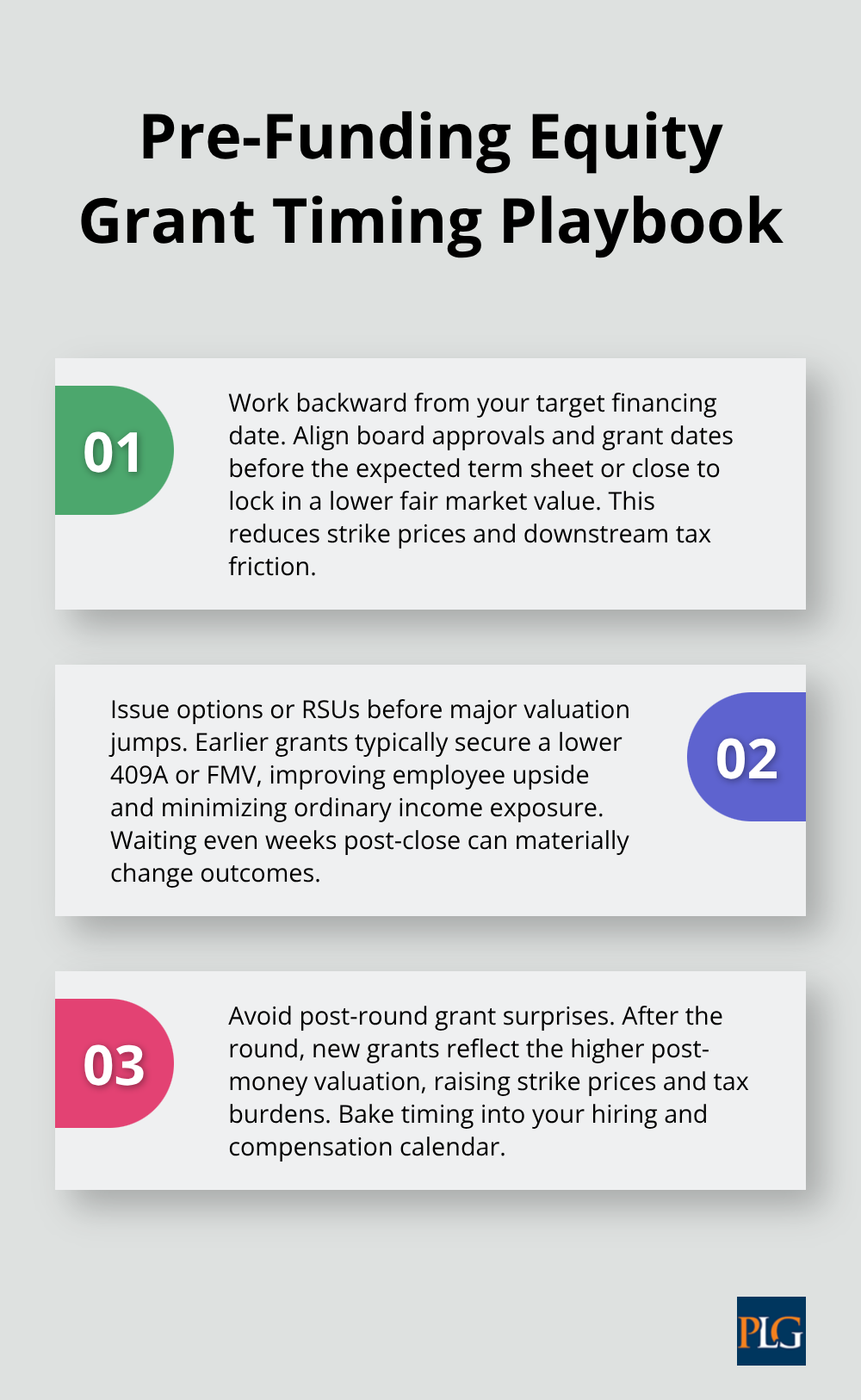
The timing strategy should work backward from your expected Series A or Series B close date. Grant options or RSUs before major valuation increases, not after. If you’re raising capital in the next 12 months, your current grant date valuation is your last chance to issue equity at a lower strike price. Waiting until after the round closes means new grants hit the higher post-money valuation.
Vesting Schedules and Tax Mechanics
Early-stage founders often issue options on a vesting schedule of four years with a one-year cliff, which means employees earn nothing for the first year, then earn 25% of their grant. This structure aligns employee incentives with company survival. However, the tax impact depends on whether you use incentive stock options or non-qualified stock options. Incentive stock options deliver capital gains treatment if holding periods are met, but they trigger alternative minimum tax for some high-income employees when the spread between exercise price and fair market value exceeds $100,000 in a single year. Non-qualified options are simpler from a tax perspective but generate ordinary income on the spread at exercise.
Founder Equity Decisions and IRS Scrutiny
For founders taking salary, the decision between options and RSUs matters significantly. If you grant yourself options at the same strike price as employees, the IRS may challenge whether you’re playing games with valuation. Granting yourself RSUs sidesteps this issue because there’s no strike price to defend. However, RSU taxation happens at vesting, which creates a tax liability whether or not you’ve had a liquidity event.
Many founders grant themselves options at inception with a $0.001 strike price, which the IRS generally accepts because the company had minimal value at formation. This approach works only if documented properly in board minutes with a contemporaneous valuation. The interaction between entity structure and equity compensation is direct. C Corporations can issue options and RSUs cleanly. S Corporations face complications because preferred stock classes don’t work with pass-through taxation, which is why venture investors reject S Corporations. LLCs can issue options but the mechanics are messier, and many founders operating as LLCs avoid equity compensation entirely.
The psychological factor of equity timing also drives retention and morale. Employees who receive options before a major valuation increase feel rewarded. Employees who receive options after a Series A at a $25 million valuation feel they missed the upside. This perception affects how your team views their stake in the company’s future, which makes the timing decision matter beyond pure tax calculations.
Global Startup Tax Reality in San Francisco
Operating across borders transforms your tax situation from complex to genuinely difficult. The IRS doesn’t care that you’re a startup or that you’re trying to grow fast. If you have employees, contractors, or revenue in multiple countries, you owe tax obligations in each jurisdiction where you operate, and these obligations often conflict with each other. The US taxes worldwide income for citizens and residents, which means your founders owe US tax on foreign earnings even if they never touch the money. Most founders face this reality too late, after they’ve already structured operations inefficiently and created compliance nightmares that cost tens of thousands to unwind. The three core problems are establishing which country taxes your income, proving you’ve paid what’s owed in each jurisdiction, and moving money between entities without triggering massive tax bills.
The Controlled Foreign Corporation Trap
San Francisco startups expanding internationally almost always make the same structural mistake: they create a foreign subsidiary without understanding that the IRS will tax the subsidiary’s profits as if they were earned in the US if the subsidiary qualifies as a controlled foreign corporation. The CFC rules, defined in IRC Section 957, mean that if US shareholders own more than 50% of a foreign company, the US parent corporation pays tax on the CFC’s earnings annually through Subpart F income, regardless of whether the money is repatriated. This forces immediate tax on profits earned abroad, which defeats the purpose of forming a foreign entity.
Transfer Pricing and Intercompany Transactions
Transfer pricing rules add another layer of complexity. The IRS demands that transactions between your US parent and foreign subsidiary happen at arm’s length prices, meaning prices that unrelated parties would charge each other. If your US entity charges its foreign subsidiary $50,000 for services that should cost $100,000, the IRS will recharacterize the transaction and assess additional tax plus penalties. The OECD Transfer Pricing Guidelines and US Treasury Regulations Section 1.482-1 provide the framework, but applying these rules requires actual economic analysis, not guesswork. Startups commonly underprice intercompany service agreements, transfer technology at artificially low rates, or charge below-market royalties, all of which trigger IRS challenges.
Documentation requirements are strict. The IRS demands contemporaneous transfer pricing documentation that demonstrates your pricing methodology, comparable transactions, and economic justification. Without this documentation, you lose the ability to defend your pricing in an audit, and the penalty for inadequate documentation is 40% of the underpayment, not just the tax itself. A startup generating $5 million in transfer pricing adjustments faces a $2 million penalty before interest and additional tax.
Tax Treaties and Substance Requirements
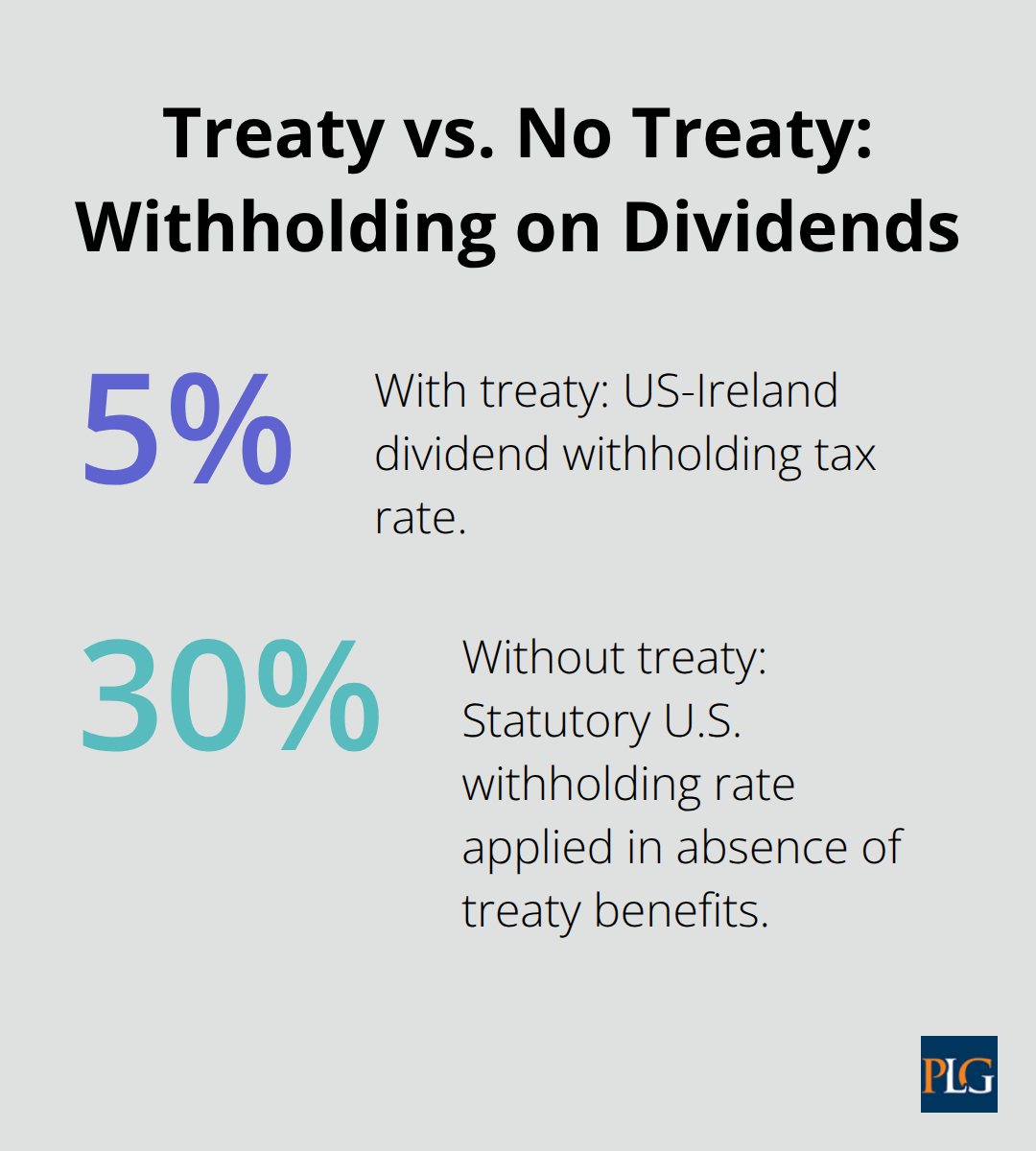
Structuring operations across multiple jurisdictions requires understanding tax treaty benefits available between the US and your target countries. Most developed nations have income tax treaties with the US that reduce withholding taxes on dividends, interest, and royalties. For example, the US-Ireland tax treaty provides reduced withholding rates that differ from the statutory rates in the Internal Revenue Code. A US parent receiving dividends from an Irish subsidiary pays 5% withholding tax under the treaty versus 30% without the treaty. This difference compounds over time and justifies the cost of proper structuring.
However, tax treaties include substance requirements. You can’t simply incorporate in Ireland and claim treaty benefits if your operations and management remain in San Francisco. The IRS applies economic substance doctrine to disallow treaty benefits when the primary purpose is tax avoidance without genuine business reasons.
Foreign Earned Income and Permanent Establishment
The Foreign Earned Income Exclusion under IRC Section 911 allows US citizens working abroad to exclude approximately $120,000 in foreign earned income from US taxation, adjusted annually for inflation. This provision helps US founders and employees stationed abroad, but it applies only to individuals, not corporate entities, and it requires genuine foreign residence, not just remote work. A founder who moves to London but maintains a US home and returns monthly won’t qualify.
The permanent establishment rules determine whether your foreign operations trigger corporate tax filing in that country. If you have a fixed place of business abroad or an agent with authority to conclude contracts, you’ve established PE and owe corporate tax in that jurisdiction. Many startups operate in foreign markets through contractors or distributors specifically to avoid PE, but the IRS and foreign tax authorities scrutinize these arrangements. If your contractor functions as a dependent agent of your US entity, you’ve created PE regardless of the contract language.
Structuring Before Operations Begin
The practical answer is that global startups need country-by-country tax planning before establishing foreign operations, not after. The structure you choose for your first foreign subsidiary locks in tax consequences for years. Changing structure later requires unwinding existing arrangements, which triggers taxable events and creates compliance complications.
Final Thoughts
Startup tax planning decisions made early compound into massive financial outcomes by year five. The entity structure you select, the timing of equity grants, and how you handle international operations determine whether you retain capital for growth or hand it to the IRS. Most founders treat these decisions as compliance checkboxes rather than strategic levers, which is why they leave substantial money on the table.
Choose a C Corporation if you’re raising venture capital because investors demand it and changing structure later costs thousands. Choose an S Corporation or LLC if you’re bootstrapped and profitable because self-employment tax savings often exceed accounting costs. Time equity grants before major valuation increases, not after, because the strike price locks in tax consequences for your entire team. Structure international operations before you hire your first foreign employee or open a foreign bank account because unwinding inefficient structures later triggers taxable events and compliance nightmares.
The practical reality is that startup tax planning requires professional guidance because the rules interact in ways that generic online resources can’t address. Your specific situation depends on your funding timeline, exit strategy, team size, and geographic footprint. We at Primum Law Group work with founders to structure operations efficiently from inception, which saves far more than the cost of proper planning through our startup counseling and tax law services.