

Startups face real legal threats that can derail growth and drain resources. Employment disputes, IP claims, and contract disagreements happen more often than founders expect.
At Primum Law Group, we’ve seen how litigation risk startups encounter can be prevented with the right approach. The difference between companies that thrive and those that struggle often comes down to one thing: acting before problems become lawsuits.
What Legal Threats Actually Hit Startups
Employment disputes, IP claims, and contract disagreements drain money and time from startups at alarming rates. According to research from Hiscox, the average cost per legal claim reaches around $160,000, with investigations lasting nearly a year. That’s capital you could have spent on product development or hiring. Employment issues alone account for a significant portion of startup litigation, particularly around worker misclassification. Many founders classify workers as independent contractors to save on payroll taxes and benefits, only to face Department of Labor audits and back-pay claims that spiral into six figures. The Fair Labor Standards Act sets clear rules on classification, yet about 20% of startups violate this in their early years. IP infringement claims hit harder when you haven’t registered your trademarks or patents.
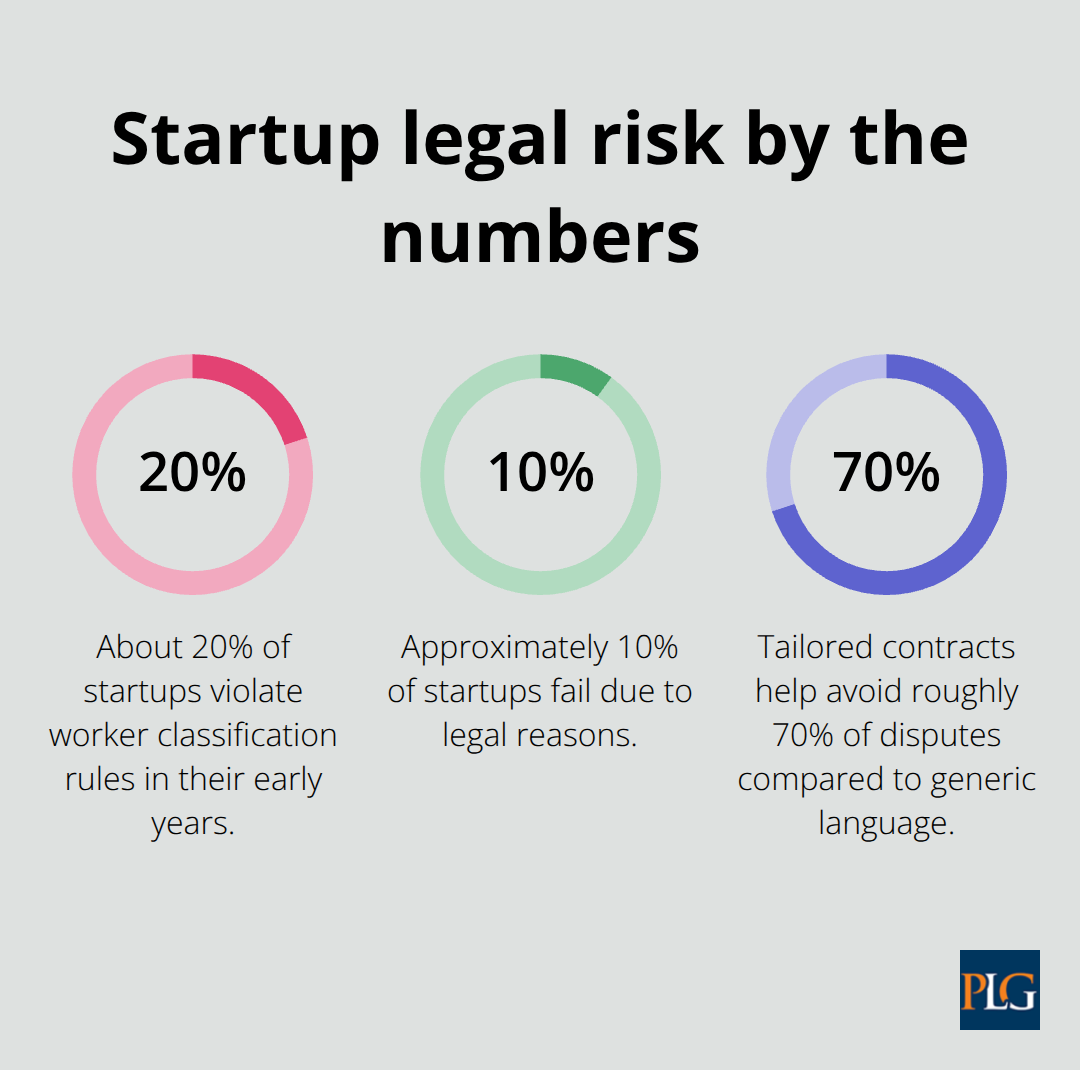
Without proper registration through the U.S. Patent and Trademark Office, you lose the ability to sue for damages if someone copies your work, and you can’t prove you owned it first. Contract disputes emerge from vague terms, missing signatures, or handshake deals that fall apart when money tightens. Tech in Asia found that approximately 10% of startups fail due to legal reasons, and most of those failures trace back to poor contract practices or missing foundational agreements.
Misclassification mistakes cost more than you think
Startups often treat early team members as contractors to stay lean, but the IRS and state labor boards scrutinize this heavily. If you classify someone as a contractor when they should be an employee, you owe back wages, taxes, and penalties that can exceed $10,000 per worker. The test isn’t about what you call them-it’s about control. If you set their hours, provide equipment, or direct their work, they’re likely employees. Many founders learn this lesson only after receiving a wage-and-hour complaint. You should document your classification decision upfront with clear criteria and maintain records showing why each person falls into their assigned category.
IP ownership gaps create future disputes
IP disputes often stem from unclear ownership rather than infringement itself. If you hire a developer as a contractor and fail to secure a written IP assignment agreement, that person technically owns the code they wrote. When you try to raise funding or sell the company, investors uncover the IP ownership gap during due diligence and deals collapse. Registration adds another layer-trademark registration costs around $250 to $400 per class through the USPTO, but it gives you federal rights to enforce against infringers. Without it, you can only claim common law rights, which are harder to prove and worth far less in a dispute.
Contract vagueness creates the disputes you could prevent
Generic templates from the internet miss state-specific requirements and industry risks. When you use the same vendor contract for every supplier without customization, you inherit terms that might not protect your data or limit your liability. A clear contract defines deliverables, timelines, payment terms, and what happens if someone breaches. It should also include a dispute resolution clause that specifies whether you’ll use arbitration or mediation before litigation. Startups that invest in tailored contracts upfront avoid 70% of the disputes that plague those using generic language.
What happens when you ignore these three areas
The consequences compound quickly. A single misclassification claim can trigger audits across your entire payroll. An IP ownership gap can halt a funding round or acquisition. A vague contract can leave you liable for damages you never anticipated. These three areas represent the highest-risk zones for startup litigation, and they’re also the most preventable. The next chapter shows you exactly how to address each one before disputes take root.
How to Build a Legal Foundation That Actually Prevents Disputes
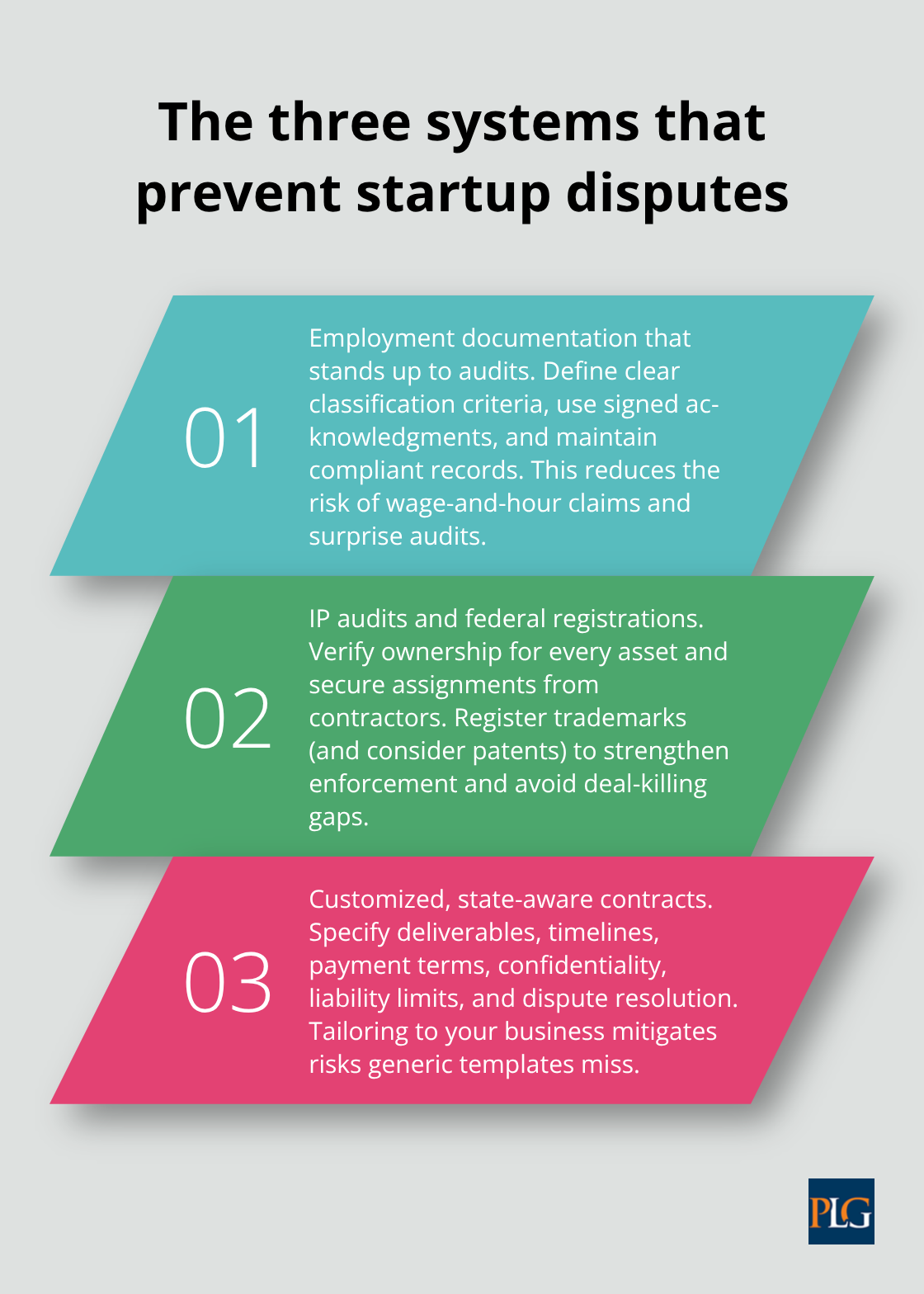
The difference between startups that avoid litigation and those that face costly claims comes down to structure. You need three concrete systems in place: employment documentation that holds up under audit, IP protections registered with federal agencies, and contracts written for your actual business risks. Most founders treat these steps as overhead, but they function as insurance policies that cost thousands instead of hundreds of thousands.
Employment Documentation Stops Misclassification Audits Before They Start
Misclassification audits arrive without warning, so you must act first. Create a written classification policy that defines the criteria for each worker category: employees work on your schedule with your equipment and under your direction, while contractors operate independently with their own tools and clients. Document this decision for every hire with a signed acknowledgment form. The Fair Labor Standards Act requires clear records, and the IRS uses a three-part test to evaluate classification regardless of what you call someone. If you have five employees and one contractor, spend two hours clarifying the distinction now rather than facing a Department of Labor audit that costs $15,000 and demands six months of back wages.
IP Audits and Registration Protect What You’ve Built
Conduct a written IP audit of everything your company has created: code, designs, brand materials, processes, and documentation. For each asset, verify who owns it. If contractors built anything, retrieve signed IP assignment agreements retroactively if necessary-gaps discovered during fundraising due diligence kill deals. Register your trademark with the USPTO for around $250 to $400 per class; this takes four to six months but gives you federal enforcement rights that matter when someone copies your brand. Patent registration is more complex and expensive, but if your core technology is patentable, file a provisional patent application within one year of first public disclosure to preserve your filing date. Trademarks protect brand identity, patents protect technology, and copyrights protect original works automatically, but registration strengthens your legal position dramatically.
Customized Contracts Eliminate Vague Terms That Create Disputes
Draft or audit your key contracts: vendor agreements, employment offer letters, independent contractor agreements, and client service agreements. Each contract should specify deliverables, timelines, payment terms, confidentiality obligations, liability limits, and how disputes get resolved. Avoid generic templates-state law varies significantly, and your industry has specific risks that generic language misses. A vendor contract for a SaaS company looks different from one for a manufacturing startup. Include a dispute resolution clause requiring mediation before litigation; mediation costs a fraction of court proceedings and resolves disputes in weeks rather than years. Legal counseling helps ensure your agreements comply with regulations and mitigate risks effectively. Startups that invest in tailored contracts upfront report avoiding roughly 70% of the disputes that plague those relying on generic language.
What These Three Systems Actually Accomplish
These three systems-employment documentation, IP audits and registration, and customized contracts-form the foundation that prevents the disputes described in the previous chapter. They cost time and money upfront but eliminate the $160,000 average cost per legal claim that Hiscox documented. Once you have these systems in place, you’re ready to implement the proactive strategies that catch problems before they escalate into litigation.
Spot Disputes Before They Become Lawsuits
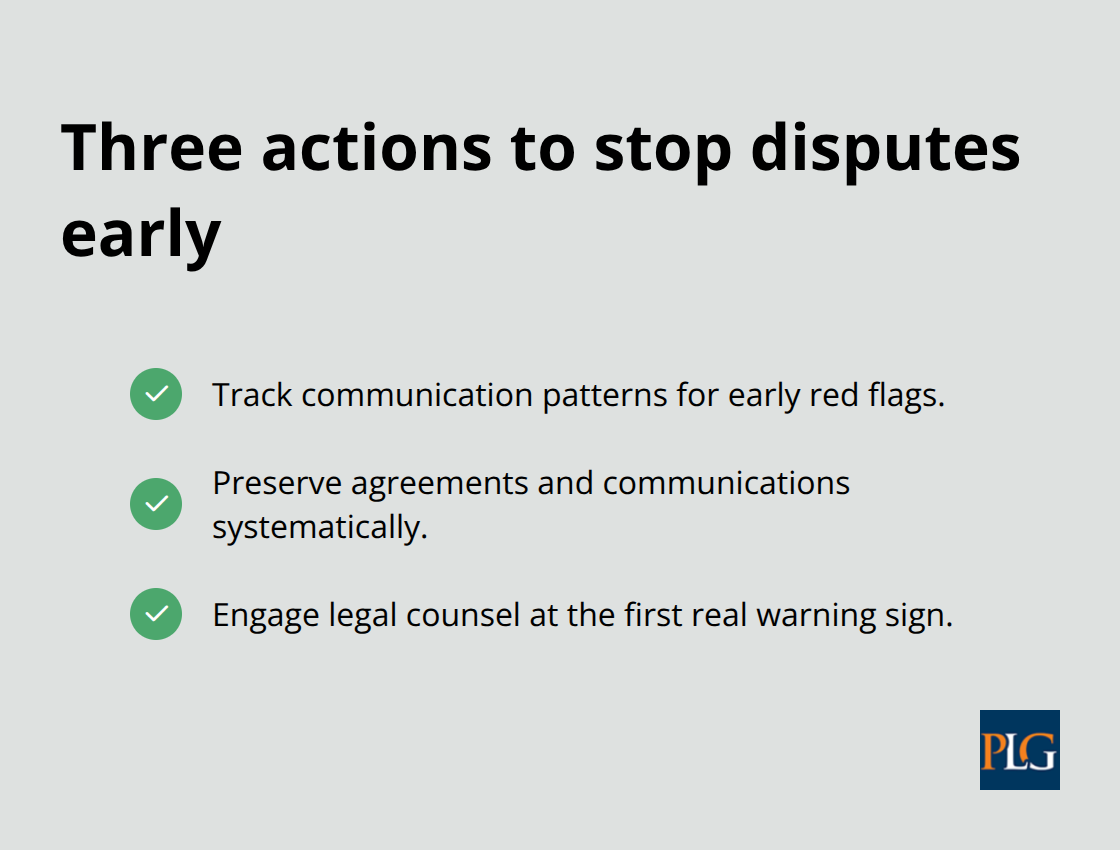
The moment a team member complains about pay, a vendor threatens to stop work, or a partner questions equity splits, most founders hope the problem resolves itself. It won’t. Research from Hiscox shows that legal investigations last nearly a year on average, meaning early intervention cuts that timeline dramatically. The critical window exists right now-when tension first appears but before formal demands arrive. You need three concrete actions: track communication patterns that signal escalating conflict, preserve evidence systematically, and bring in legal counsel at the first genuine red flag, not after lawyers are already threatening.
Communication patterns reveal disputes months before they explode
Read your emails, Slack messages, and meeting notes for specific warning signs. When a contractor suddenly demands written confirmation of their scope after weeks of verbal agreement, that’s a red flag. When a team member stops responding to feedback or begins documenting every instruction in writing, they’re building a record for a potential claim. When a vendor shifts from friendly to formal language in communications, payment disputes are likely coming. These patterns emerge weeks or months before actual litigation, giving you time to intervene. Start a simple log: note the date, who’s involved, what triggered the shift in tone, and what the underlying issue appears to be. Don’t wait for a formal letter from an attorney. The moment communication becomes defensive or unusually formal between parties that were previously collaborative, schedule a conversation to clarify expectations. Many disputes stem from misunderstanding, not malice. A founder who catches a contractor’s frustration about scope creep and adjusts the workload prevents a breach-of-contract claim. One who ignores the shift in tone watches the contractor stop work and then faces a demand letter.
Evidence preservation requires immediate action
Start now, before disputes arise. Save all agreements-even informal ones-in a centralized location with clear naming conventions. If you had a phone call about terms, send an email recap that same day: I understood you would deliver X by Y date for Z payment. This creates a written record. Maintain organized files for each vendor, contractor, and employee containing offers, signed agreements, change orders, and communications. When a dispute actually surfaces, you’ll have everything needed to show your position was reasonable. Courts and arbitrators evaluate claims based on contemporaneous documentation, not later recollections. A founder who kept emails showing a contractor agreed to specific deliverables wins disputes. One who relies on memory loses. Screenshot important messages, back up files to cloud storage, and ensure your document management system survives a computer crash. Many startups lose disputes not because they were wrong, but because they can’t produce the evidence showing they were right.
Legal counsel at the first real warning sign costs far less than litigation
The moment communication becomes adversarial, a vendor threatens non-performance, or a team member mentions legal action, that’s your signal to contact a lawyer. Not after you receive a demand letter-before. An attorney reviewing the situation when you still have room to negotiate or resolve the issue costs hundreds or low thousands. The same dispute, once it enters formal litigation, costs tens of thousands. Founders often wait until a lawsuit is filed, then spend five times more trying to fix problems that could have been resolved cheaply with early intervention. A lawyer helps you assess whether the other party has a real claim, identifies what documentation you’re missing, and crafts a response that protects your position. They also advise whether settlement makes sense or if fighting the claim is justified. This decision requires legal judgment, not founder instinct. Many disputes that feel catastrophic to founders are actually weak claims that settle for minimal payment once a lawyer explains the law to the other party.
Final Thoughts
Litigation risk startups face is real, but preventable action stops it. The three areas we covered-employment documentation, intellectual property protection, and customized contracts-form the backbone of a legal strategy that prevents disputes before they become expensive lawsuits. Misclassification audits cost $15,000 and demand months of back wages, IP ownership gaps kill funding rounds, and vague contracts leave you liable for damages you never anticipated. These aren’t theoretical risks; they happen to startups every day, and you can avoid them entirely with the right foundation in place.
A founder who invests a few thousand dollars in proper employment classification, IP registration, and contract review avoids the $160,000 average cost per legal claim that Hiscox documented. More importantly, they avoid the year-long investigations that drain focus from building the business. When you raise capital, investors conduct due diligence specifically looking for the gaps we discussed, and companies with clear employment records, registered IP, and documented contracts close rounds faster and on better terms.
Start with your employment classification this week-audit your current team and contractors, document your decisions, and fix any gaps. Next, conduct an IP audit and register your trademark with the USPTO. Finally, review your key contracts and customize them for your actual business risks. We at Primum Law Group help startups build these foundations through outsourced general counsel that fits your budget and growth stage, and the moment you spot communication patterns shifting toward conflict, reach out to legal counsel before disputes escalate.