

Raising venture capital for artificial intelligence startups requires more than a solid idea-it demands proof, strategy, and the right connections.
At Primum Law Group, we’ve guided founders through this process and seen what separates funded companies from those left behind. This guide walks you through what VCs actually want to see, how to prepare your startup, and how to navigate the funding process itself.
What VCs Actually Demand from AI Startups
Venture capitalists investing in AI startups in 2025 are far more demanding than they were just two years ago. The market has matured, mega-rounds dominate funding, and investors now expect concrete proof before writing checks.
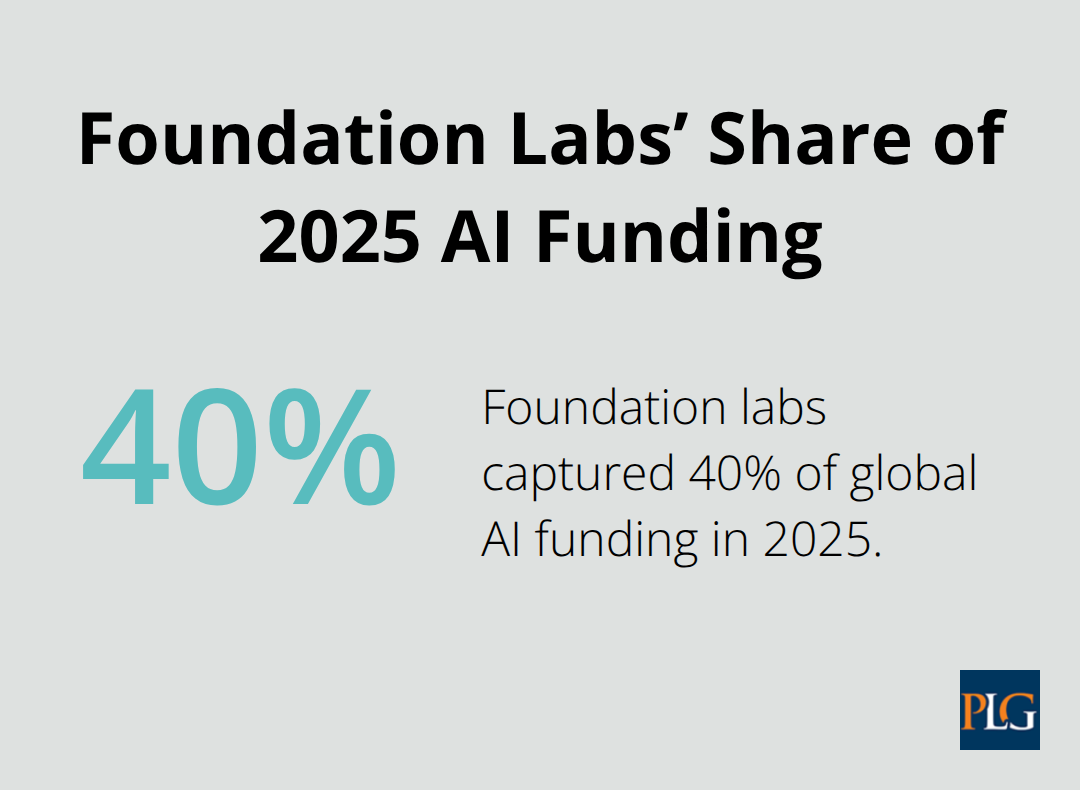
According to Crunchbase data, foundation labs alone raised about 80 billion dollars in 2025, representing 40 percent of global AI funding. This concentration means VCs scrutinize every detail.
Proprietary Data Creates Your Competitive Moat
Your data assets determine whether you survive investor scrutiny. VCs want to see proprietary data that creates a defensible moat around your technology-whether customer datasets, proprietary training methodologies, or domain-specific information that competitors cannot easily replicate. Generic AI applications built on top of existing models like GPT-4 won’t cut it anymore. This is non-negotiable.
VCs also examine whether your technology actually works better than alternatives and whether that advantage persists over time. They ask hard questions about model accuracy, latency, bias detection, and whether your solution delivers measurable ROI to customers. If your model performs at 85 percent accuracy while a competitor achieves 92 percent, investors will want to understand why they should fund you instead.
Revenue and Unit Economics Trump User Growth
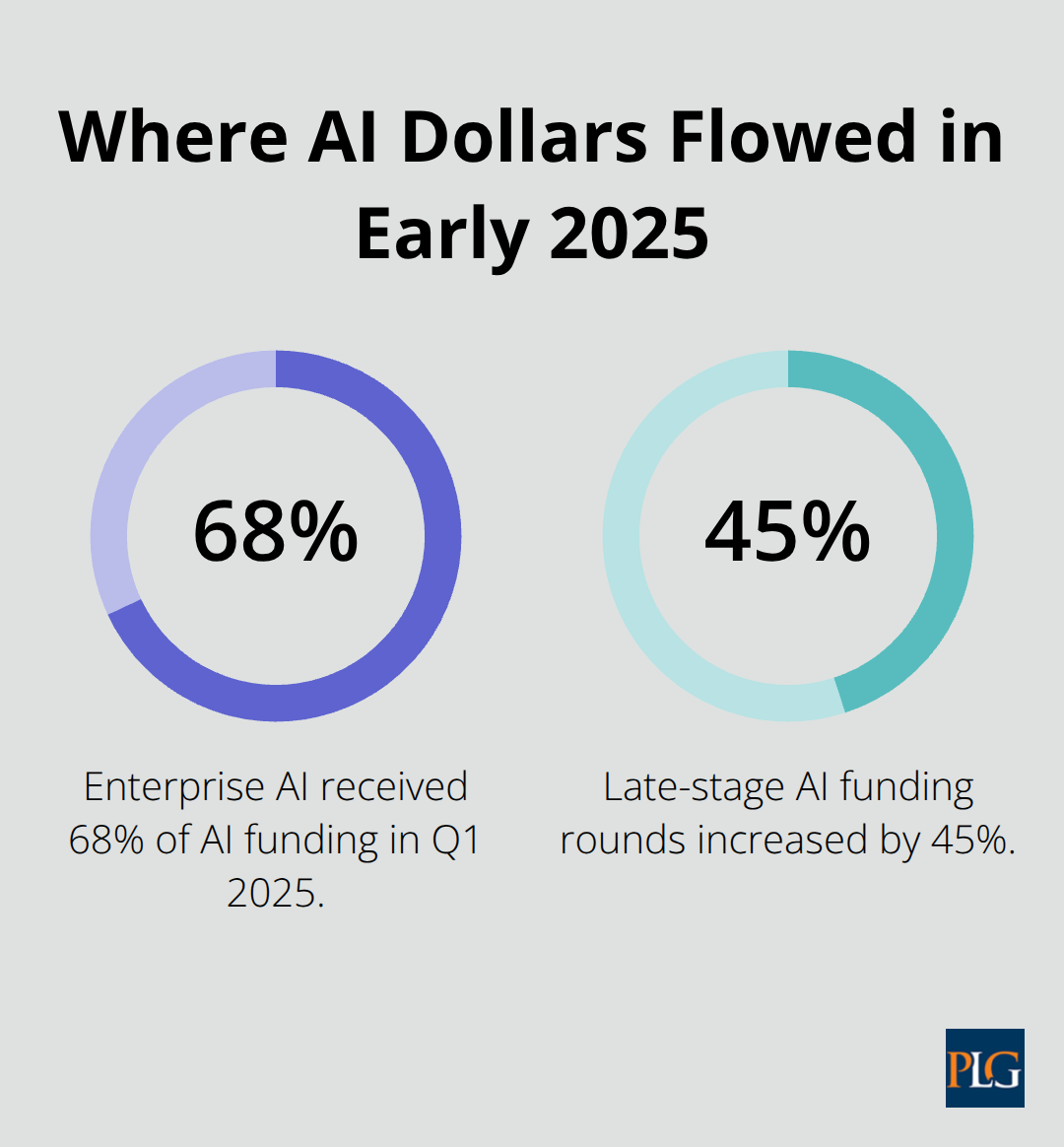
The days of funding AI startups purely on user growth metrics are over. VCs now obsess over unit economics and the path to profitability. They want to see that your cost of compute per customer decreases as you scale, not increases. According to Dealroom analysis, 68 percent of AI funding in Q1 2025 went to Enterprise AI, and late-stage rounds increased 45 percent. This shift reflects investor focus on businesses with proven revenue and improving margins.
You need realistic financial projections showing exactly how you’ll make money. Subscription models, tiered pricing, or usage-based revenue streams must connect directly to your product roadmap. If you’re burning 500,000 dollars monthly in compute costs to generate 200,000 dollars in revenue, investors will pass. They expect LTV to CAC ratios exceeding 3 to 1 within 18 months and net revenue retention above 110 percent.
Your founding team must include someone who deeply understands your unit economics and can articulate how you’ll reach profitability. This person doesn’t need a finance background, but they must know their numbers cold and be prepared to defend them under pressure.
Your Team Must Demonstrate Real Commitment
VCs invest in people as much as ideas. For AI startups specifically, they want founders who have already worked in AI or understand the specific domain where they’re applying AI. A team that built recommendation systems at a major tech company and is now launching an AI tool for supply chain optimization carries far more credibility than a team with no AI background.
Investors also watch whether founders have put personal capital into the company. If you’re asking VCs for millions but haven’t invested your own savings, you signal low conviction. Additionally, VCs examine equity distribution. Co-founders with dramatically different ownership stakes, or situations where one founder holds the majority, raise red flags about team cohesion and decision-making. They also verify that your team has the bandwidth to execute. If your CTO is still running a consulting business on the side, that’s a problem. VCs want founders who are fully committed and have demonstrated they can build and scale products in competitive markets.
With your technology, unit economics, and team aligned, the next step involves packaging all this evidence into a format that captures investor attention.
Building Your Pitch Deck and Financial Story
Lead with Defensibility, Not Vision
Your pitch deck determines whether VCs spend 20 minutes reviewing your company or pass immediately. The decks that attract funding share one critical trait: they lead with defensibility and revenue, not vision statements. Open with your proprietary data advantage or technology moat, then immediately show revenue traction. According to CB Insights, 69 percent of AI VC dollars flow into mega-rounds, meaning investors have already seen generic pitches. You need specifics.
Include your current monthly recurring revenue, week-over-week or month-over-month growth rates, and customer acquisition cost. If you’re pre-revenue, show pilot results with named customers and their willingness to pay. Vague claims about market size mean nothing; instead, show that three enterprise customers in your target segment actively use your product and expand their contracts.
Structure Your Deck for Maximum Impact
Your deck should contain 12 to 15 slides maximum covering your problem, solution, market size tied to actual TAM calculations, go-to-market strategy, your team’s relevant experience, financial projections for three years, and the funding ask with explicit use of capital. Do not use percentages for growth without absolute numbers attached. Investors want to know you’re growing 15 percent month-over-month from a 50,000 dollar MRR baseline, not just that you’re growing 15 percent.
Stress-Test Your Financial Projections
Financial projections require brutal honesty about compute costs. Training large language models costs tens of millions of dollars according to AI research, and inference costs scale with customer volume. Your three-year projection must show exactly how your compute costs per customer decline as you scale. If your margins are negative today, show the inflection point where they turn positive and the specific actions that trigger that shift.
Include a sensitivity analysis showing what happens to profitability if your growth rate drops 30 percent or your customer acquisition cost rises 40 percent. VCs expect you to have stress-tested your numbers. Show that you’ve calculated customer lifetime value at realistic retention rates. If you’re assuming 95 percent annual retention, justify that assumption with data from your pilot customers or comparable SaaS companies in your vertical.
Address the Runway Question Head-On
Build in a section on how you’ll manage cash runway. If you have 18 months of runway at current burn rate but need 24 months to reach profitability, explain how you’ll extend that runway through revenue growth or reduced spending. This honesty about timeline and capital needs builds credibility far more than overly optimistic projections that no one believes.
Investors scrutinize not just your numbers but your ability to defend them under pressure. The founders who win funding rounds articulate their financial story with precision and acknowledge the assumptions underlying their projections. With your pitch deck and financial narrative locked in, you’re ready to identify which VCs actually fit your company and how to reach them effectively.
Finding and Approaching the Right VCs
Most founders treat venture capital as a numbers game-spray pitch decks across 500 VCs and hope someone responds. This approach wastes months and destroys your credibility. Instead, treat VC outreach as targeted research.
Research VCs in Your Specific Domain
Start by identifying which firms have actually funded AI companies in your vertical. If you’re building enterprise AI for supply chain optimization, look at which VCs led rounds in that space over the past 18 months. According to Crunchbase data, the top VC players in billion-dollar AI deals in 2025 included Lightspeed Venture Partners, Founders Fund, and Andreessen Horowitz-but these names mean nothing if they lack conviction in your sector.
Research their portfolio companies, read their investment theses, and understand whether they prefer infrastructure plays or applications. VCs in 2025 concentrate heavily on mega-rounds; mega-rounds of $500 million or more represent 58 percent of total AI funding according to Crunchbase. This concentration means mid-market firms hungry for strong AI deals often move faster than household names. Target 15-20 VCs that actively invest in your sector and stage, not hundreds.
Leverage Warm Introductions Over Cold Outreach
Warm introductions matter far more than cold emails. Ask your board members, advisors, and early customers for introductions to their VC contacts. If you’ve raised a seed round, your existing investors likely have relationships you can activate. A warm introduction from someone a VC trusts dramatically increases your odds of securing a meeting.
When you do meet with a VC, arrive with specific knowledge about that firm’s portfolio and recent investments. Ask potential investors for specific examples of how they’ve helped companies in your space reach product-market fit, hire key executives, or land first customers. This signals you’ve completed your homework and aren’t pitching the same generic story to every firm.
Navigate Due Diligence and Data Room Preparation
Due diligence for AI startups runs deeper than traditional software because investors scrutinize your data sourcing, model performance metrics, and regulatory compliance more carefully. Prepare a data room with your technical documentation, customer contracts, financial models, and any regulatory assessments you’ve completed.
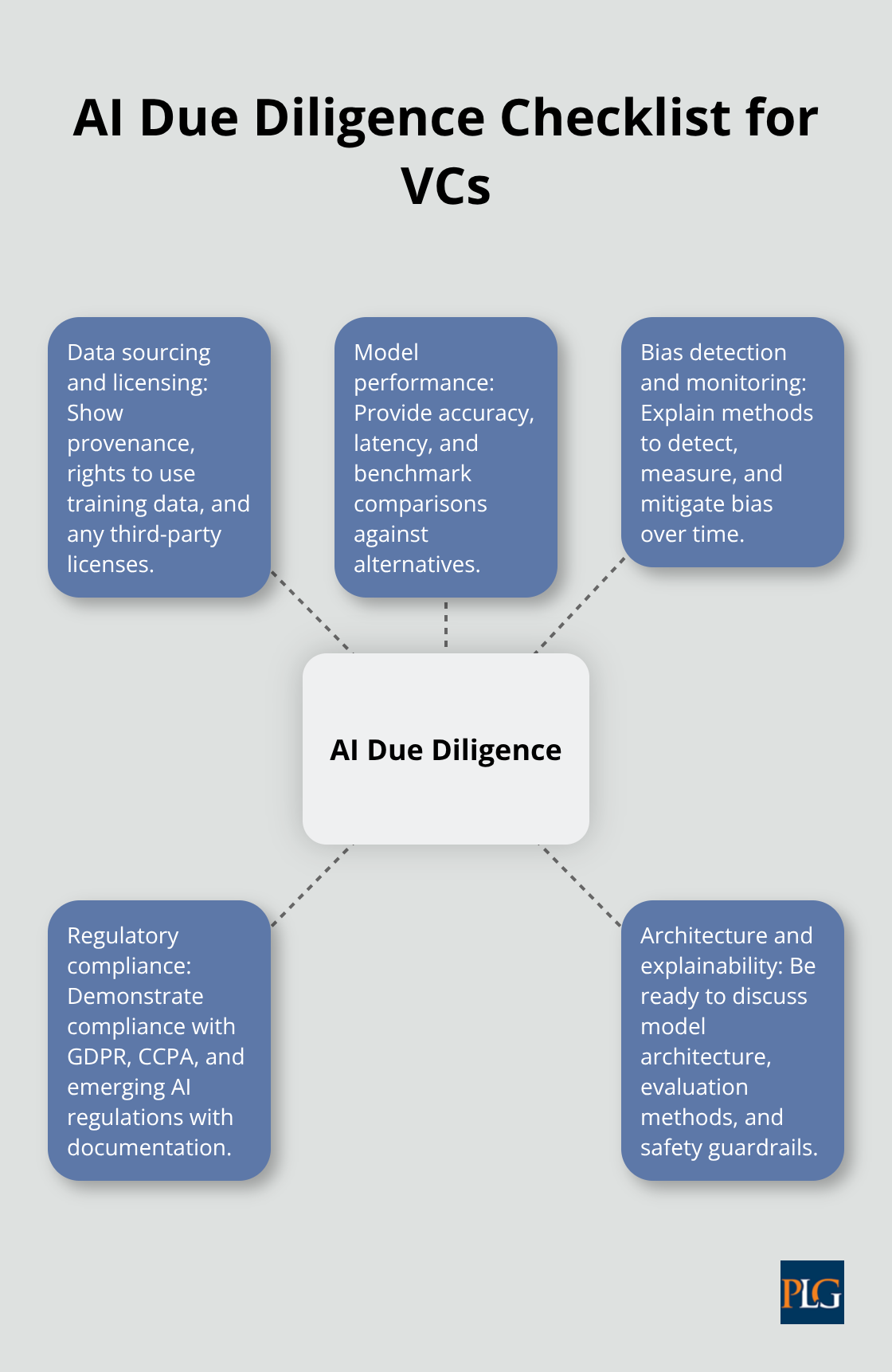
Have your technical co-founder or CTO ready to discuss model architecture, accuracy benchmarks, and how you handle bias detection. VCs will ask whether you’ve secured proper licensing for training data and whether your models comply with GDPR, CCPA, and emerging AI regulations. If you haven’t addressed compliance, start now-investors increasingly view regulatory risk as a major downside.
Negotiate Terms That Align Incentives
On term sheet negotiations, focus on the economics and control provisions that matter most to your company’s future, not vanity metrics. Board seat allocation, liquidation preferences, and anti-dilution provisions carry far more weight than valuation multiples. If a VC demands onerous anti-dilution terms or excessive board control, that signals misaligned incentives.
You want investors who trust your team to execute, not investors who need to micromanage every decision. Negotiate for milestone-based funding if you’re early-stage-this lets you prove traction before deploying all capital and gives you leverage for better terms in future rounds.
Close Your Round with Velocity
Move fast once you have multiple term sheets. The VC market for AI moves at velocity. If you’re in serious conversations with three firms, create tension through a structured process with clear decision deadlines. VCs respect founders who move decisively and won’t tolerate endless negotiation. Close your round, lock in your capital, and focus entirely on execution.
Final Thoughts
Securing venture capital for artificial intelligence startups demands preparation, precision, and persistence. The founders who successfully raise capital build defensible technology backed by proprietary data, demonstrate revenue and unit economics that improve with scale, and move decisively through the fundraising process. Mega-rounds of $500 million or more now represent 58 percent of total AI funding, which means investors scrutinize every metric before committing capital and reward founders who arrive with concrete proof rather than promises.
Most founders stumble on execution details that seem minor but cost them funding. They spray pitch decks across hundreds of VCs instead of targeting 15 to 20 firms that actively invest in their sector, present financial projections built on unrealistic assumptions about retention or customer acquisition cost, and fail to prepare for technical due diligence on model accuracy, bias detection, or regulatory compliance. These mistakes compound and signal to investors that the team lacks discipline, which destroys credibility in a competitive venture capital artificial intelligence landscape.
After you close your round, capital becomes a tool, not a victory. The founders who build lasting companies treat their funding round as a milestone and immediately focus on hitting the milestones that justified their valuation, manage cash runway ruthlessly, and execute the product roadmap that convinced investors to write the check. If you’re preparing for fundraising or navigating term sheets, contact our team for legal guidance tailored to your stage and situation.